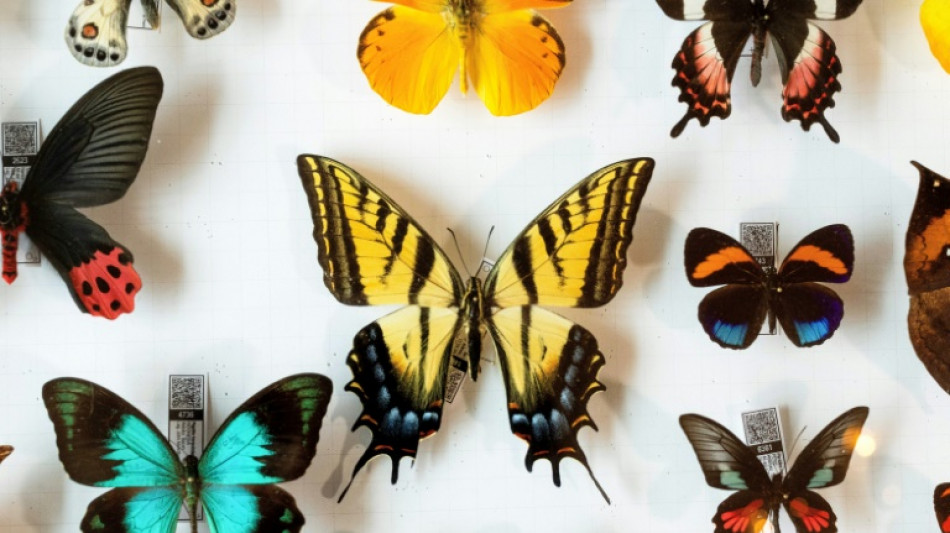
Ailing New Zealand butterfly collector gives away life's work / Photo: Marty MELVILLE - AFP

 Denmark hails 'binding' Greenland deal with Trump

 We don't want Games host Japan losing money, says Asian Olympic official

 Ed Sheeran returns to stage after Palestinian controversy

 Asian Games to open in Japan after troubled build-up

 Drone owners rush to offload devices ahead of Beijing ban

 Trump's beef policies irk Texas ranchers, testing their loyalty
 Nvidia, OpenAI CEOs to attend Xi dinner at White House

 Anthropic picks Accenture for in-house AI safety evaluation
 Balogun returns as Monaco beat Lens to continue strong Ligue 1 start

 'Pause' on overt repression in Venezuela, but reforms still needed: HRW

 Global stocks mixed as yen falls despite Bank of Japan rate hike

 Cuba hit with seventh major blackout of the year

 Murray out with concussion so Wentz will start for Vikings

 UN chief 'deeply regrets' US visa refusal to Abbas for annual meeting

 England quick Carse to face no charges over alleged nightclub assault

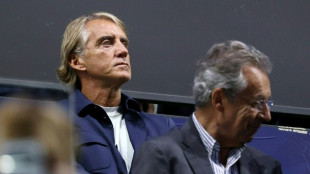 Mancini brings nine newcomers into the first squad of his Italy comeback

 Czechs level Davis Cup tie against USA as South Korea eye Finals

 New France boss Zidane confirms Mbappe as captain after naming first squad

 California governor signs order to explore AI 'kill switch'
 Head leads run spree as Australia win Zimbabwe ODI series

 In-form Raphinha wants to finish career at Barcelona

 Warren Buffett steps down as Berkshire Hathaway chairman

 Carrick confident Man Utd can 'work through' tough time

 Mbappe ends Nike partnership to join Swiss brand On

 Liverpool boss Iraola puts Bournemouth love affair on hold
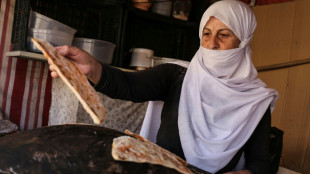
A New Zealand enthusiast spent half a century amassing one of the world's largest private butterfly collections. As death nears, he has handed this life's work of 20,000 specimens to a museum.
Wheelchair-bound and ravaged by multiple sclerosis, 68-year-old John McArthur vividly recalls the first time he saw a butterfly.
He was 10 years old and it was a shock of yellow and black, a swallowtail butterfly flitting among the zinnia flowers in his mother's New York garden.
"I was mesmerised", McArthur says, recounting the first step of a journey that would take him from the Amazon to the Himalayas, the Andes back to his native New Zealand.
Over nearly 60 years, he collected more than 20,000 specimens, a kaleidoscope of colour and life that he painstakingly pinned into hundreds of boxes that lined the walls of his home.
McArthur also remembers the last time he caught a butterfly.
It was during a 2008 visit to the achingly beautiful Cobb Valley, in New Zealand's South Island.
He happened across a boulder copper butterfly. Quickly slinging aside his crutches, he dropped to his knees to scoop up the diminutive wonder.
Soon enough, that kind of effort would be too much.
By that time, he had already felt a tingling sensation in his spine. Doctors diagnosed multiple sclerosis, an incurable disease of the central nervous system.
"A specialist told me I would probably need a walking stick within 15 years," McArthur remembers. "But six months after the diagnosis, I was in a wheelchair."
The disease has now robbed McArthur of the use of his hands and legs, and his speech is laboured.
But his mind remains sharp, recalling specimen names and locations where he found his favourite butterflies.
- High price -
Faced with his own mortality, McArthur resolved to find the thousands of beloved butterfly specimens a new home, somewhere they could find a new life after his death.
He ruled out donating to a New Zealand museum: "They just don't have the facilities" he said.
"You need climate control, very rigorous pest control. Accepting a large collection has quite a price tag."
Instead, he chose the Natural History Museum in London, paying to ship his collection from Wellington to London this April.
"I had mixed emotions -- sad to see it go, but absolutely thrilled that it was going where it would be useful."
His Lepidoptera were merged into the museum's vast collection, which contains about 13.5 million butterflies, housed in 80,000 drawers.
Some of McArthur's favourites are now kept alongside specimens studied by Charles Darwin, the 19th-century naturalist who popularised the theory of evolution.
"For a collector, that's quite a big deal. It's humbling," McArthur added.
- Deadly viper -
The walls of the room that once housed his butterflies have now been torn down and the space converted into a laundry.
"I never went in there again once they were gone. It felt like a black hole," he said.
All that remains are a handful of butterflies he couldn't bear to part with.
They include a box of startlingly colourful specimens from Indonesia, a riot of orange, red, yellow, neon blue and bone white
McArthur disliked killing the butterflies -- harming the thing he loved.
"It's never nice" -- and the best method was crushing the thorax where the wings join the body -- "they die instantly".
"If I enter Buddhist hell, I'm sure I'll end up with thousands of pins through me," he said.
But the New Zealander's eyes light up when discussing some of the mischief his collecting caused.
As a child, he once cut the lining of his mother's gown to make a butterfly net.
"I didn't catch anything. The material was too stiff, but she was understanding of my passion."
Eventually, he followed in his father's footsteps becoming a diplomat, allowing exploration in several continents.
In the Peruvian rainforest, he had a dangerous brush with a bushmaster viper -- one of the world's most venomous snakes.
His greatest find -- a white female Hypsochila -- which lives only in the high Andes also came with trouble.
After netting the rare specimen, he was questioned by Chilean police, who accused him of consorting with smugglers.
"They said the person who took me up there was a gun runner. The police let me go, but that was a pretty close call."
His husband and now carer James Hu, who McArthur met in the 1990s when posted in Shanghai, became an accomplice on hunts.
With a chuckle, Hu recalled how he once nervously kept watch for monks from a Buddhist temple while McArthur scoured a nearby field for Chinese peacock butterflies in the foothills of the Himalayas.
If he had his time again, McArthur said he would rather help protect, not collect, butterflies.
"I'd be more interested in breeding -- doing whatever it might take to enhance the protection of their habitat."
M.AbuKhalil--SF-PST