Ethiopia plagued by abductions 'epidemic' / Photo: Sylvie HUSSON, Jean-Michel CORNU - AFP

 UK actor Naomi Watts honoured at Spain film festival
 Japan emperor declares Asian Games open after turbulent build-up

 Asian Games open with unity message after troubled build-up
 Denmark hails 'binding' Greenland deal with Trump

 We don't want Games host Japan losing money, says Asian Olympic official

 Ed Sheeran returns to stage after Palestinian controversy

 Asian Games to open in Japan after troubled build-up
 Drone owners rush to offload devices ahead of Beijing ban

 Trump's beef policies irk Texas ranchers, testing their loyalty

 Nvidia, OpenAI CEOs to attend Xi dinner at White House

 Anthropic picks Accenture for in-house AI safety evaluation
 Balogun returns as Monaco beat Lens to continue strong Ligue 1 start

 'Pause' on overt repression in Venezuela, but reforms still needed: HRW

 Global stocks mixed as yen falls despite Bank of Japan rate hike

 Cuba hit with seventh major blackout of the year

 Murray out with concussion so Wentz will start for Vikings

 UN chief 'deeply regrets' US visa refusal to Abbas for annual meeting
 England quick Carse to face no charges over alleged nightclub assault

 Mancini brings nine newcomers into the first squad of his Italy comeback

 Czechs level Davis Cup tie against USA as South Korea eye Finals

 New France boss Zidane confirms Mbappe as captain after naming first squad

 California governor signs order to explore AI 'kill switch'

 Head leads run spree as Australia win Zimbabwe ODI series

 In-form Raphinha wants to finish career at Barcelona

 Warren Buffett steps down as Berkshire Hathaway chairman

One day in August, Aynalem was on her way to university in the Amhara region of northern Ethiopia when armed men suddenly stopped the bus and climbed aboard.
"They were all very young and threatened us with assault rifles. I was terrified," recalled the 21-year-old biomedical engineering student.
The kidnappers blindfolded Aynalem and the other passengers. After several hours on the road, they forced her to call her family to demand a ransom payment.
They wanted 500,000 birr (about $4,400), a huge sum in a country where more than a third of the population lives below the poverty line.
Then began a harrowing days-long wait in a forest.
"They made us sleep on the grass, we only had dirty water and a loaf of bread," Aynalem said.
"I experienced horrific things," she continued, collapsing into sobs. "I was sexually assaulted."
After several days, Aynalem's family managed to get the money together "by getting into a lot of debt and borrowing from several people", said her mother, and she was released.
Aynalem's name has been changed for security reasons, along with those of other victims and relatives who spoke to AFP.
Not everyone on the bus escaped the ordeal alive.
"While I was held, several people died because their families could not pay the ransom. I could hear them begging our kidnappers before their deaths," she said.
- 'Security vacuum' -
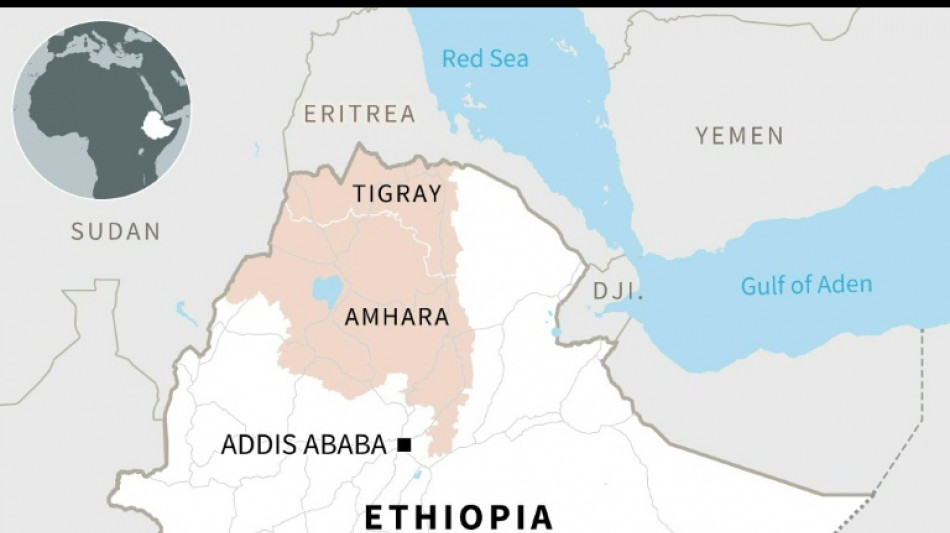
Many regions of Ethiopia, Africa's second most populous country, with around 120 million inhabitants, are plagued by kidnappings.
Observers say the menace has grown since the end of the brutal two-year war between the government and rebel forces in the northern region of Tigray, which resulted in the deaths of several hundred thousand people.
That conflict largely ended with a peace agreement in November 2022, but armed rebellions have worsened in two other regions, Oromia and Amhara.
Armed groups are exploiting the security vacuum in areas beyond the government's control, said Mebrihi Brhane of the Human Rights First Ethiopia NGO.
"The capital city is the only safe place in the country," Mebrihi told AFP, saying that kidnappings have become an "epidemic".
"They are a way for unemployed young people to earn money," he said.
The Ethiopian Human Rights Commission, a state-affiliated but independent body, warned in a report this month of a "proliferation and aggravation" of abductions both by organised criminal gangs and "members of the government security forces".
The authorities rarely comment on such incidents and the government spokesman did not respond to AFP requests.
- 'Too poor to pay' -
The EHRC accuses the Oromo Liberation Army, which has been fighting federal forces in Oromia since 2018, of carrying out numerous abductions, including the seizure of more than 160 students travelling through the region in July.
One man told AFP the kidnappers demanded 700,000 birr (around $6,100) in return for his sister's release.
"But we are too poor to pay," he said.
"I've received no proof that my sister is alive. It has left my family and I anxious and desperate."
In another kidnapping in March in Adwa in the Tigray region, a family said they were asked for three million birr (around $26,000) for the release of 16-year-old Mahlet Teklay.
Her sister Millen told AFP that the kidnappers refused to let her speak on the phone.
Without proof of life, and lacking the money, the family did not pay.
Three months later, after geolocating Mahlet's phone, police arrested three suspects.
"They led police to the place where they killed and buried my sister," said Millen, her voice shaking.
"They had lost their nerve and strangled her with her own shoelaces."
The family are pushing to have the murder trial in the Tigrayan capital Mekele rather than Adwa, where they fear the suspects will have friends in official positions.
Mebrihi, the rights activist, said impunity was rife.
"So long as the government does not control certain regions, criminals will go unpunished," he said.
D.Khalil--SF-PST