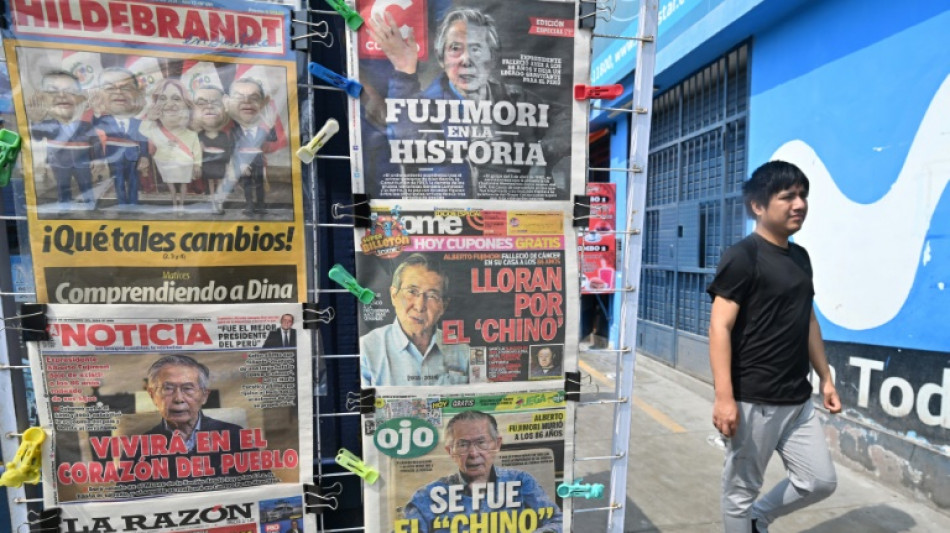
Fujimori 'never asked forgiveness': families of Peru massacre victims / Photo: CRIS BOURONCLE - AFP

 Asian Games offer 'deepest apologies' for South Korea anthem blunder
 تطورات "سي أن أن": تقرير بالذكاء الاصطناعي كاد يشعل حرباً بين أميركا والصين

 Inter Milan and Italy icon Mazzola dies aged 83
 UK actor Naomi Watts honoured at Spain film festival

 Saudi capital issues first air raid alert since renewed fighting in Yemen

 Martin edges title rival Marquez for Austrian MotoGP pole

 Indonesia accepts Malaysia's help to tackle wildfires
 Indians living in Japan on stand-by to house Asian Games athletes
 Trump signs bill authorizing sweeping Russia sanctions

 Protesters form human chain at Kennedy Center after Trump threat
 Death toll from attack at police HQ in Pakistan rises to 31

 Trump says Denmark to give US 'permanent control' over Greenland security
 Kennedy Center: future unclear for iconic Washington arts hub

 Trump claims 'infinite' Greenland security deal with Denmark

 Helicopters battle wildfire threatening Ecuador's capital

 Brentford batter Chelsea to undo Alonso's promising start
 Kane hits Bundesliga century as Bayern rout Union
 Trump says CNN, MS NOW, Politico banned from White House
 Hushing and hedging: US companies retreat on climate

 Springboks to face Fiji before 2027 Rugby World Cup
 Nigeria miners struggled to breathe in cell before 37 died: survivors

 McIlroy on the charge at PGA Championship as Reed withdraws
 McIlroy on the charge at PGA Championship

 Crisis-wracked Volkswagen warns of 10-bn-euro hit to profits

 Costa Rica's Grynspan tops third informal poll for UN chief: diplomat

As Peru prepares to lay former president Alberto Fujimori to rest on Saturday, the families of civilians killed in his war on left-wing guerrillas are grappling with his death.
"He left without asking for forgiveness from the (victims') relatives. He made a mockery of us," sobbed Gladys Rubina, the sister of one of the victims of two massacres in the 1990s for which Fujimori spent 16 years behind bars.
During Fujimori's 1990-2000 rule, government forces cracked down hard on insurgents, particularly Maoist Shining Path rebels, whose war with the state between 1980 and 2000 left more than 69,000 people dead and 21,000 missing, according to official figures.
Rubina's teenage sister, Nelly, was among 15 people killed by government forces in the Barrios Altos neighborhood of Lima on November 3, 1991.
Six masked soldiers stormed a house party and opened fire on what they mistakenly thought were insurgents.
The same military death squad, known as the Colina Group, executed nine students and a professor at La Cantuta University in the capital the following year.
Both cases were instrumental in the conviction of Fujimori, who spent 16 years in prison before being freed on humanitarian grounds last December.
He died on Wednesday at the age of 86 after a long battle with cancer.
- 'We couldn't go on the street' -
Nonetheless, in a sign of the reverence many Peruvians still hold for Fujimori, thousands of people queued Thursday and Friday to see him lying in state at the Museum of the Nation in Lima.
Many came bearing flowers and photographs of the late president, with some even sporting his features printed on tee-shirts.
Milagros Parra, 54, recalled that Fujimori came to power "at a time when we couldn't even go out on the street" at the height of an insurgency by Maoist Shining Path guerrillas.
"There were bombings, we couldn't go past a police station, we couldn't go past a bank," he said, declaring Fujimori's Peru's "best president."
While there were no street protests this week over the human rights abuses or corruption that marred his rule, Fujimori's legacy was vigorously debated on social media.
Carmen Amaro, sister of one of the 10 victims of an army massacre at Cantuta University in Lima 1992, noted that Fujimori had served only two-thirds of his 25-year sentence.
On July 18, 1992, Colina Group members stormed student dorms in the middle of the night and abducted nine students and a professor, whom they later executed.
Amaro's brother Richard, a 25-year-old student, was burned to death after being shot and buried in a mass grave.
"His (Fujimori's) death does not mean an end to our suffering nor give him absolution," Carmen told AFP.
"He will continue to be the murderer of, and the person chiefly responsible for the disappearance of our relatives."
Gisela Ortiz, whose brother Enrique, was also killed at La Cantuta, lamented that the deceased president "never admitted to his crimes, never asked for forgiveness and never paid reparations".
The right-winger, who won praise from international institutions for his neo-liberal economic policies, claimed he paved the way for Peru to become one of the leading countries of Latin America.
"Let history judge what I got right and what I got wrong," he told AFP in an interview in 2018.
N.AbuHussein--SF-PST