UK beekeepers and scientists tackle sticky problem of honey fraud / Photo: Justin TALLIS - AFP

 Toulouse edge Vannes, Lyon beat Pau to take Top 14 summit

 تطورات جيميناي يخترق أنظمة 3 شركات خلال اختبار للأمن السيبراني

 Thiam makes winning heptathlon return at Decastar meet

 Czechs beat USA to qualify for Davis Cup finals

 ملف الشيخ خليل لفلسطين 500 ألف طالب يبدؤون الدراسة في غزة وسط نقص حاد

 France's debt climbs to highest since 1978: ministry

 مجلس وزراء الداخلية العرب يدين ويستنكر بدء ميليشيا الحوثي الإرهابية طائرة مسيّرة باتجاه مدينة الطائف
 Dortmund sink Stuttgart to climb to Bundesliga summit
 Trump says will not tolerate attempts to slow AI growth

 Martinez brace saves Inter in Serie A top-two clash with Roma

 Rosenior abused but guides Paris FC past old club Strasbourg
 تقرير حول موهبة مانشستر يونايتد في برشلونة للتفاوض

 Seven-try Lyon beat Pau, climb to Top 14 summit

 تقرير حول ليسلم نفسه للاحتلال معتقل منذ 2007 في سجون السلطة

 سيول تجدد تأكيد لواشنطن عزمها المساهمة في استعادة حرية الملاحة بمضيق هرمز

 England thrash Sri Lanka again to return to top of T20 rankings

 ملياردير روسي موّل جانباً من زفاف نجل ترمب... والرئيس الأميركي يجدد تأكيد سداد الأموال

 تقرير حول سوريا: توقيف ضباط سابقين يُشتبه بمسؤوليتهم عن غارات جوية خلال عهد الأسد
 ملف خادم الحرمين يوجه بناءً على ما رفعه ولي العهد بإطلاق اسم الأمير مساعد بن عبدالرحمن على الجامعة السعودية الإلكترونية

 South Korea, Austria qualify for Davis Cup finals

 'Fragile' Tottenham beaten by Aston Villa despite late rally

 Mourinho hails Real Madrid grit before Atletico derby clash

 Brigitte Bardot widower slams sale of star's belongings

 Aston Villa compound Tottenham's misery despite late rally
 حصيلة من يملك جسد اللاعب ورسائله؟ قميص سبتة يتحول إلى نقاش أكبر من السياسة

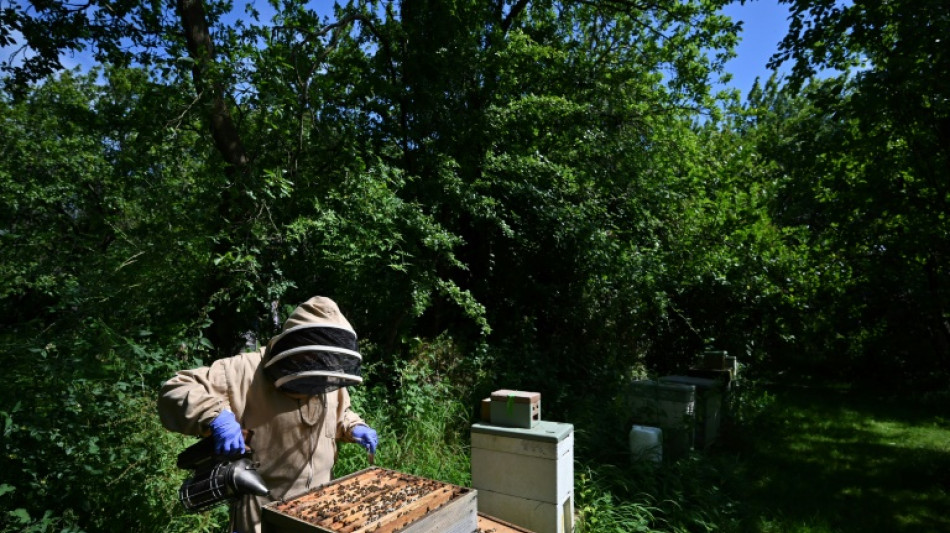
Lynne Ingram cuts a peaceful figure as she tends to a row of humming beehives in a leafy corner of Somerset, southwest England.
But the master beekeeper, who has been keeping hives for more than 40 years, has found herself in a fight against a tricky and evolving foe -- honey fraudsters.
The practice of adulterating honey is well known, and historically adulterants such as ash and potato flour have been used.
Now, advancements in technology and science have made it much easier, with "bespoke, designer or bioengineered" syrups used as diluting agents capable of fooling authenticity tests, Ingram said.
She founded the UK Honey Authenticity Network (HAN UK) in 2021 to raise awareness about natural honey and warn of the threat posed by fraud.
"One of the impacts we're seeing all over the world is beekeepers going out of business," she said.
Adulterated honey can be sold to retailers for a price several times lower than genuine producers can afford.
As well as producing their own honey, many larger-scale beekeepers have crop pollination contracts with farmers, delivering thousands of colonies to growers across the country.
If they go out of business due to unfair competition, this vital natural method of pollinating crops is reduced and food production suffers.
The British Beekeepers Association, which represents more than 25,000 producers and where Ingram is a honey ambassador, wants the risk of fraud to be recognised to protect the industry and consumers.
"I'd like to see an acknowledgement that there is actually an issue here," she said.
- Better labelling -
In May, the European Union updated its honey regulations to ensure clearer product labelling and a "honey traceability system" to increase transparency.
On the labelling for blended honeys, for example, all countries of origin are now required to appear near a product's name, where previously it was only mandatory to state whether blending had occurred.
Labelling in the UK, which has now left the EU, is not as stringent and Ingram believes consumers are "being misled" by vague packaging.
Behind the EU action is an apparent increase in adulterated honey arriving in the 27-nation bloc.
The substandard adulterates can have adverse effects on consumers' health, such as raising the risk of diabetes, obesity, and liver or kidney damage.
Between 2021 and 2022, 46 percent of the honey tested as it entered the EU was flagged as potentially fraudulent, up from 14 percent in the 2015-17 period.
Of the suspicious consignments, 74 percent were of Chinese origin.
Honey imported from the UK had a 100-percent suspicion rate.
The EU said this honey was probably produced in third countries and blended again in the UK before being sent to the bloc.
The UK is the second largest importer of honey in terms of volume in the whole of Europe. China is its top supplier.
Not all of the UK's imported honey leaves the country, however. Considerable quantities stay on the domestic market.
"We think there's an awful lot of it on the shelves," said Ingram, adding that adulterated honey was "widely available" in big supermarkets.
- Lasers -
Behind the closed blinds of a research laboratory at Aston University in Birmingham, central England, researchers fighting honey fraud are harnessing cutting-edge technology.
Aston scientists and beekeepers, including Ingram, are using light to reveal the contents of honey samples at the molecular level.
The technique -- known as Fluorescence Excitation-Emission Spectroscopy (FLE) -- involves firing lasers into samples.
The light frequencies re-emitted are then collated into a three-dimensional image -- or "molecular fingerprint" -- of the honey tested.
Alex Rozhin, the project lead and a reader in nanotechnology, said the test "can trace different molecules through the spectrum and confirm which type of biochemicals are present".
In the darkened lab, the light from different honeys is clearly visible.
The first gives off a vivid green and the second a cooler blue, indicating distinct chemical compositions.
Using FLE, Rozhin says his team "can immediately trace a concentration of fraud inside samples" with "different spectral bands corresponding to syrup (or) to natural honey".
Rozhin said FLE is more accurate than existing tests and can provide results far quicker, at a greatly reduced cost and without the need for highly trained personnel.
One of the Aston team's aims is to create a version of FLE that can be used by honey producers or even consumers with scaled-down equipment or eventually just a smartphone.
Rolling the test out like this would also accelerate the creation of a honey database which, through machine learning, could be used as a catalogue of biometric signatures.
"If we get a new sample and it's been tampered with and it's different from how the database is built up, we'll know there's something obscure," said Steven Daniels, an Aston research associate specialising in machine learning.
Ingram said the test could close international gaps in testing methods by establishing a unified standard, but the government needed to monitor the sector too.
"We really need to get to grips with this," she said.
video/phz/gil
H.Jarrar--SF-PST