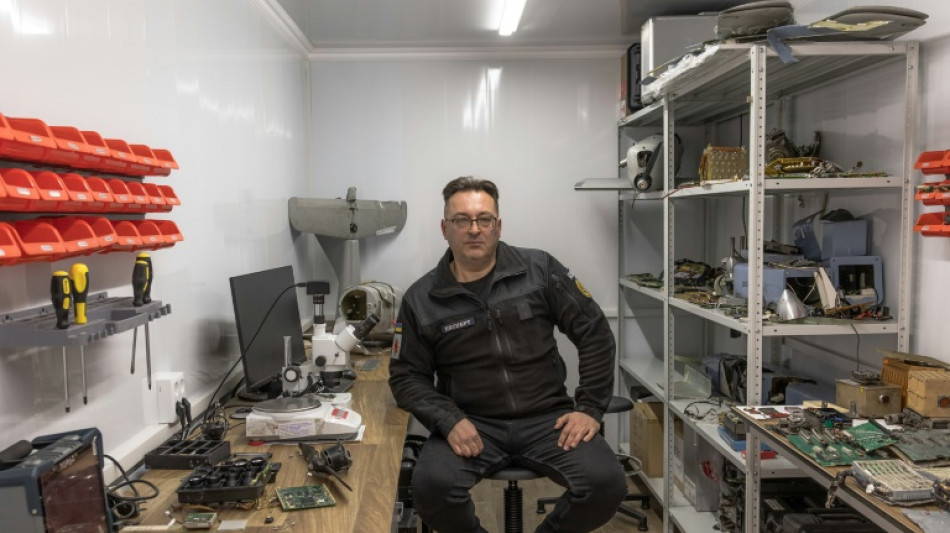
Ukraine's forensics experts trace foreign origins of Russian arms / Photo: Roman PILIPEY - AFP

 South Korea, Austria qualify for Davis Cup finals

 'Fragile' Tottenham beaten by Aston Villa despite late rally

 Mourinho hails Real Madrid grit before Atletico derby clash

 Brigitte Bardot widower slams sale of star's belongings

 Aston Villa compound Tottenham's misery despite late rally

 حصيلة من يملك جسد اللاعب ورسائله؟ قميص سبتة يتحول إلى نقاش أكبر من السياسة
 Asian Games offer 'deepest apologies' for South Korea anthem blunder
 تطورات "سي أن أن": تقرير بالذكاء الاصطناعي كاد يشعل حرباً بين أميركا والصين

 Inter Milan and Italy icon Mazzola dies aged 83
 UK actor Naomi Watts honoured at Spain film festival

 Saudi capital issues first air raid alert since renewed fighting in Yemen

 Martin edges title rival Marquez for Austrian MotoGP pole

 Indonesia accepts Malaysia's help to tackle wildfires
 Indians living in Japan on stand-by to house Asian Games athletes
 Trump signs bill authorizing sweeping Russia sanctions
 Protesters form human chain at Kennedy Center after Trump threat
 Death toll from attack at police HQ in Pakistan rises to 31
 Trump says Denmark to give US 'permanent control' over Greenland security

 Kennedy Center: future unclear for iconic Washington arts hub

 Trump claims 'infinite' Greenland security deal with Denmark

 Helicopters battle wildfire threatening Ecuador's capital

 Brentford batter Chelsea to undo Alonso's promising start
 Kane hits Bundesliga century as Bayern rout Union
 Trump says CNN, MS NOW, Politico banned from White House
 Hushing and hedging: US companies retreat on climate

At a research facility in Kyiv, forensic experts pour over the wreckage of missiles, working to confirm that despite unprecedented sanctions, Russia is still using imported components to attack Ukraine.
The courtyard of the Kyiv Scientific Research Institute of Forensic Expertise holds dozens of missiles, shells and drones, covered in a dusting of snow.
In metal-walled cabins, experts have examined wreckage from recent attacks using microscopes, screwdrivers and computers.
The researchers -- mainly former military engineers -- have identified parts from across the globe, despite tough sanctions on Russia's technology imports.
AFP journalists were shown a Russian drone carburettor inscribed with "Made in Ireland" and Japanese camera lenses from a Russian Kartograf reconnaissance drone.
Russia sometimes removes foreign marks from components like microchips, said an expert identified as Oleksiy, dismissing those efforts as pointless.
"It doesn't matter, basically," he said.
"How do you hide it? If there are thousands of these microchips, if they wipe off a few of them, what difference does it make?"
Russia imports microelectronics and other hi-tech components for its missiles because there is not enough domestic production of sufficiently high quality.
A Ukrainian government website called War & Sanctions has a database of components found in Russian weaponry originating from over 30 countries.
- North Korea probe -
Oleksiy said "constant pressure" was needed to prevent Russia obtaining microelectronics intended for civilian use.
He said countries involved in the trade included China, Kazakhstan and Turkey.
A report this month by Kyiv's KSE Institute and the Yermak-McFaul international working group repeated Ukraine's concerns that "Russia continues to be able to import large amounts of goods needed for military production".
The United States announced in early January that Russia's close ally North Korea had supplied Moscow with missiles that it fired on Ukraine. Kyiv has yet to confirm.
The team said the institute was awaiting fragments of the suspected North Korean missiles.
"To conduct a investigation, you need samples, you need some documentation, some technical literature," Oleksiy said.
He noted that North Korea could easily supply Russia via their shared land border.
The experts, who go to the scene of missile attacks in Kyiv, said there appeared to be a deterioration in quality of missiles.
- 'Accuracy is missing' -
The head of the military research laboratory, Andriy Kulchitskyi, a 68-year-old former high-ranking military sapper, said that in Russia's recent barrages of missiles on Ukraine's cities, strikes appear less precise.
He cited the heavy bombardment of Kyiv on January 2, during which a downed missile fell beside a block of flats near the central rail station, killing four.
"What we see from their use of their so-called high-precision weapons... (is that) accuracy is missing," he said.
"It's not necessarily linked to a lack of components. They have them," he said of Russia.
"But if they specify accuracy of seven to 10 metres (23 to 33 feet) and it strikes 50-100 metres away, that already means there are production problems in the Russian industry, bad missiles."
British Prime Minister Rishi Sunak recently visited the seriously damaged block of flats on Kudryashova Street in Kyiv, where a missile caused a crater in the yard.
Kulchitskyi said the institute's experts were also set to examine a Russian Kh-32 cruise missile that fell in a field in the northern Sumy region bordering Russia in early January.
It just fell from the sky and broke up," he said. "It didn't carry out its operational task."
The Kyiv Institute's experts draw up their findings in response to a request from investigators and their conclusions are handed to courts.
In the case involving civilian casualties, their findings will also go to international courts investigating war crimes.
D.Khalil--SF-PST