
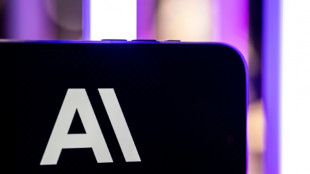
EU seeks agreement on world's first AI law / Photo: Kirill KUDRYAVTSEV - AFP/File

 Ed Sheeran returns to stage after Palestinian controversy

 Asian Games to open in Japan after troubled build-up

 Drone owners rush to offload devices ahead of Beijing ban
 Trump's beef policies irk Texas ranchers, testing their loyalty

 Nvidia, OpenAI CEOs to attend Xi dinner at White House
 Anthropic picks Accenture for in-house AI safety evaluation

 Balogun returns as Monaco beat Lens to continue strong Ligue 1 start

 'Pause' on overt repression in Venezuela, but reforms still needed: HRW

 Global stocks mixed as yen falls despite Bank of Japan rate hike
 Cuba hit with seventh major blackout of the year

 Murray out with concussion so Wentz will start for Vikings

 UN chief 'deeply regrets' US visa refusal to Abbas for annual meeting

 England quick Carse to face no charges over alleged nightclub assault

 Mancini brings nine newcomers into the first squad of his Italy comeback

 Czechs level Davis Cup tie against USA as South Korea eye Finals
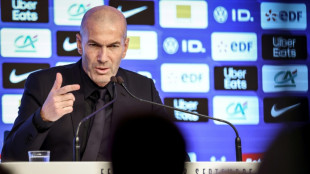 New France boss Zidane confirms Mbappe as captain after naming first squad

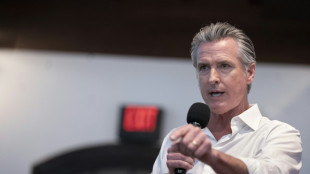 California governor signs order to explore AI 'kill switch'

 Head leads run spree as Australia win Zimbabwe ODI series

 In-form Raphinha wants to finish career at Barcelona
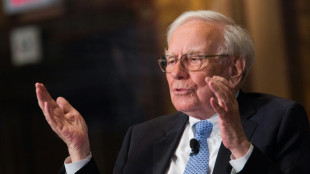 Warren Buffett steps down as Berkshire Hathaway chairman

 Carrick confident Man Utd can 'work through' tough time

 Mbappe ends Nike partnership to join Swiss brand On

 Liverpool boss Iraola puts Bournemouth love affair on hold

 'A disaster' if Man City do not win says Maresca after flawless start

 Kerry James Marshall: American 'blackness' painter celebrated in Europe
The European Union will seek to thrash out an agreement on sweeping rules to regulate artificial intelligence on Wednesday, following months of difficult negotiations in particular on how to monitor generative AI applications like ChatGPT.
The EU is racing to approve the world's first comprehensive AI law after the issue took on greater urgency when the ChatGPT bot burst onto the scene last year, highlighting AI's dizzying advances.
ChatGPT wowed with its ability to produce poems and essays within seconds from simple user prompts.
AI proponents say the technology will benefit humanity, transforming everything from work to healthcare, but others worry about the risks it poses to society, fearing it could thrust the world into unprecedented chaos.
Brussels is bent on bringing big tech to heel with a powerful legal armoury to protect EU citizens' rights, especially those covering privacy and data protection.
The European Commission, the EU's executive arm, first proposed an AI law in 2021 that would regulate systems based on the level of risk they posed. For example, the greater the risk to citizens' rights or health, the greater the systems' obligations.
Negotiations on the final legal text began in June, but a fierce debate in recent weeks over how to regulate general-purpose AI like ChatGPT and Google's Bard chatbot threatened talks at the last minute.
Negotiators from the European Parliament and EU member states began discussions on Wednesday and the talks were expected to last into the evening.
Some member states worry that too much regulation will stifle innovation and hurt the chances of producing European AI giants to challenge those in the United States, including ChatGPT's creator OpenAI as well as tech titans like Google and Meta.
Although there is no real deadline, senior EU figures have repeatedly said the bloc must finalise the law before the end of 2023.
- Chasing local champions -
EU diplomats, industry sources and other EU officials have warned the talks could end without an agreement as stumbling blocks remain over key issues.
Others have suggested that even if there is a political agreement, several meetings will still be needed to hammer out the law's technical details.
And should EU negotiators reach agreement, the law would not come into force until 2026 at the earliest.
The main sticking point is over how to regulate so-called foundation models -- designed to perform a variety of tasks -- with France, Germany and Italy calling to exclude them from the tougher parts of the law.
"France, Italy and Germany don't want a regulation for these models," said German MEP Axel Voss, who is a member of the special parliamentary committee on AI.
The parliament, however, believes it is "necessary... for transparency" to regulate such models, Voss said.
Late last month, the three biggest EU economies published a paper calling for an "innovation-friendly" approach for the law known as the AI Act.
Berlin, Paris and Rome do not want the law to include restrictive rules for foundation models, but instead say they should adhere to codes of conduct.
Many believe this change in view is motivated by their wish to avoid hindering the development of European champions -- and perhaps to help companies such as France's Mistral AI and Germany's Aleph Alpha.
- 'Not scared to walk away' -
Another sticking point is remote biometric surveillance -- basically, facial identification through camera data in public places.
The EU parliament wants a full ban on "real time" remote biometric identification systems, which member states oppose. The commission had initially proposed that there could be exemptions to find potential victims of crime including missing children.
There have been suggestions MEPs could concede on this point in exchange for concessions in other areas.
Brando Benifei, one of the MEPs leading negotiations for the parliament, said he saw a "willingness" by everyone to conclude talks.
But, he added, "we are not scared of walking away from a bad deal".
France's digital minister Jean-Noel Barrot said it was important to "have a good agreement" and suggested there should be no rush for an agreement at any cost.
"Many important points still need to be covered in a single night," he added.
Concerns over AI's impact and the need to supervise the technology are shared worldwide.
US President Joe Biden issued an executive order in October to regulate AI in a bid to mitigate the technology's risks.
burs-raz/rmb/rl
G.AbuGhazaleh--SF-PST