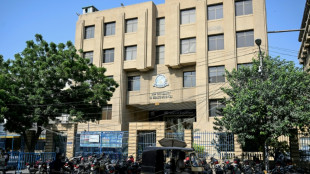
Spanish PM's controversial Catalan amnesty deal / Photo: OSCAR DEL POZO - AFP

 Trump says Denmark to give US 'permanent control' over Greenland security

 Kennedy Center: future unclear for iconic Washington arts hub

 Trump claims 'infinite' Greenland security deal with Denmark

 Helicopters battle wildfire threatening Ecuador's capital

 Brentford batter Chelsea to undo Alonso's promising start
 Kane hits Bundesliga century as Bayern rout Union
 Trump says CNN, MS NOW, Politico banned from White House
 Hushing and hedging: US companies retreat on climate

 Springboks to face Fiji before 2027 Rugby World Cup

 Nigeria miners struggled to breathe in cell before 37 died: survivors

 McIlroy on the charge at PGA Championship as Reed withdraws

 McIlroy on the charge at PGA Championship

 Crisis-wracked Volkswagen warns of 10-bn-euro hit to profits

 Costa Rica's Grynspan tops third informal poll for UN chief: diplomat

 Stock markets retreat after central bank rate hikes

 Russia labels director of Cannes Grand Prix winner a 'foreign agent'

 Macron warns of Russian 'hybrid' threat after meeting presidential hopefuls

 UN holds third informal poll for new chief

 Kulusevski return can spark Spurs: De Zerbi

 Shakira to cap off world tour with Madrid 12-gig run

 Isolated Syrian-Druze city blames Damascus for shortages

 Isolated Syrian-Druze city shortages

 Dutch drop Depay for Germany match in Xavi's first pick

 Ronaldo named in Portugal squad for Nations League

 Stock markets diverge after central bank rate hikes

Acting Spanish Prime Minister Pedro Sanchez's agreement to grant an amnesty to hundreds of Catalan separatists in order to secure another term in office has sparked angry protests across the country.
Sanchez says the measure will help ease lingering tensions over Catalonia's failed 2017 bid to break away from Spain.
But his opponents argue the amnesty -- which the Socialist premier had previously said he would never agree to -- is a self-serving means to remain in power.
- Why now? -
The divisive amnesty accord follows an inconclusive general election in July which left Sanchez needing the support of Catalan separatist parties ERC and JxCat to win a vote of confidence in parliament and be sworn in for another term.
The parliamentary vote is due to take place on Thursday.
In exchange for their support, the two Catalan parties have demanded an amnesty for hundreds of people facing legal action, mainly over their roles in Catalonia's failed push for independence in 2017.
That bid involved a referendum on secession for Catalonia that went ahead despite being banned by the courts and was marred by police violence.
Sanchez, who has been in power since 2018, has defended the amnesty deal.
He argues it makes "a virtue of necessity" and will turn the page on an independence bid that sparked Spain's worse political crisis in decades.
- What it covers -
The draft amnesty law, which was tabled in parliament on Monday, covers all events related to the Catalan independence drive, from 2012 to the present day, including a symbolic vote held in 2014 and the 2017 referendum.
Backers of the bill estimate the amnesty could benefit around 400 people, primarily minor officials and ordinary citizens who helped stage the 2017 referendum or took part in protests.
Police officers facing legal action over their sometimes violent efforts to stop the referendum from going ahead or their clashes with protesters are also covered.
The most high-profile beneficiary would be JxCat founder Carles Puigdemont, who was head of the Catalonia regional government in 2017 and fled to Belgium shortly after the referendum to avoid prosecution.
Other top Catalan separatist leaders who were serving lengthy prison sentences over the secession bid and who Sanchez pardoned in 2021 -- such as ERC leader Oriol Junqueras -- will see their ban on holding public office lifted.
- What opponents say -
The amnesty law has the backing of Sanchez's Socialists as well as far-left party Sumar and smaller Basque, Catalan and Galician nationalist and separatist groups.
That gives it the support of an absolute majority of 178 lawmakers in the 350-seat parliament.
But opponents accuse Sanchez of violating the rule of law just to remain in power.
The main opposition conservative Popular Party and the far-right Vox plan to challenge the amnesty in the courts and describe it as "giving into blackmail".
Police unions, judges, leading law firms, civil servants and Spain's main business lobby group, the CEOE, have also rejected the amnesty plan, arguing that it undermines the separation of powers and legal security.
- Other promises -
Sanchez's government has also agreed to forgive 15 billion euros ($16 billion) owed by Catalonia to the national government dating from the 2008 financial crisis, and to address "lawfare", a term used by Catalan separatists to describe the alleged use of the courts to persecute pro-independence activists.
Judges have expressed concern over plans to set up parliamentary "commissions of enquiry" to look into court decisions that the separatists say constitute use of the judiciary for political purposes.
This goes against "the independence of the judiciary" and constitutes "an unacceptable distrust of the functioning of the judiciary", several magistrates' groups said in a joint statement last week.
H.Darwish--SF-PST