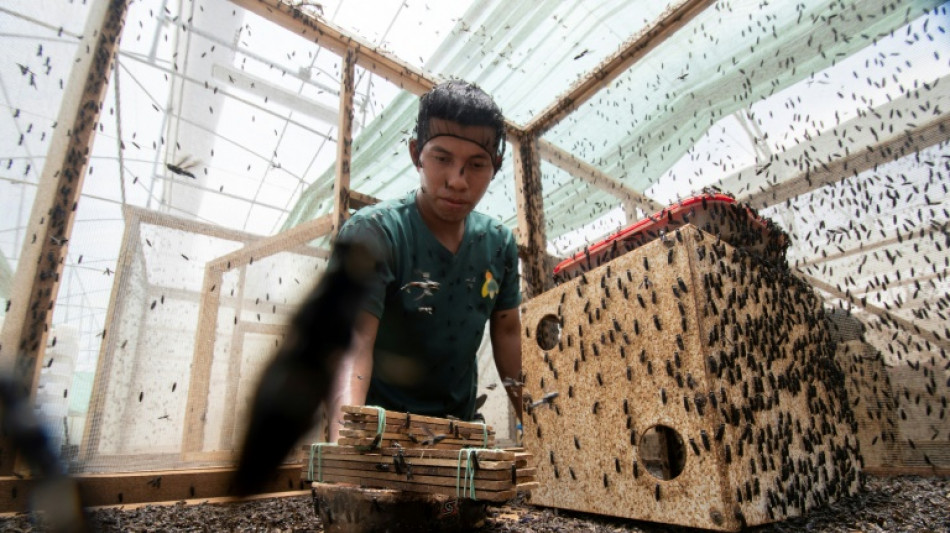
Fly larvae: Costa Rica's sustainable protein for animal feed / Photo: Ezequiel BECERRA - AFP

 Trump says Denmark to give US 'permanent control' over Greenland security
 Kennedy Center: future unclear for iconic Washington arts hub

 Trump claims 'infinite' Greenland security deal with Denmark

 Helicopters battle wildfire threatening Ecuador's capital

 Brentford batter Chelsea to undo Alonso's promising start

 Kane hits Bundesliga century as Bayern rout Union

 Trump says CNN, MS NOW, Politico banned from White House

 Hushing and hedging: US companies retreat on climate

 Springboks to face Fiji before 2027 Rugby World Cup

 Nigeria miners struggled to breathe in cell before 37 died: survivors

 McIlroy on the charge at PGA Championship as Reed withdraws

 McIlroy on the charge at PGA Championship

 Crisis-wracked Volkswagen warns of 10-bn-euro hit to profits

 Costa Rica's Grynspan tops third informal poll for UN chief: diplomat

 Stock markets retreat after central bank rate hikes

 Russia labels director of Cannes Grand Prix winner a 'foreign agent'

 Macron warns of Russian 'hybrid' threat after meeting presidential hopefuls

 UN holds third informal poll for new chief

 Kulusevski return can spark Spurs: De Zerbi

 Shakira to cap off world tour with Madrid 12-gig run

 Isolated Syrian-Druze city blames Damascus for shortages

 Isolated Syrian-Druze city shortages

 Dutch drop Depay for Germany match in Xavi's first pick

 Ronaldo named in Portugal squad for Nations League

 Stock markets diverge after central bank rate hikes

Raised in vertical farms and stuffed with fruit waste, fly larvae have been turned into animal feed, as a new Costa Rican venture in sustainability is demonstrating.
The Central American nation, one of the most biodiverse places on Earth, has put a lot of energy and creativity into the goal of becoming the greenest, most sustainable country in Latin America.
In Guapiles, a farming town just 60 kilometers (37 miles) north of the capital San Jose, an innovative company has turned the tables on the flies that have always buzzed annoyingly around the crops -- putting them to work.
The black soldier fly (Hermetia illucens) is native to tropical climates such as Costa Rica's, with its larvae incessantly gobbling up organic waste.
"It's a high-quality protein," Miguel Carmona, president of the company ProNuvo, told AFP.
So fly larvae can provide "healthier" proteins for animals and with less environmental impact than feed based on animal (beef or fish) or vegetable (soy) protein, the 52-year-old businessman explained.
The company's final products, in the form of dried larvae, protein powder or insect oil, are exported -- for now only to the United States, although one Costa Rican fishery is already using them in its tilapia farm in the north of the country.
- 'Sustainable business' -
The flies are raised in cages in a greenhouse at about 40 degrees Celsius (104 Fahrenheit) and in high humidity. They live for a week and lay about 500 eggs each before dying.
Four days later, the eggs hatch and the larvae begin to feed on organic waste from banana, mango and papaya plantations. Over the next 14 days, they gain 10,000 times their original weight, Carmona explained.
"These larvae are then converted into very rich proteins and oils and fats for animal feed," Gabriel Carmona, general manager of ProNuvo and Miguel's brother, told AFP.
Not even the waste goes to waste: the excrement deposited by the larvae makes an ideal fertilizer for the same fruit plantations.
"We are practicing a sustainable business," said Miguel Carmona.
- Fewer inputs -
"We are using waste from other industries to make a high-quality protein without having the environmental impacts that overfishing, soy and livestock have today," said the company president.
According to ProNuvo, the production of one ton of beef requires 30,000 square meters (7.5 acres) of land, and soybeans require 3,000 square meters. Vast areas are thus deforested, sharply reducing the numbers of carbon dioxide-absorbing trees.
Yet, the fly larvae farm requires only 300 square meters.
The same applies to water use. Production of a ton of beef protein requires 15.4 million liters of water (4.1 million gallons), while soybean crops require 1.6 million liters. The larvae consume barely 10,000 liters.
The production time for a ton of larvae protein is also substantially shorter: flies take 14 days, soybeans six months, and cows 36 months.
- 'Regional pioneers' -
The farm in Costa Rica is the first in Latin America to produce insect protein, according to Miguel Carmona.
"Pioneers of the region," he said proudly.
With food, grain and fertilizer prices increasing due to the war between Russia and Ukraine, other innovative projects are underway elsewhere.
There is work in Kenya and Uganda, for example, on using the black soldier fly in the production of organic fertilizers.
And in Europe, the larvae are being sold as a protein supplement for animals -- available to order online.
Z.AlNajjar--SF-PST