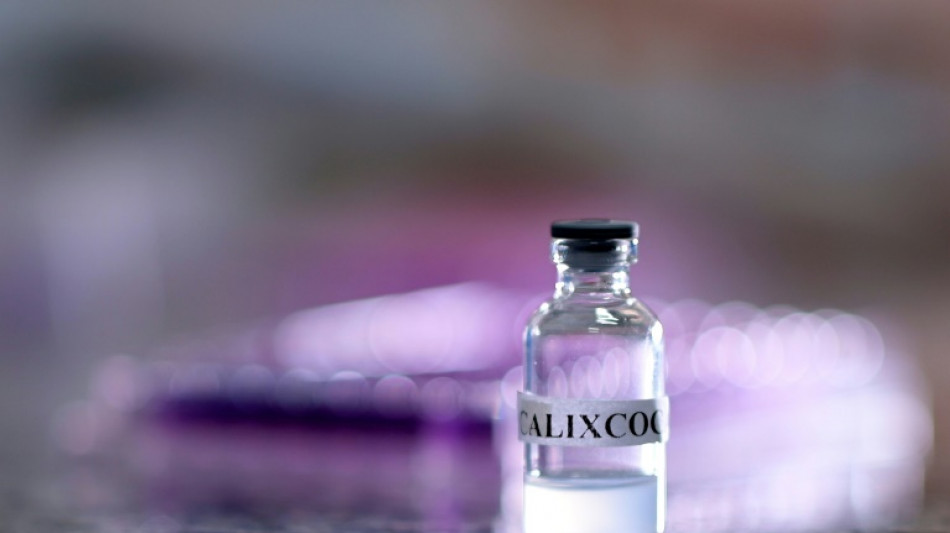
Brazil scientists developing new 'vaccine' for cocaine addiction / Photo: Douglas Magno - AFP

 Trump claims 'infinite' Greenland security deal with Denmark

 Helicopters battle wildfire threatening Ecuador's capital

 Brentford batter Chelsea to undo Alonso's promising start

 Kane hits Bundesliga century as Bayern rout Union

 Trump says CNN, MS NOW, Politico banned from White House

 Hushing and hedging: US companies retreat on climate

 Springboks to face Fiji before 2027 Rugby World Cup

 Nigeria miners struggled to breathe in cell before 37 died: survivors

 McIlroy on the charge at PGA Championship as Reed withdraws

 McIlroy on the charge at PGA Championship

 Crisis-wracked Volkswagen warns of 10-bn-euro hit to profits

 Costa Rica's Grynspan tops third informal poll for UN chief: diplomat

 Stock markets retreat after central bank rate hikes

 Russia labels director of Cannes Grand Prix winner a 'foreign agent'

 Macron warns of Russian 'hybrid' threat after meeting presidential hopefuls

 UN holds third informal poll for new chief

 Kulusevski return can spark Spurs: De Zerbi

 Shakira to cap off world tour with Madrid 12-gig run

 Isolated Syrian-Druze city blames Damascus for shortages

 Isolated Syrian-Druze city shortages

 Dutch drop Depay for Germany match in Xavi's first pick

 Ronaldo named in Portugal squad for Nations League

 Stock markets diverge after central bank rate hikes

 Anti-Assad music star makes triumphant return to Syria

 In-form Fernandez included in Spain Nations League squad

Scientists in Brazil, the world's second-biggest consumer of cocaine, have announced the development of an innovative new treatment for addiction to the drug and its powerful derivative crack: a vaccine.
Dubbed "Calixcoca," the test vaccine, which has shown promising results in trials on animals, triggers an immune response that blocks cocaine and crack from reaching the brain, which researchers hope will help users break the cycle of addiction.
Put simply, addicts would no longer get high from the drug.
If the treatment gets regulatory approval, it would be the first time cocaine addiction is treated using a vaccine, said psychiatrist Frederico Garcia, coordinator of the team that developed the treatment at the Federal University of Minas Gerais.
The project won top prize last week -- 500,000 euros ($530,000) -- at the Euro Health Innovation awards for Latin American medicine, sponsored by pharmaceutical firm Eurofarma.
The vaccine works by triggering patients' immune systems to produce antibodies that bind to cocaine molecules in the bloodstream, making them too large to pass into the brain's mesolimbic system, or "reward center," where the drug normally stimulates high levels of pleasure-inducing dopamine.
Similar studies have been carried out in the United States -- the world's top cocaine consumer, according to the United Nations Office on Drugs and Crime. But they stalled when clinical trials did not demonstrate sufficient results, among other reasons, Garcia says.
Calixcoca has so far proven effective in testing on animals, producing significant levels of antibodies against cocaine and few side effects.
It also protected rat fetuses against cocaine, researchers found, suggesting it could be used in humans to protect the unborn babies of pregnant addicts.
The vaccine is now set to enter the final stage of trials: testing on humans.
- No 'panacea' -
Garcia says Calixcoca could reshape addiction treatment.
"There's no specific registered treatment for cocaine and crack addiction. We currently use a combination of psychological counseling, social assistance and rehabilitation, when necessary," he says.
Calixcoca could add an important tool to that regimen, helping patients at critical stages of recovery, such as when they leave rehab, he says.
The vaccine is made with chemical compounds designed in the lab, rather than biological ingredients, meaning it would be less expensive to produce than many vaccines and would not have to be stored at cold temperatures.
But it won't be a "panacea" that can be administered to anyone, Garcia says.
The exact target group will depend on the outcome of clinical trials, but is theoretically meant to be recovering addicts "who are off (cocaine) and want to stay that way," he says.
The goal is to change what Garcia calls a "sad statistic": according to the US National Institute on Drug Abuse, one in four regular cocaine users becomes addicted.
And just one in four addicts manages to quit after five years of treatment.
Given the stakes, anticipation around the vaccine is high. More than 3,000 people have contacted Garcia's team to volunteer to take part in the clinical trials.
D.Qudsi--SF-PST