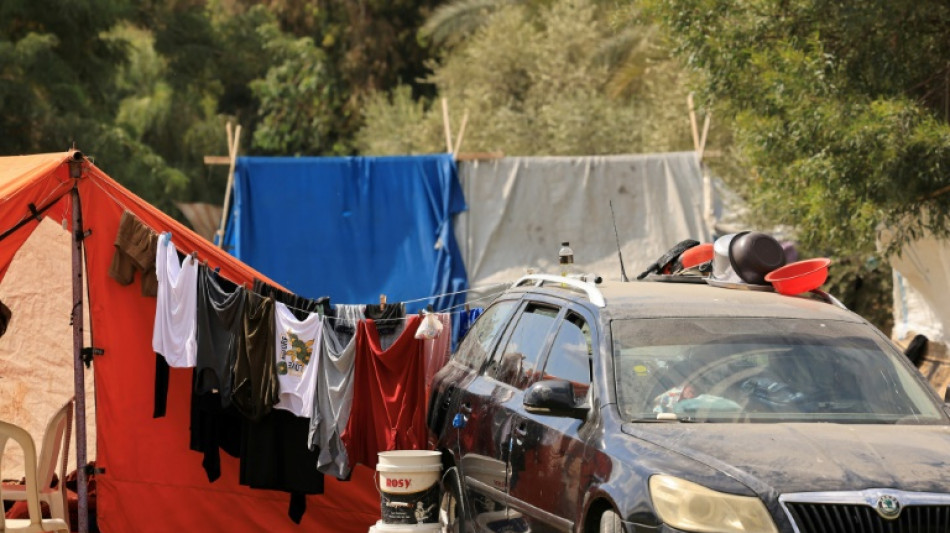
Journalists on the ground share the pain of Gaza / Photo: MAHMUD HAMS - AFP

 Trump claims 'infinite' Greenland security deal with Denmark

 Helicopters battle wildfire threatening Ecuador's capital

 Brentford batter Chelsea to undo Alonso's promising start

 Kane hits Bundesliga century as Bayern rout Union
 Trump says CNN, MS NOW, Politico banned from White House
 Hushing and hedging: US companies retreat on climate

 Springboks to face Fiji before 2027 Rugby World Cup
 Nigeria miners struggled to breathe in cell before 37 died: survivors

 McIlroy on the charge at PGA Championship as Reed withdraws

 McIlroy on the charge at PGA Championship

 Crisis-wracked Volkswagen warns of 10-bn-euro hit to profits

 Costa Rica's Grynspan tops third informal poll for UN chief: diplomat

 Stock markets retreat after central bank rate hikes
 Russia labels director of Cannes Grand Prix winner a 'foreign agent'

 Macron warns of Russian 'hybrid' threat after meeting presidential hopefuls

 UN holds third informal poll for new chief

 Kulusevski return can spark Spurs: De Zerbi

 Shakira to cap off world tour with Madrid 12-gig run

 Isolated Syrian-Druze city blames Damascus for shortages
 Isolated Syrian-Druze city shortages
 Dutch drop Depay for Germany match in Xavi's first pick

 Ronaldo named in Portugal squad for Nations League

 Stock markets diverge after central bank rate hikes

 Anti-Assad music star makes triumphant return to Syria

 In-form Fernandez included in Spain Nations League squad

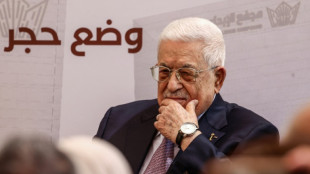
Hundreds of Palestinian journalists have had to flee south from Gaza City and work in fear for their lives in appalling conditions as Israeli air raids pound the territory.
Tents in a hospital courtyard have become their newsroom by day and dormitory at night.
Some work for local media outlets and others for international news organisations. But all suffer the same ordeal as they try to do their jobs amid the violence and suffering caused by the Israel-Hamas war.
On October 7, the Palestinian Islamist group launched deadly raids across the Gaza border into Israel which says 1,400 people, most of whom civilians, died in the attacks.
Gaza's Hamas government says that retaliatory Israeli air and artillery bombing since then has left more than 6,500 dead, including some 2,700 children.
Hamas also dragged more than 200 hostages from Israel back into Gaza on October 7.
Since the war erupted, the Palestinian journalists' union says that more than 22 of its members have been killed in the territory.
Media representatives in the Palestinian territory, including AFP, used to work from offices in Gaza City.
But intense Israeli bombardments, which destroyed many buildings, forced news organisations to send their teams towards the south, even as Israeli strikes hit targets across the entire territory.
Several hundred journalists, including those from AFP, now find themselves under canvas at the Nasser hospital in the southern city of Khan Yunis.
When they are not out reporting, they use the tents to work in by day and to sleep in at night, if the sound of bombing allows.
The hospital teems with women and men in flak jackets stamped "Press", helmets on their heads because of frequent deadly blasts nearby.
- Sleeping in cars -
The Nasser hospital also currently houses an estimated more than 30,000 Palestinians displaced by the war.
Hygienic conditions are basic, but at least the hospital generators mean the journalists can charge phones, laptops, cameras and other equipment that enables them to keep doing their job.
Water supplies are often cut, and with no showers washing becomes very basic.
Inside the tents, some sleep on mattresses, others on the ground, covering themselves with whatever they can.
To get some privacy, many of the women sleep in their cars parked in the hospital grounds.
"It's been two weeks that I've worked from the Nasser hospital," Wissam Yassin told AFP. She works for the US Arabic-language television channel Alhurra.
"I sleep in the car. I drink very little water in order not to have to go to the toilet," she said.
"The bombing is all around us. Several times we've had to abandon our cameras and not go on air for live broadcasts.
"To have a shower I went to a family I don't know near the hospital, and in the evening I sleep in the car."
Yassin has covered several Israeli offensives against the Gaza Strip, but said she has "never experienced such difficult conditions".
"I left my home in Gaza on the morning of October 7 and haven't been back since," she said.
"Sometimes I don't answer calls from my nine-year-old daughter Bana because her crying is heartbreaking and I have no words to calm her."
Houda Hijazi, 25, grew up in Spain and moved to Gaza five years ago where she works as a correspondent for a Spanish-language broadcaster.
She too is among the contingent of journalists working from the hospital courtyard. Hijazi left her family behind in Gaza City because of the scarcity of accommodation in Khan Yunis.
"It's the first war of such magnitude that I've had to cover," Hijazi told AFP.
- Communications problems -
"It's a tragic situation, and I haven't been able to see my family for two weeks. I think about them all the time, and that just piles up the pressure on me," she said.
Hijazi also has Spanish nationality, and theoretically she could leave the Gaza Strip if the Rafah border crossing with Egypt were reopened.
But she said she was determined to stay "and do my work".
"But I will get my family out" if possible, she said.
"I manage to grab a shower every two or three days inside the hospital" in bathrooms reserved for staff, she admitted.
Mohammad Daher works for Jordanian broadcaster Roya. He evacuated his family from Gaza City to Nuseirat in the centre of the territory and then rejoined his colleagues at the Nasser hospital in Khan Yunis.
The 34-year-old said he hasn't had a shave for several days.
"I'll shave when the war is over," he said. "We can barely use the toilets for our personal needs and to remain clean."
Apart from hygiene challenges, according to Turkey's TRT World correspondent Nizar Saadawi, 36, there are "communications problems caused by raids which targeted the network".
"Staying in touch with our colleagues, our families and our sources is becoming difficult," he said.
"When it started I slept on my flak jacket in the car park between vehicles, but a couple of days ago we managed to get a mattress and set up a kind of tent with a tarpaulin," Saadawi said.
The journalists work in the shadow of the ever-present fear for their families that consumes all the people of Gaza.
On Wednesday, Qatar-based broadcaster Al Jazeera announced that the wife, son and daughter of Wael Al-Dahdouh, its chief Arabic-language correspondent in Gaza, had been killed "in an Israeli airstrike".
C.AbuSway--SF-PST