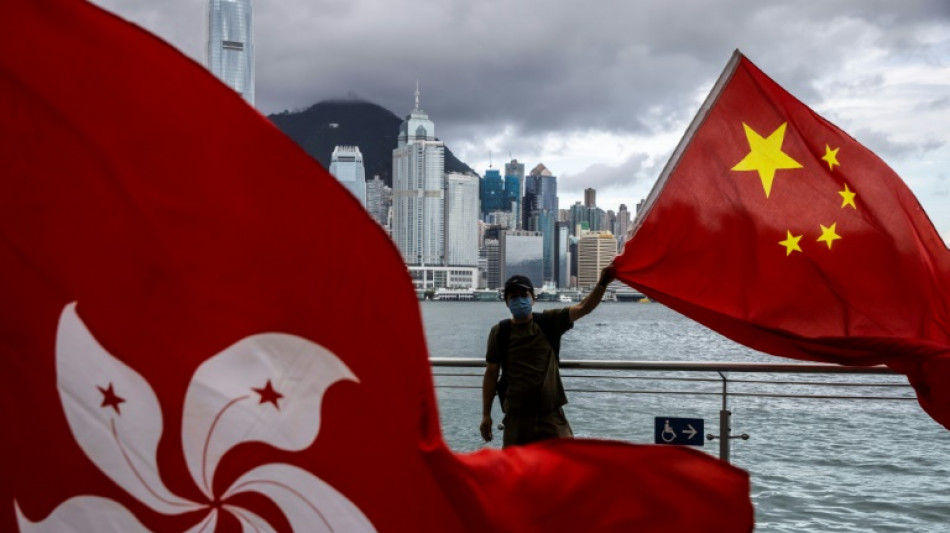
Hong Kong security crackdown targets 'soft resistance' / Photo: ISAAC LAWRENCE - AFP

 Trump claims 'infinite' Greenland security deal with Denmark

 Helicopters battle wildfire threatening Ecuador's capital

 Brentford batter Chelsea to undo Alonso's promising start
 Kane hits Bundesliga century as Bayern rout Union
 Trump says CNN, MS NOW, Politico banned from White House
 Hushing and hedging: US companies retreat on climate

 Springboks to face Fiji before 2027 Rugby World Cup

 Nigeria miners struggled to breathe in cell before 37 died: survivors

 McIlroy on the charge at PGA Championship as Reed withdraws

 McIlroy on the charge at PGA Championship

 Crisis-wracked Volkswagen warns of 10-bn-euro hit to profits

 Costa Rica's Grynspan tops third informal poll for UN chief: diplomat

 Stock markets retreat after central bank rate hikes
 Russia labels director of Cannes Grand Prix winner a 'foreign agent'

 Macron warns of Russian 'hybrid' threat after meeting presidential hopefuls

 UN holds third informal poll for new chief

 Kulusevski return can spark Spurs: De Zerbi

 Shakira to cap off world tour with Madrid 12-gig run

 Isolated Syrian-Druze city blames Damascus for shortages

 Isolated Syrian-Druze city shortages

 Dutch drop Depay for Germany match in Xavi's first pick

 Ronaldo named in Portugal squad for Nations League
 Stock markets diverge after central bank rate hikes

 Anti-Assad music star makes triumphant return to Syria

 In-form Fernandez included in Spain Nations League squad
Hong Kong leader John Lee used his policy address on Wednesday to sound the alarm on the threat of "soft resistance" -- a vague term used by Chinese politicians to signal a new chapter in their crackdown against dissent.
The phrase has no clear definition nor is it included in the city's laws, but this week it appeared in a guilty verdict issued by a Hong Kong court for the first time.
Li Jiexin, 69, was convicted Tuesday of unlicensed performance and fundraising after publicly playing "Glory To Hong Kong" -- an anthem that emerged during the city's huge, sometimes violent pro-democracy protests in 2019.
Judge Amy Chan said Li's performance amounted to "soft resistance that instigated social conflicts".
"I was only playing 'do re mi fa so' and it turned out to be an enormous case," Li told reporters outside court.
Beijing imposed a sweeping national security law to quell dissent after the 2019 pro-democracy protests brought hundreds of thousands of people to the streets to call for more autonomy from mainland China.
Hong Kong will complete its own national security legislation next year, Lee said in his address, vowing to finish the task set out in the city's mini-constitution, but which has yet to be done since the territory was returned under Chinese rule in 1997.
The new law could address "soft resistance", according to Security Minister Chris Tang.
The rise of the ambiguous concept has triggered rare debate in Hong Kong's pro-establishment camp, which is the only game in town after the political opposition was wiped out under Beijing's national security law.
Legislator Paul Tse told AFP in August that criminalising "soft resistance" with further national security laws could be damaging.
"There will be a very big grey area and huge censorship threat," he said.
"In the long run it won't benefit us because no society can sustain without noises, not for long."
So far, 280 people have been arrested under Beijing's law.
- 'Hidden within Hong Kong' -
"Soft resistance" was first mentioned in a speech by Luo Huining, Beijing's former liaison chief in Hong Kong, on April 15, 2021 -- a day now dedicated to educating the Hong Kong public about national security.
"Anything that endangers national security, if it belongs to 'hard resistance', it should be struck by law," said Luo. "If it belongs to 'soft resistance', it should be regulated by law."
The term has since been used to describe criminal offences such as sedition, incitement, terrorism, and advocacy for Hong Kong independence, according to security chief Tang.
"Some national security perpetrators have continued to incite, infiltrate and collude with foreign forces through means like 'soft resistance'," Tang told pro-Beijing newspaper Wen Wei Po in June.
He also blamed "soft resistance" for causing "multiple social chaos in Hong Kong over the past 20 years".
Leader Lee -- under US sanctions for his role in cracking down on the 2019 protests -- had in July warned about "destructive forces engaging in soft resistance hidden within Hong Kong".
Taking a lead from Lee, customs commissioner Louise Ho later vowed to "strictly scrutinise 'soft resistance' items being imported".
- 'Ace card' -
Rare dissent emerged on Chinese social media platform WeChat in a July article that went viral.
"A small number of people... have turned the (national security law) into an ace card to promote their initiatives," anonymous influencer Jinghaihou wrote.
Such "irresponsible" use would damage Hong Kong's liberty and political pluralities, the writer said, adding that doing so could also constitute a form of "soft resistance".
The post echoed sentiments of "the relatively rational dove fraction" in Hong Kong's business sector, said a current affairs analyst, who requested anonymity for fear of being labelled as "soft resistance".
"Using soft resistance as an excuse, or the (national security law) as an imperial token is a main reason behind our loss of talents and foreign visitors," the analyst said.
The finance hub has suffered from a brain drain since 2019, with major international operations downsizing or exiting.
"They know if Hong Kong doesn't change path, the city will lose its edge."
Another Hong Kong-based scholar feared the phrase suggested a further crackdown on civil society.
"The regime... wants to completely reshape Hong Kong as an illiberal society with little to no dissidence," the scholar, who requested anonymity, told AFP.
"At the same time, it is likely meant to further strengthen self-censorship, which is already pervasive."
C.AbuSway--SF-PST