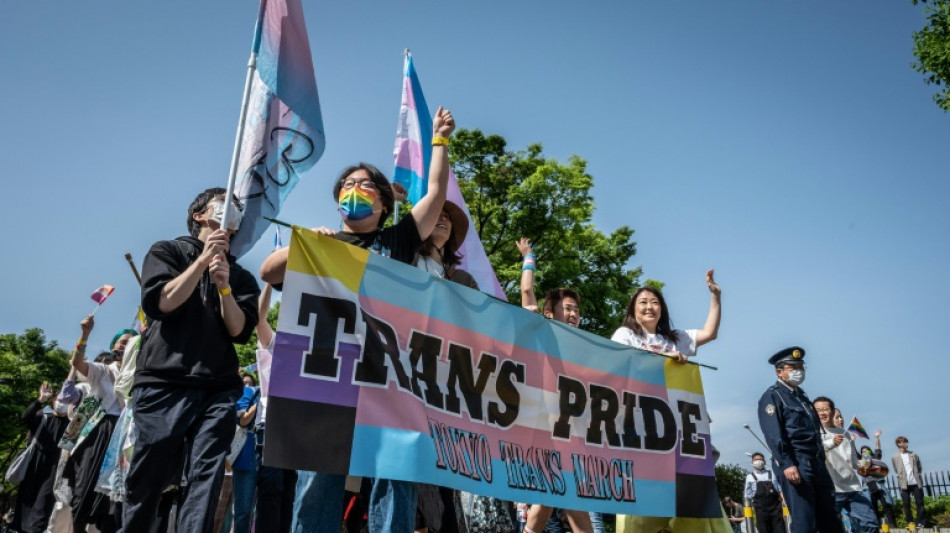
Japan court says 'cruel' gender change sterilisation rule unconstitutional / Photo: Yuichi YAMAZAKI - AFP/File

 Trump claims 'infinite' Greenland security deal with Denmark

 Helicopters battle wildfire threatening Ecuador's capital

 Brentford batter Chelsea to undo Alonso's promising start

 Kane hits Bundesliga century as Bayern rout Union
 Trump says CNN, MS NOW, Politico banned from White House

 Hushing and hedging: US companies retreat on climate

 Springboks to face Fiji before 2027 Rugby World Cup

 Nigeria miners struggled to breathe in cell before 37 died: survivors

 McIlroy on the charge at PGA Championship as Reed withdraws

 McIlroy on the charge at PGA Championship

 Crisis-wracked Volkswagen warns of 10-bn-euro hit to profits

 Costa Rica's Grynspan tops third informal poll for UN chief: diplomat

 Stock markets retreat after central bank rate hikes

 Russia labels director of Cannes Grand Prix winner a 'foreign agent'

 Macron warns of Russian 'hybrid' threat after meeting presidential hopefuls

 UN holds third informal poll for new chief

 Kulusevski return can spark Spurs: De Zerbi

 Shakira to cap off world tour with Madrid 12-gig run

 Isolated Syrian-Druze city blames Damascus for shortages

 Isolated Syrian-Druze city shortages

 Dutch drop Depay for Germany match in Xavi's first pick

 Ronaldo named in Portugal squad for Nations League

 Stock markets diverge after central bank rate hikes

 Anti-Assad music star makes triumphant return to Syria

 In-form Fernandez included in Spain Nations League squad

Japan's top court said on Wednesday that obliging transgender people to be sterilised in order to change their legal gender was unconstitutional.
But the claim from a transgender woman at the centre of the case against having to undergo gender affirmation surgery will be sent back to a lower court for further deliberation, the court said.
The sterilisation rule "restricts a person's free rights not to have their bodies invaded against their will," the supreme court said in the keenly awaited decision that partially overturned its own earlier 2019 ruling.
The requirement imposes a "cruel choice" on those who wish to change gender between "embracing the sterilisation surgery that requires an intense level of bodily invasion" and "relinquishing important legal benefits of being treated according to their gender identity", the court said.
Under rules introduced in 2004, transgender people applying to legally change their gender must meet criteria including forfeiting reproductive capacity -- effectively meaning sterilisation.
Other conditions include being unmarried, not having children and being officially diagnosed with gender dysphoria.
Only a handful of countries around the world allow transgender people to change their status with a simple declaration.
But campaigners say that conditions imposed by Japan, the only Group of 7 wealthy country that does not recognise same-sex marriage or civil unions at a national level, forced people into highly invasive, lengthy and potentially risky medical procedures.
"The procedure for changing one's legally recognised gender, which requires sterilisation surgery and an outdated psychiatric diagnosis, is anachronistic, harmful, and discriminatory," Human Rights Watch had said in a 2019 report.
The advocacy group blasted it as rooted on a "pejorative" notion that transgender identity amounts to a "mental illness".
Recent years have seen traditionally conservative Japan take small steps towards embracing sexual diversity.
In July, Japan's Supreme Court ruled in favour of a transgender bureaucrat who sued the government over access to female toilets at work.
Opinion polls have shown growing support for LGBTQ-friendly laws, especially among younger people, but the ruling Liberal Democratic Party has been reluctant to push ahead with reforms.
And in recent months activists have warned of a rising tide of hateful online rhetoric, particularly targeting transgender women, fuelled in part by contentious debate around anti-discrimination legislation that passed this year, albeit in watered-down form.
- 'Still in pain' -
At the heart of Wednesday's case was a transgender Japanese woman whose claim to be legally listed as female without surgery was rejected.
She has called the obligation to be sterilised a "grave human rights violation and unconstitutional".
"It's extremely rare for the supreme court to rule a law unconstitutional," her lawyer Kazuyuki Minami told reporters on Wednesday.
He added though that it was "sad" that the applicant still "will have to live tomorrow and beyond with her gender not recognised by the law."
The ruling will "ease burdens" on those for whom the sterilisation requirement had been the only hurdle to gender change, but will leave many trans women obliged to undergo surgery on their genitals or wait in limbo for the lower court's decision.
Wednesday's top court ruling has been hotly anticipated among Japan's transgender community, including 34-year-old transgender man Tomoya Asanuma.
At 23, Asanuma's womb and ovaries were removed in order to legally change gender and be allowed to marry his female fiance at the time.
"Making surgery a condition for changing legal gender is too risky for trans people in all aspects -- physically, emotionally and financially," Asanuma said.
"I am still in pain. It's really frustrating to think I wouldn't be suffering as much as I am now, if only I had been allowed to change my gender without surgery."
H.Nasr--SF-PST