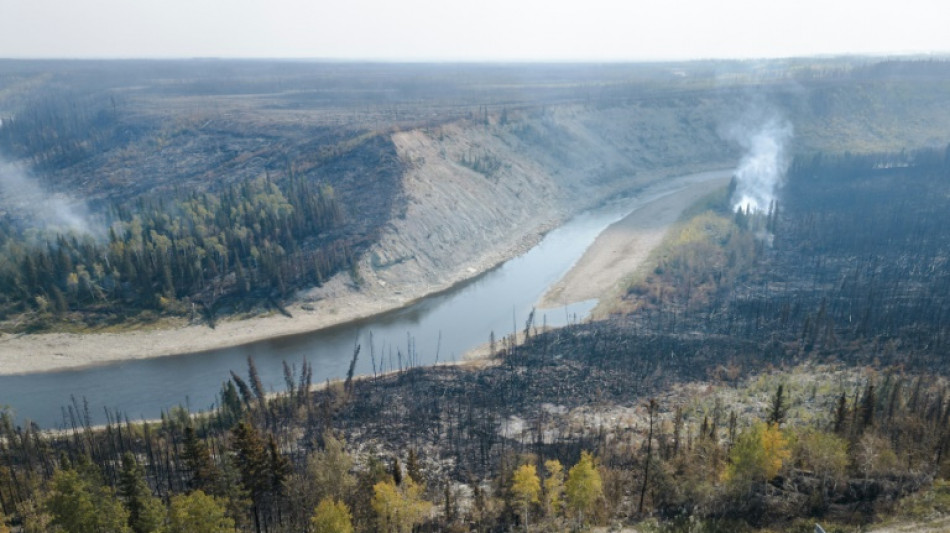
Canada left battered by 'never before seen' wildfire season / Photo: ANDREJ IVANOV - AFP

 England quick Carse to face no charges over alleged nightclub assault

 Mancini brings nine newcomers into the first squad of his Italy comeback

 Czechs level Davis Cup tie against USA as South Korea eye Finals

 New France boss Zidane confirms Mbappe as captain after naming first squad

 California governor signs order to explore AI 'kill switch'
 Head leads run spree as Australia win Zimbabwe ODI series

 In-form Raphinha wants to finish career at Barcelona

 Warren Buffett steps down as Berkshire Hathaway chairman

 Carrick confident Man Utd can 'work through' tough time

 Mbappe ends Nike partnership to join Swiss brand On

 Liverpool boss Iraola puts Bournemouth love affair on hold

 'A disaster' if Man City do not win says Maresca after flawless start

 Kerry James Marshall: American 'blackness' painter celebrated in Europe

 Spain coach De la Fuente offers 'full support' to people of Ceuta

 Russia seizes assets of Nestle, French firms over West's Ukraine support
 England can build on World Cup 'spirit', says Tuchel

 UNESCO can be 'moderator' in AI debate: chief to AFP

 Infantino 'must go', says German FA vice-president

 Russia seizes assets of Nestle, French firms

 Japan's busiest rail station tests robot bins

 Anthropic says AI systems moving towards building themselves

 Asian stocks boosted by falling oil, yen weakens after BoJ rate hike
 Pakistan court blocks expulsion of Afghan medical college students

 Athletes 'can't take it any more' as Asian Games issues mount

 Allen lights up Bills' new stadium with 41-31 win over Lions

When scientists started pouring over data to assess Canada's fire season this year, they struggled to find the right superlatives.
"Never before seen," was thrown around, as was "exceptional in scale, duration" and "huge long-term consequences."
"We have shattered all the records on a Canadian scale," says a shaken Yan Boulanger, a researcher for the country’s natural resources ministry.
There had never been so many areas burned -- 18 million hectares (70,000 square miles), via 6,400 fires -- or so many people evacuated, at more than 200,000.
"It's an impressive wake-up call because we didn't necessarily expect it so quickly, even if the potential was there," Boulanger, a forest fire specialist at Natural Resources Canada, told AFP.
In Quebec, hard hit and less accustomed than the west to very large fires, the shock is immense.
No more leaves on the branches, trunks blackened and roots charred: in the spruce forest of Abitibi-Temiscamingue,only a few tufts of moss managed to resist the onslaught of blazes that started in June. As far as the eye can see, there is the same desolate landscape.
"There is little chance that this forest will be able to regenerate. The trees are too young to have had time to form cones which ensure the next generation," says Maxence Martin, a professor of forest ecology at the University of Quebec in Abitibi-Temiscamingue.
In this remote region, forestry is the main industry, supporting entire towns with the 60,000 direct and indirect jobs linked to it. But both the industry and the wildfires have significantly reshaped the landscape.
- Losing one third of forest -
"If we continue on the current trend (of fires), by 2100 as much as one third of the boreal forest in Quebec will have been lost," says Martin, slaloming among the regrowth starting to poke through the scorched ground.
This area is part of a vast ring of greenery which encircles the Arctic, stretching from Canada through Alaska, Siberia and northern Europe to form the largest expanse of wilderness in the world.
Fires here are fueled by drier and hotter conditions caused by climate change. And by releasing greenhouse gasses into the atmosphere, these fires in turn contribute to global warming, in a vicious circle.
Another particularity of this northern forest: it releases 10 to 20 times more carbon per unit of burned area than other ecosystems.
That's helped Canada's emissions reach unprecedented levels, at 473 megatons this year. That’s more than three times higher than the previous record, according to data from Europe's Copernicus observatory.
And in the boreal forest, due to the thickness of the humus on the ground, fires can continue to burn for months.
"When we explain to people that the fires will only really be extinguished with snow, everyone becomes eager for winter to arrive," Guy Lafreniere, the mayor of Lebel-sur-Quevillon, a small Quebec town of 2,000 residents who had to evacuate twice this summer, says with a smile.
Homes were saved thanks to the nearby lake which halted the advance of the fire. But the whole summer was disrupted, no child finished their school year and hundreds of small chalets built in the forest for weekends and vacations were destroyed.
Today the city is surrounded by fire breaks, built during the blazes. A ring of conifers -- which are very flammable -- were chopped down.
"We had a helicopter dumping water on the machines as they moved along chopping down the trees, so the machines didn't themselves catch on fire," the mayor recalled.
- Overwhelmed -
Much of Canada, including the far north, is facing extreme drought conditions. Lightning storms earlier this year were triggering hundreds of fires in a single day.
Firefighters, authorities and residents were overwhelmed and declared emergencies persisting through the summer.
"People had five minutes to leave their homes and hit the road. It was intense and stressful, especially since there was a lot of smoke and we could see the flames very close," says Doris Nolet, in charge of volunteer firefighters from Normetal, another evacuated Quebec village.
"It was the first time that we were faced with forest fires. We know how to take care of houses, car fires, but not forest fires," she adds.
"We had a strange summer," confirms Omer Riviere, who lives in this village and remains traumatized at having lost his chalet in the forest where "he had old furniture and, above all, so many memories."
For the first time in its history, almost all Canadians were affected by this year's fire season, either directly or because they had to deal with the smoke, which traveled thousands of miles -- repeatedly polluting the air across North America and even parts of Europe.
"We need to think deeply. It's not Europe here, we don't have the means to fight all the fires. They are too far away, too big, too inaccessible -- so we have to be proactive," suggests Natural Resources Canada's Marc-Andre Parisien.
While the mega fires of 2023 are now smoldering, they'll almost certainly be back again.
I.Saadi--SF-PST