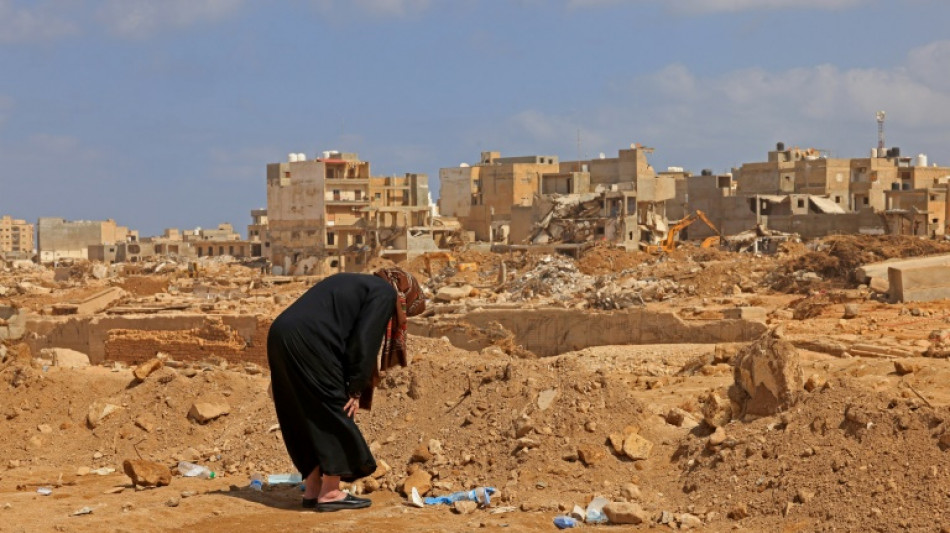
Cities wiped out, or nearly, by disasters / Photo: KARIM SAHIB - AFP/File

 Crisis-wracked Volkswagen warns of 10-bn-euro hit to profits

 Costa Rica's Grynspan tops third informal poll for UN chief: diplomat

 Stock markets retreat after central bank rate hikes

 Russia labels director of Cannes Grand Prix winner a 'foreign agent'

 Macron warns of Russian 'hybrid' threat after meeting presidential hopefuls

 UN holds third informal poll for new chief

 Kulusevski return can spark Spurs: De Zerbi

 Shakira to cap off world tour with Madrid 12-gig run

 Isolated Syrian-Druze city blames Damascus for shortages

 Isolated Syrian-Druze city shortages

 Dutch drop Depay for Germany match in Xavi's first pick

 Ronaldo named in Portugal squad for Nations League

 Stock markets diverge after central bank rate hikes

 Anti-Assad music star makes triumphant return to Syria

 In-form Fernandez included in Spain Nations League squad

 Arteta buries hatchet with Hurzeler ahead of Brighton clash

 Alexander-Arnold and Palmer return to England squad for Nations League

 Russians vote as Ukraine war drags on for fifth year

 Backpackers fret over Australian visa crackdown
 Most Asian stocks track Wall St rally, yen drops after BoJ rate hike
 Russians begin voting in controlled election as war drags on

 Trump 'clearly' wants dialogue with Pyongyang: South Korean President

 Bank of Japan hikes rates to 31-year high to battle inflation
 Thailand's Muslim separatists vow to fight to the end

 Mideast turmoil, AI set to dominate UN gathering of world leaders

The coastal city of Derna in Libya, devastated by a huge flash flood, joins a grim list of metropolises nearly annihilated by natural disasters since the turn of the century.
But from the debris, many of those razed landscapes have also managed to rebuild and reinvent themselves following years of reconstruction.
- Bhuj, 2001 -
A massive earthquake struck the western Indian state Gujarat on January 26 killing more than 20,000 people, with most victims from the city of Bhuj.
The city was flattened but a massive reconstruction effort has turned it into an economic hub with two new ring-roads, improved sewerage systems and an airport.
The local government bulldozed temples and mosques to widen roads, and the construction of apartments of more than one storey is now forbidden.
- Bam, 2003 -
A quake on December 26 levelled much of the ancient southeastern Iranian city of Bam with 80 percent of its infrastructure damaged or destroyed.
An estimated 26,000-32,000 people died in the disaster of such proportions that Iran allowed its arch-enemy the United States to send planes laden with aid.
The jewel of Bam, a 2,000-year-old citadel, which was the largest mud-brick structure in the world, was nearly completely destroyed.
Today more than 90 percent of the city has been rebuilt.
- Banda Aceh, 2004 -
On December 26 a 9.3-magnitude earthquake off Indonesia's western tip generated a series of massive waves that pummelled the coastline of 14 countries as far apart as Indonesia, Thailand, Sri Lanka and Somalia.
Most of Indonesia's 170,000 victims were in the province of Aceh and its main city Banda Aceh was razed.
More than $6.7 billion was poured into rebuilding Aceh, funding among other things 140,000 new homes, 1,759 schools, 363 bridges and 13 airports.
The disaster also ended a decades-long separatist conflict in Aceh, with a peace deal between rebels and Jakarta struck less than a year later.
- L'Aquila, 2009 -
In the early hours of April 6, a devastating earthquake hit the historic Italian city of L'Aquila, killing 309 people.
Around 20,000 homes were damaged or destroyed.
Over a decade later, the city's elegant buildings and squares spanning medieval, Renaissance and Baroque periods are still being renovated.
Over 8,000 people are still living in temporary housing, most of them in quake-proof apartments.
- Port-au-Prince, 2010 -
A massive quake on January 12 wrecked the Haitian capital Port-au-Prince and the surrounding region.
It killed more than 200,000 people, destroyed the homes of 1.5 million Haitians and shattered much of the country's frail infrastructure.
The disaster tipped Haiti into chaos and destitution.
A cholera epidemic the same year introduced by peacekeepers who arrived after the quake killed more than 10,000 people.
More than a decade later, downtown Port-au-Prince, including multiple government agency headquarters and the presidential palace, have still not been rebuilt and camps built for the displaced have become shantytowns.
- Minamisanriku, 2011 -
The coastal town was one of many in eastern Japan devastated when a 9.1-magnitude undersea earthquake and tsunami struck on March 11, 2011, triggering a disaster at the Fukushima nuclear plant.
Some 620 people died in Minamisanriku, a fishing port of 17,600 inhabitants, and around 60 percent of all buildings were destroyed.
Six years later the town was back on its feet: residents had been relocated and the town hall, schools and hospitals had been rebuilt.
J.AbuHassan--SF-PST