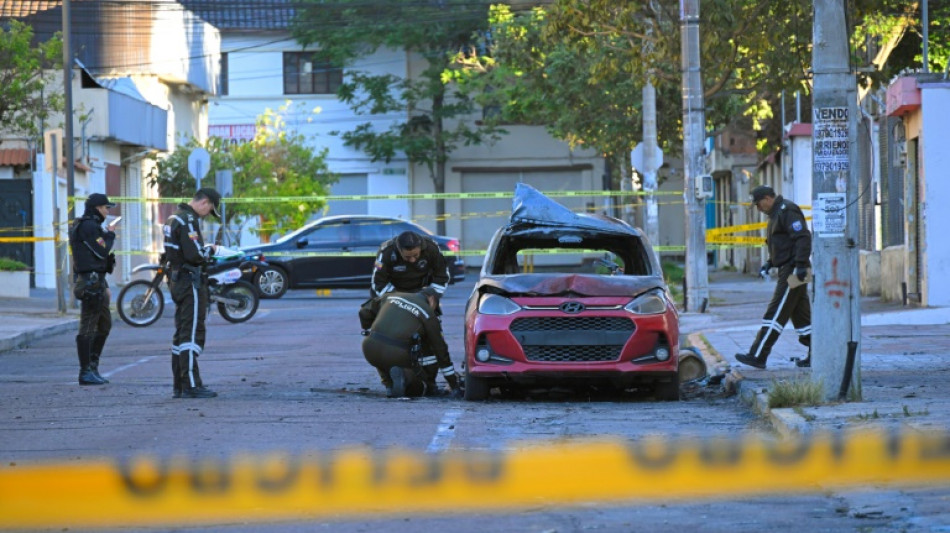
Car bombs rock Ecuador capital as prisoners seize 57 guards, police / Photo: Rodrigo BUENDIA - AFP

 In-form Fernandez included in Spain Nations League squad

 Arteta buries hatchet with Hurzeler ahead of Brighton clash

 Alexander-Arnold and Palmer return to England squad for Nations League
 Russians vote as Ukraine war drags on for fifth year

 Backpackers fret over Australian visa crackdown
 Most Asian stocks track Wall St rally, yen drops after BoJ rate hike
 Russians begin voting in controlled election as war drags on

 Trump 'clearly' wants dialogue with Pyongyang: South Korean President

 Bank of Japan hikes rates to 31-year high to battle inflation
 Thailand's Muslim separatists vow to fight to the end

 Mideast turmoil, AI set to dominate UN gathering of world leaders
 Australia to detain tourists who overstay visa, minister says

 Championship rivals brace for renewal of bitter feuds

 In Brazil's Amazon, the hunt for oil fuels hopes and fears
 Australian athlete who soiled herself apologises for continuing Hyrox race

 Baby orangutans in India expose 'frightening' scale of trafficking
 Doom Loop? Ed Sheeran struggles against Gaza tide
 Sudanese women hold fast to threatened henna body art

 Man Utd misery puts Carrick under pressure, Spurs feeling the heat
 Prized Mexican relic returns on loan, two centuries on

 Venezuela unblocks some censored news sites

 Samba stars on debut in Man City rout of Norwich

 Oversight Board blasts 'inadequate' Meta safeguards for AI deepfakes

 The Easter Island origins of buzzy Malkovich drama 'Wild Horse Nine'

 Third body recovered after Grand Canyon flash flood

Ecuador's capital Quito was rocked by attacks with grenades and two car bombs overnight, followed hours later by inmates in six prisons taking hostage 57 prison guards and police officers on Thursday, officials said.
The wave of attacks was an apparent show of force by organized crime gangs that claimed no victims, while the uprising in the prisons was believed to be a riposte to a police sweep of jails to confiscate weapons the day before.
The car bombs targeted the violence-hobbled country's SNAI prisons authority -- one exploding outside its headquarters and the other at a building that formerly housed SNAI offices.
Hours later, SNAI said, prisoners in six penitentiaries across the country had managed to seize 50 prison guards and seven police officers who were being held hostage.
"We are concerned about the safety of our officials," said Interior Minister Juan Zapata at a press conference in the capital Quito.
The country, until a few years ago a peaceful haven nestled between the world's largest cocaine producers -- Colombia and Peru -- has recently descended into violence as it has itself become a hub for drug trafficking.
Ecuador's prisons have been the location of massacres by rival gangs with links to Colombian and Mexican cartels that have led to more than 430 inmate deaths since 2021, often leaving a trail of burned and dismembered bodies.
The police's anti-drug investigations boss, General Pablo Ramirez, told reporters one of the rigged cars, a sedan, had been loaded with "two gas cylinders with fuel, a slow fuse and apparently dynamite sticks."
Firefighters said there were no injuries.
Quito Mayor Pabel Munoz said the night also saw three grenade explosions in the city.
Six people, including a Colombian national, were arrested near the scene of one of these explosions, according to Ramirez.
All have a criminal history of extortion, robbery and murder, he said.
"Three of them were arrested 15 days ago for the theft of a truck and extortive kidnappings... and were released" under conditions, Ramirez said.
- 'Intimidate the state' -
Such attacks are rare in Quito, but reminiscent of the terror sown in Colombia by drug lord Pablo Escobar in the 1980s when he declared war on the state to prevent his extradition to the United States.
Ramirez said an inmate transfer earlier Wednesday, aimed at preventing gang clashes, may have been the trigger.
Furthermore, hundreds of police and soldiers on Wednesday raided a prison in the southern city of Latacunga, searching for weapons, ammunition and explosives.
In apparent protest, inmates in Cuenca -- hundreds of kilometers away -- and jails in five other unnamed locations took dozens of prison guards hostage.
"They want to intimidate the state to prevent us from continuing to fulfill the role of the armed forces and the police in controlling these penitentiary centers," Security Minister Wagner Bravo told FM Mundo radio.
President Guillermo Lasso in July decreed a 60-day state of emergency for the country's prisons, allowing the deployment of soldiers to control the penitentiary system.
Drug gangs, which use prisons as operations centers, also face off in the streets of Ecuador, where the homicide rate rose to a record 26 per 100,000 inhabitants in 2022, almost double the previous year and higher than the rates in Colombia, Mexico or Brazil.
The violence spilled over into the political sphere earlier this month, with anti-corruption presidential candidate Fernando Villavicencio assassinated in Quito.
The Ecuadoran city most affected by the violence to date has been Guayaquil in the southwest, whose port is key to the fast-expanding drug trade to Europe and the United States.
Apart from gruesome prison clashes, Guayaquil has also seen car bombs, dismembered bodies hanged from bridges, kidnappings and extortion.
X.Habash--SF-PST