Water-stressed Iraq dries up fish farms / Photo: Ahmad AL-RUBAYE - AFP

 Fiji declares national HIV crisis
 Australia to cut migration to fix housing crisis: minister
 NASA scan discovers new, 'once in a century' Moon crater

 Most stocks rise as Fed hikes and indicates drive to curb inflation
 US again denies Palestinian leader Abbas visa to attend UN assembly
 Lula says he will go to UN to tell Trump to 'stay out' of Brazil's elections

 Messi heads Inter Miami to Campeones Cup triumph

 AI looms large ahead of Xi, Trump summit

 Smith still haunted by 'Sandpapergate' as he prepares for South Africa Tests

 UK-Sudanese author pens book to give children 'African history of Africa'

 Boehly and Walter sell Chelsea stake to Clearlake Capital

 US House backs data center power cost bill amid midterm backlash
 US Congress passes sweeping Russia sanctions bill

 Barca hit Racing for seven as Atletico crush Osasuna

 US Fed raises rates to tackle 'too high' inflation, irking Trump

 Man Utd misery mounts after League Cup collapse against Brighton

 Turkey releases 106 protesters, jails more LGBTQ activists

 US Fed raises rates to tackle 'too high' inflation in move sure to rile Trump

 England were 'waiting for death' in World Cup semi-final defeat: Tuchel

 NFL star fined for displaying name of slain Palestinian girl
 Witsel retires from internationals after 18-year Belgium career

 US Fed raises rates to battle inflation in move likely to rile Trump

 Fitzpatrick 'not comfortable' over Dubai golf finale

 Gaza apartment block collapse kills 21, including 12 children

 Gaza apartment block collapse leaves 21 dead

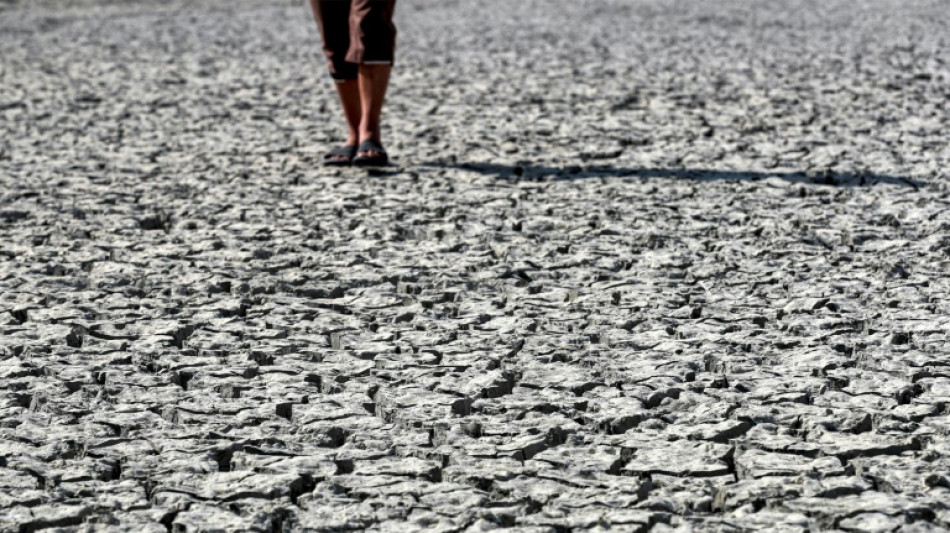
Iraqi villager Omar Ziad gazes at the cracked and barren earth where his fish farm once stood, lost to water conservation efforts during a devastating four-year drought.
As the alarming water crisis blamed mostly on climate change drags on, officials see the need for trade-offs in an effort to meet the country's demands.
Drastic government measures have restricted water use for some purposes, including crop irrigation, and authorities have cracked down on illegal practices they long ignored.
Since late May, unauthorised fish farms like Ziad's have become a target.
"I've worked in this industry since 2003," the 33-year-old said at his village of Al-Bu Mustafa in Iraq's central Babylon province.
He had watched helplessly as officials from the water resources ministry sealed his family's seven fish ponds.
Surrounded by fields and majestic palm trees, this was where Ziad, his father and seven brothers would rear carp, which Iraqis use to make their beloved grilled fish dish known as masguf.
At full capacity, the farm held about 50,000 fish and earned the family the equivalent of $1,300-2,600 a month, far more than many in the country.
"We would share the revenues", said Ziad, who also works as a teacher.
He added that they sold their fish "cheaply", but since all but five of the village's 80 fish ponds shut down, the price of carp has almost doubled, now selling at more than 8,000 dinars (around $6) per kilogram, he said.
- 'Strategic reserves' -
From a bird's-eye view, the backfilled dry patches of land that replaced the ponds are marked out by unpaved roads.
The monotony of the barren landscape is occasionally interrupted by ponds that still hold water. These were spared because their owners had the necessary permits, according to Ziad.
Water supply in Iraq, which the United Nations ranks as one of the five countries most impacted by some effects of climate change, is in a dire state.
Declining rain over the past four years coupled with rising temperatures has brought water levels in the Tigris and Euphrates rivers to staggering lows, for which Baghdad also accuses upstream dams built by neighbouring Turkey and Iran.
"The strategic water reserves in Iraq are at their lowest point" in nearly a century, said Khaled Shamal, spokesman for the water resources ministry.
Some of Iraq's 43 million inhabitants share the blame, he told AFP, due to water-intensive "irrigation practices".
Shamal justified the crackdown on unauthorised fish farms by saying the ponds "increase the water surface susceptible to evaporation", provoke seepage into the soil, and contribute to "environmental pollution".
About half of Iraq's estimated 5,000 "unlicensed" fish farms have been closed, Shamal said, pointing out that authorities still allow mobile fish tanks which are submerged in rivers.
- Plunging output -
Ayad al-Talibi, president of the Iraqi association of fish farmers, said he accepted the shutting of unauthorised ponds but questioned whether the water that has been saved was "properly used".
Before the May crackdown, Iraq produced nearly one million tonnes of fish per year, but Talibi told public broadcaster Al-Ikhbariya that output has now plunged to 190,000 tonnes.
According to him, the sector employs two million Iraqis. "All of these families will migrate to the cities" which might struggle to accommodate them, he predicted.
The water crisis has also affected river fishing.
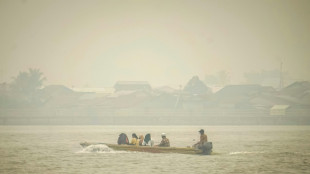
In Iraq's far south, high salinity has harmed fishing in the Shatt al-Arab waterway, where the Tigris and Euphrates converge before spilling into the Gulf.
As the flow of fresh water from the north decreases every year, the riverbed gradually fills with salt water.
Sailing the waters of Shatt al-Arab, fisherman Khdeir Aboud, 71, casts his net but expects no major catch.
Fresh water would once carry "all types of fish" but "with the salt water, there's nothing left", said the white-bearded man.
The meagre pay he now makes "can't support a household", he lamented.
"Most fishermen have quit the trade for odd jobs. There are only a few old people left."
M.Qasim--SF-PST