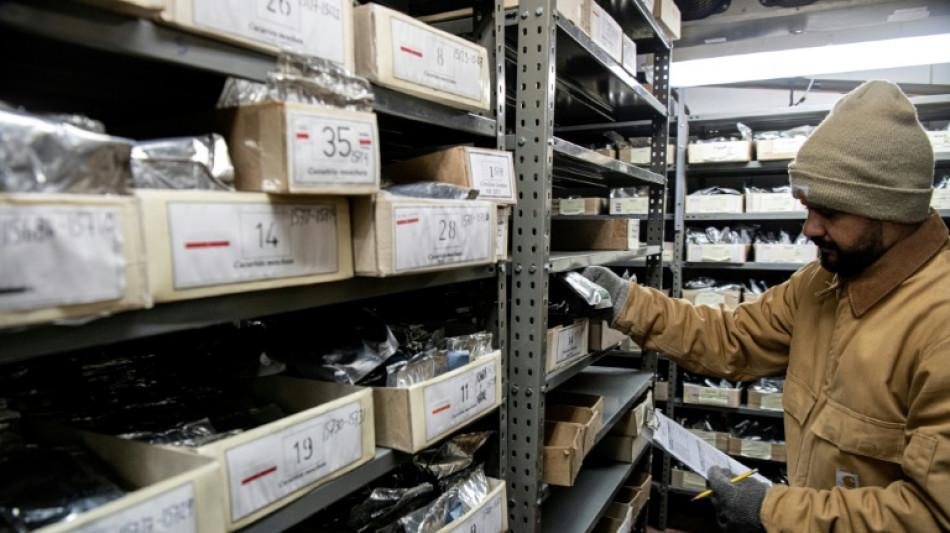
In Costa Rica, saving seeds to feed future generations / Photo: Ezequiel BECERRA - AFP

 Fiji declares national HIV crisis

 Australia to cut migration to fix housing crisis: minister
 NASA scan discovers new, 'once in a century' Moon crater

 Most stocks rise as Fed hikes and indicates drive to curb inflation
 US again denies Palestinian leader Abbas visa to attend UN assembly
 Lula says he will go to UN to tell Trump to 'stay out' of Brazil's elections

 Messi heads Inter Miami to Campeones Cup triumph

 AI looms large ahead of Xi, Trump summit

 Smith still haunted by 'Sandpapergate' as he prepares for South Africa Tests

 UK-Sudanese author pens book to give children 'African history of Africa'

 Boehly and Walter sell Chelsea stake to Clearlake Capital

 US House backs data center power cost bill amid midterm backlash
 US Congress passes sweeping Russia sanctions bill

 Barca hit Racing for seven as Atletico crush Osasuna

 US Fed raises rates to tackle 'too high' inflation, irking Trump

 Man Utd misery mounts after League Cup collapse against Brighton

 Turkey releases 106 protesters, jails more LGBTQ activists

 US Fed raises rates to tackle 'too high' inflation in move sure to rile Trump

 England were 'waiting for death' in World Cup semi-final defeat: Tuchel

 NFL star fined for displaying name of slain Palestinian girl
 Witsel retires from internationals after 18-year Belgium career

 US Fed raises rates to battle inflation in move likely to rile Trump

 Fitzpatrick 'not comfortable' over Dubai golf finale

 Gaza apartment block collapse kills 21, including 12 children
 Gaza apartment block collapse leaves 21 dead

In the tropical mountains of Costa Rica, scientists guard a treasure trove of seeds collected over decades as a bulwark against food insecurity and climate change.
Some 6,200 samples from 125 species of squash, chilli, tomato and other edible plants are held at the Tropical Agricultural Research and Higher Education Center (CATIE) near the town of Turrialba.
In temperatures as low as minus 20 degrees Celsius, the seeds can be kept for up to 40 years for purposes of research, genetic engineering of plants more resistant to pests, diseases or changing weather, or to replace species that die out.
The bank "is a resource we have for use now or in the future," plant geneticist William Solano told AFP at the facility some 60 km east of the capital San Jose.
It holds seeds from 57 countries, he said, but about 90 percent are from the Central American region, collected from markets and farms or growing wild.
The CATIE stockpile, stacked on shelves in hundreds of small, silver envelopes, includes the second-largest collection of squash family seeds in the world.
Many of the seeds are not present in banks anywhere else in the world, according to the center.
- 'Genetic archive' -
"In response to climate change, we have here important materials for food security that are locally adapted" to a variety of climate conditions, ranging from humidity to extreme drought, Solano told AFP.
As ever-more extreme weather threatens food production, traditional, native seeds are essential to "give sustainability to agri-food systems," he added.
According to seed expert Ester Vargas of the University of Costa Rica, "there is variability in native seeds that gives them the ability to adapt to different conditions" in the areas of their origin.
Seed banks like the one at CATIE serve to guarantee an availability of "crops with high nutritional value" for generations to come, she added.
The UN's Food and Agriculture Organization (FAO) estimates that almost one in ten people in the world suffered hunger in 2022 -- some 735 million in total -- with increases in parts of Africa, western Asia and the Caribbean.
The FAO says seed banks help preserve "the most adapted varieties" for a given region.
"As climate change has a significant impact on agricultural production, growing local varieties, which have a high degree of genetic diversity, is highly important because these varieties have the ability to better withstand and adapt to environmental stresses and changes," a document on the organization's website states.
CATIE agronomist Daniel Fernandez said the bank also served another purpose: as a "genetic archive" of species that were replaced by more modified crops and that one day may need to be brought back.
S.Barghouti--SF-PST