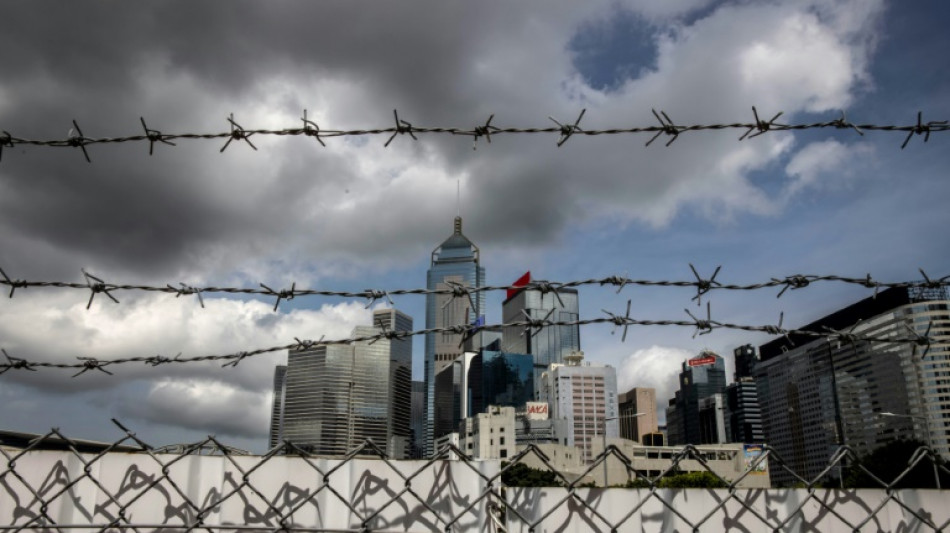
Sedition clampdown hits 'ordinary' Hong Kongers / Photo: Isaac LAWRENCE - AFP

 Where the US-China tariff row stands ahead of White House summit

 Croc-habitat gets green light for 2032 Olympic rowing

 Indonesia cash-for-photos scheme turns animal hunters into protectors
 'Left-field' life: Briton becomes Thailand's top foreign monk

 India's transgender amendment leaves many in limbo

 Trump to host Xi amid pomp, low expectations

 Harry set for UK public outings with security, royal status hazy

 NFL Chiefs' Kelce among investors bilked in Ponzi scheme

 Trump threatens EU over 'hostile' Canada association plan

 Argentine judge orders suspension of Falklands oil project

 Carrick takes the blame as troubled Man Utd suffer League Cup misery

 Barcelona hit seven in Racing Santander rout

 Amorim's Milan beaten by Benfica, Sunderland make dream European return

 US stocks fall, dollar gains after Fed lifts interest rates

 Seahawks rule out Darnold for Sunday game at Arizona

 Mbappe explains Ceuta shirt stance after criticism

 Improving Atletico cruise to comfortable win over Osasuna

 Candidate for UN chief calls for AI regulation akin to nuclear weapons

 O'Neill expects Celtic recovery after Old Firm misery

 Man City midfield trio backed to emulate Rodri and Silva

 'We're losing control,' AI pioneer Yoshua Bengio tells AFP

 WHO eyes 'encouraging' signs in DRCongo fight against Ebola

 Liga boss criticises Real Madrid trio for Ceuta shirt incident

 WTA Finals moved to Charlotte from 2027

 Almost 8,000 excess deaths in France's scorched summer: statistics

Single mother Law Oi-wah pled guilty to sedition in an almost inaudible voice, as her 12-year-old son watched from a few feet away in a Hong Kong court.
Arrested in March, the 48-year-old was accused under a colonial-era law for sharing dozens of pro-democracy social media posts authored by others, and then denied bail.
But Law is not an activist, and her posts received sparse reactions.
"My mother has been away for a month... Please let my mother come home," Law's son wrote to the court, which sentenced her in April to four months in jail.
Her prosecution is one in a string of sedition convictions in the city, where critics say Beijing is tightening its authoritarian grip.
After massive and at times violent pro-democracy protests in 2019, and Beijing's subsequently imposed national security law, Hong Kong has used the sedition offence -- created under British colonial rule -- to charge residents for the first time in over 50 years.
From service industry workers to delivery staff, at least 20 of the more than 30 peoplecharged with sedition have not been activists nor politicians.
Their cases receive little public attention as they are swiftly convicted as national security threats by the city's lowest-level courts.
Their "seditious" acts have mostly involved criticising authorities -- the government, police and courts -- through posters, stickers or on social media platforms.
The trials are also handled by judges picked by the government to rule on security cases, and bail for defendants has become the exception, not the norm.
Prominent activists and journalists charged with sedition have put up high-profile legal defences, but most residents accused of the crime choose not to fight after they are denied bail, due to the perceived slim chance of success, former defendants and lawyers told AFP.
- Plead for quicker exit -
Kenji, who requested a pseudonym to avoid reprisals, said his will to fight his sedition case collapsed after he spent five months in pre-trial detention.
"When you are inside... you would spend all day thinking whether the prosecution would add an actual national security charge on you," he told AFP.
"Although you might find it very unfair, you would offer a guilty plea in exchange for a quicker exit," said Kenji, who was arrested for publicly criticising officials.
Sedition carries a penalty of up to two years in prison, but a guilty plea can reduce the sentence by a third.
Of the 18 sedition defendants convicted at the magistrate level, more than 80 percent pled guilty within three months -- triple the rate of all cases handled in 2022.
On average, they were sentenced to about 200 days in prison, according to an AFP tally.
The city's security minister, Chris Tang, has said the sedition charge remains a necessary tool to plug gaps in the national security law.
"Some other existing laws... such as sedition can handle some situations for now," Tang told broadcaster RTHK in April.
The law covers acts, speech or publications deemed to have any "seditious intentions", which include raising "discontent or disaffection", promoting "feelings of ill-will" and inciting violence.
The United Nations Human Rights Committee has said it is concerned about the "overly broad interpretation and arbitrary application" of both the sedition and security laws -- warning against using them to suppress dissent.
Senior officials say the laws are clear.
- 'Wide and mysterious' -
But Kim Hau, whose tea shop was raided by police last February when she was arrested for sedition, said the offence remains "wide and mysterious" to her.
Hau had posted flyers questioning the city's Covid vaccination scheme and urged people to boycott a government location-tracking anti-pandemic app.
During the raid, her phone was confiscated, and she was later sentenced to seven months in jail, with judge Peter Law saying she and a co-defendant were "venting the hatred in their heart".
"They define something as seditious when they feel you are urging people to directly or indirectly act against the government," she told AFP.
One lawyer working on sedition cases agreed the offence has a "lack of legal certainty".
"Such ambiguity is something they want," the lawyer, who requested anonymity, told AFP. "It's just enough to scare off the ordinary."
The burden of proof is also placed on defendants, they said, explaining that taking a stand to "clarify their intention" is not something the average resident would do.
"Meanwhile, it's rather easy for the prosecution to deduce the intention backwards with their own interpretation of certain words said by the accused."
- 'The red line' -
Homemaker Chiu Mei-ying, 68, found herself in the crosshairs of authorities when she was charged last April with saying "seditious words".
"All I did was utter one sentence," she told AFP.
Three months earlier, Chiu and preacher Garry Pang had attended an activist's conviction hearing and verbally criticised the magistrate judge.
The trial ended up costing her over HK$300,000 ($38,400).
Chiu eventually gave up on her appeal and served out her three-month sentence so that she wouldn't have to report to the police three times a week -- a bail condition stipulated for her appeal process.
After all that, "I still don't understand what sedition is about," she said.
"I have only learned that the red line can be very wide."
A.Suleiman--SF-PST