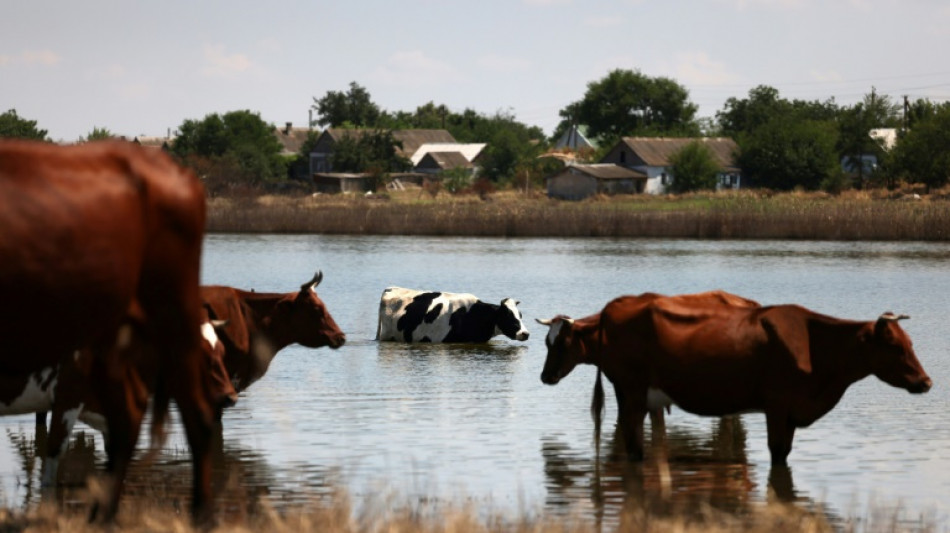
Devastation reigns one month on from Ukraine dam flood / Photo: Anatolii Stepanov - AFP

 US House backs data center power cost bill amid midterm backlash
 US Congress passes sweeping Russia sanctions bill

 Barca hit Racing for seven as Atletico crush Osasuna

 US Fed raises rates to tackle 'too high' inflation, irking Trump

 Man Utd misery mounts after League Cup collapse against Brighton

 Turkey releases 106 protesters, jails more LGBTQ activists

 US Fed raises rates to tackle 'too high' inflation in move sure to rile Trump

 England were 'waiting for death' in World Cup semi-final defeat: Tuchel

 NFL star fined for displaying name of slain Palestinian girl

 Witsel retires from internationals after 18-year Belgium career

 US Fed raises rates to battle inflation in move likely to rile Trump

 Fitzpatrick 'not comfortable' over Dubai golf finale

 Gaza apartment block collapse kills 21, including 12 children

 Gaza apartment block collapse leaves 21 dead

 US House targets data centers as midterm backlash grows

 French ex-minister Dati goes on trial in Renault-Nissan corruption case

 'Being Heumann' captures joy in fight for disability rights

 Retired great Nadal to play in exhibition matches

 IR-MED and Dice Technologies Announce collaboration to Evaluate and Advance Pressure-Injury Prevention Platform in Japan

 Watts, Pitt, Cruz to light up Spain's top film festival

 Sweden expels Iran embassy employee over anti-Jewish threats
 Toogood Gold's Table Mountain Sits in the Shadow of a Nevada Gold Rush

 MEXC July–August Security Report: 38.66M USDT in Risk Funds Intercepted, Futures Insurance Fund Hits 792M USDT

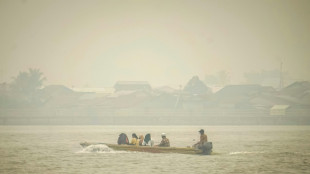 'Breathing toxin every day': Indonesians choked by haze feel helpless

 Stocks edge higher ahead of US Fed rate call

Clothes, sofas and kitchen furniture still lie strewn around Nadiya Yefremova's garden a month after her home was flooded by the destruction of the Kakhovka dam in southern Ukraine.
"I've already removed and cleaned a lot of things. Every day, I have to dry things," the 86-year-old told AFP, looking weary under the hot sun.
In a green dress with a hearts pattern and with a kerchief on her head, she walked hesitantly around her garden.
Yefremova lives in Afanasiyivka, a small village surrounded by the Ingulets River, which flows into the much bigger Dnipro River near the city of Kherson.
Her home was one of thousands flooded when a blast destroyed the Kakhovka dam upstream in the early hours of June 6.
The flooding caused dozens of deaths, including some rescuers and evacuees killed by Russian shelling in the frontline area.
Moscow and Kyiv deny responsibility for the disaster but the dam is controlled by Russia and the Ukrainian army believes the aim was to halt a counteroffensive.
The mass of water that flooded the Dnipro River also raised up the Ingulets, overwhelming many villages including Afanasiyivka, which became an island.
"There was water up to here," Yefremova said, showing the level on the wall.
"The authorities don't help. They say 'do everything yourself'," she said.
Her neighbours helped clean up her home.
- Unusable fields -
The river only returned to normals level two weeks ago.
The ground from which the water receded is now a dark brown colour made up of dead grass, destroyed crops and mud.
Sergiy Yablonsky, 40, a local farmer, said he had lost 40 hectares of barley.
"When the Kakhovka dam burst, we came here with a combine harvester to at least mow enough to feed the animals, the pigs," said the farmer, standing shirtless in front of his devastated fields in Novosofiivka.
But "the water started rising very fast and we had to abandon the combine in the water" before eventually recovering it.
"We have to wait two years" before the field can be used again, he said.
Yablonsky farms a total of 1,200 hectares, mainly sunflowers and wheat, in the key region for agriculture -- Ukraine's biggest industry which has already suffered from the ravages of war.
Wheat is being harvested in one of the fields. The combine harvesters chew up the golden ears in a cloud of dust.
When Russian forces occupied the region from March to November "the business ceased to be profitable", he said.
"Half the harvest wasn't gathered, 100 hectares burnt... They (Russian forces) did what they wanted," the farmer said.
- 'It's all gone' -
In Novosofiivka, Lyubov Osadcha, 70, and her husband Petro, 74, are still unable to live in their house which was flooded and have to rent a flat in the village.
"The sofas are broken, the clothes are mouldy, nothing is usable any more," Petro said, as he wandered around their still-damp house.
The pensioners also lost potatoes, onions, cucumbers, tomatoes, strawberries and raspberries they grew in their large garden on the banks of the Ingulets.
"We had everything. Now look, it's all rotten," said the husband, digging out a small potato.
"It's all gone, all gone.... And the garden, everything," his wife said with a trembling voice.
Ivan Kukhta, head of the military administration in Snigurivka, a nearby town of 12,000 inhabitants before the war, said the flooding damaged 375 homes and destroyed 2,5000 hectares of land in 13 places along the Ingulets River.
The main ongoing difficulty is access to drinking water.
"Many wells were flooded and nitrates from the fields got into the water and poisoned it," he said.
Humanitarian organisations travel around the villages providing drinking water.
"The consequences are major and we will be managing them for a long time to come," he said.
B.AbuZeid--SF-PST