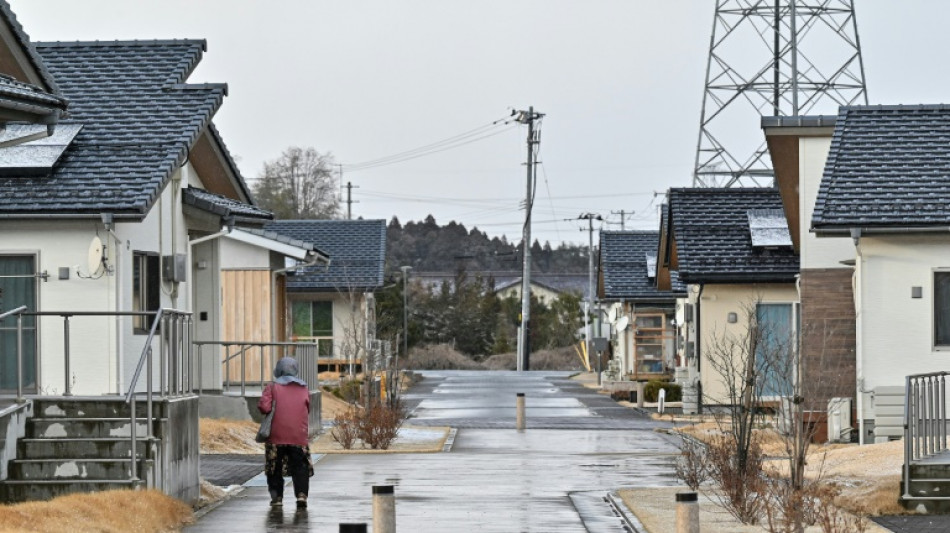
IAEA endorses Japan plan to release treated Fukushima water / Photo: Richard A. Brooks - AFP

 US House backs data center power cost bill amid midterm backlash
 US Congress passes sweeping Russia sanctions bill

 Barca hit Racing for seven as Atletico crush Osasuna

 US Fed raises rates to tackle 'too high' inflation, irking Trump

 Man Utd misery mounts after League Cup collapse against Brighton
 Turkey releases 106 protesters, jails more LGBTQ activists

 US Fed raises rates to tackle 'too high' inflation in move sure to rile Trump

 England were 'waiting for death' in World Cup semi-final defeat: Tuchel

 NFL star fined for displaying name of slain Palestinian girl
 Witsel retires from internationals after 18-year Belgium career

 US Fed raises rates to battle inflation in move likely to rile Trump

 Fitzpatrick 'not comfortable' over Dubai golf finale

 Gaza apartment block collapse kills 21, including 12 children
 Gaza apartment block collapse leaves 21 dead

 US House targets data centers as midterm backlash grows

 French ex-minister Dati goes on trial in Renault-Nissan corruption case
 'Being Heumann' captures joy in fight for disability rights

 Retired great Nadal to play in exhibition matches

 IR-MED and Dice Technologies Announce collaboration to Evaluate and Advance Pressure-Injury Prevention Platform in Japan
 Watts, Pitt, Cruz to light up Spain's top film festival
 Sweden expels Iran embassy employee over anti-Jewish threats
 Toogood Gold's Table Mountain Sits in the Shadow of a Nevada Gold Rush

 MEXC July–August Security Report: 38.66M USDT in Risk Funds Intercepted, Futures Insurance Fund Hits 792M USDT

 'Breathing toxin every day': Indonesians choked by haze feel helpless

 Stocks edge higher ahead of US Fed rate call

Japan's plan to release treated water from the Fukushima nuclear plant into the sea meets international standards and will have a "negligible radiological impact", the UN nuclear watchdog said Tuesday.
The assessment, delivered in a final review by the International Atomic Energy Agency, comes as its chief visits Japan before the expected water release begins this summer.
Tokyo's plan to dilute the treated water and release it into the sea over several decades is "consistent with relevant international safety standards", the IAEA said.
"The controlled, gradual discharges of the treated water to the sea... would have a negligible radiological impact on people and the environment," it added.
Several of the Fukushima Daiichi plant's reactors went into meltdown after cooling systems were overwhelmed by a massive 2011 tsunami.
The resulting nuclear accident was the worst since Chernobyl, and the clean-up has lasted more than a decade, with most areas declared off-limits due to radiation now reopened.
Decommissioning the plant itself will take decades more, but the facility's operator TEPCO faces the immediate problem of more than 1.33 million cubic metres of water accumulated on the site.
The water is a mixture of groundwater, rain that seeps into the area, and water used for cooling.
It is processed through a facility that TEPCO says removes almost all radionuclides but tritium, which commonly remains in wastewater discharged into the sea by nuclear plants globally.
The proposal had already been provisionally endorsed by the IAEA, but the government said the release would only begin after the "comprehensive review" that IAEA chief Rafael Grossi presented on Tuesday.
"A review by IAEA, given how authoritative it is in the management and application of nuclear safety standards, is critical to our efforts to foster international understanding," top government spokesman Hirokazu Matsuno said Tuesday.
Still, the release remains controversial, with China vocally criticising the plans, and some in South Korea panic-buying salt over fears of contamination after the discharge begins.
Fishing communities in Fukushima are also worried customers will shun their catches, despite strict testing protocols for food from the region.
Speaking after talks with Japan's prime minister and foreign minister, Grossi said the IAEA had spent two years reviewing the release plan, including testing water at its labs and sending samples to independent facilities.
"This process of dilution and chemical and other filtration is nothing new. It's something that exists in the industry," he added, pointing to similar releases by plants from China to France.
"We recognise that there are concerns," he said, pointing out that the IAEA will open a permanent office at the Fukushima site to continuously monitor the release process.
Japan has said the release will start this summer, without giving further details, and government spokesman Matsuno said that was still the plan.
"We will thoroughly explain and communicate, both domestically and internationally, details of the IAEA report, our effort to ensure safety and measures against reputational damage," he added.
I.Yassin--SF-PST