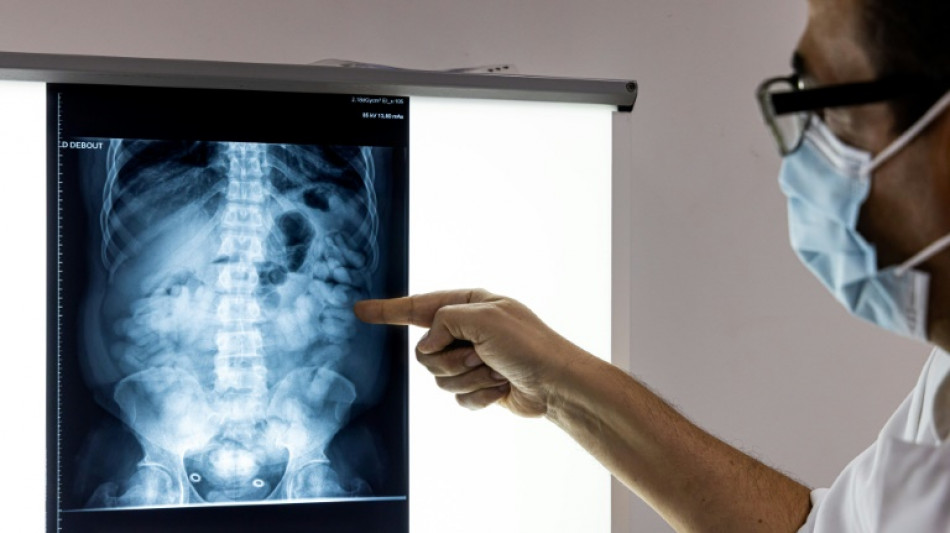
The drug mules carrying Europe's cocaine in their guts / Photo: jody amiet - AFP/File

 'Be careful what you wish for': 'Obsession' director and star reflect on success

 Messi scores but Miami held by Nashville
 US Open champ Rybakina on top of world after injury scare

 Rybakina reigns serene as new world number one

 South Africa defeat New Zealand 43-28 to complete 3-1 series victory
 Rybakina triumphs in US Open, denies Sabalenka three-peat

 Akron fan's honorary play-calling stint ends with opening-drive fumble

 Louisiana's developing roster faces USC as Trojans enter as heavy favorites

 Christa Pike seeks clemency before September 30 execution in Tennessee

 Utah hosts Arkansas as both programs begin seasons under new coaches

 Maryland groups seek statewide data center pause after local moratoriums spread

 Winston County trash-debt prosecutions face challenge from civil-rights lawyers
 Fifth Circuit upholds dismissal of Jackson residents' constitutional water claims

 Anthropic details Claude misuse as US targets major illicit online marketplace

 Japanese floating parking platform is designed to lift cars above floodwater

 Arteta blasts 'unacceptable' Sunderland penalty despite Arsenal win

 Mbappe at the double as Real Madrid sink Rayo

 Arsenal extend perfect Premier League start as Chelsea, Liverpool held

 US survive Spain scare to book World Cup final clash with France

 Celine Dion makes long-awaited return to stage in Paris
 Werro crowned Ultimate queen, US sweep 100m races

 Venezuelans outside Caracas say capital not sharing blackout burden

 Danish WWII drama wins top prize at Venice festival
 Chelsea boss Alonso yearns for 'boring game' after Hull make their point
 Werro outguns Hodgkinson to win women's 800m at Ultimate

More than a sixth of the cocaine consumed in France is smuggled inside the bodies of drug mules from its poverty-stricken South American region of Guiana.
Women -- some of them pregnant -- and even children are among those who risk their lives for a few thousands euros (dollars) by swallowing tightly wrapped packages of the drug, or hiding them in their body cavities.
"I had no other option. I needed the money," said 27-year-old Tonio, who -- weighed down with debt and with no work -- took a flight to Paris with 800 grams of "coke" in his stomach and hidden in his shoes.
Having got through the airport, he was caught in a train station and ended up in jail.
Thirty drug mules like him board every flight to France from Guiana's capital Cayenne, the authorities reckon. Traffickers -- who stand to make a 1,000 percent profit on the drugs that get through -- simply swamp the flights.
A kilogram (2.2 pounds) of cocaine bought for 4,500 euros ($4,835) in French Guiana, or 3,500 in neighbouring Suriname, can be sold to dealers in France for 35,000 euros, who then cut it and sell it on to their customers for three times that.
The mules get between 3,000 and 10,000 euros per trip, depending on how much they carry.
"It's not complicated, you just have to have the right contacts," said Tonio.
And there is no shortage of candidates.
Despite being home to Europe's Spaceport, Guiana is plagued by extreme poverty and unemployment, a legacy of its history as a slave society and prison colony -- the notorious Devil's Island is just off its coast.
Suriname, with which it shares a long jungle border that is almost impossible to police, is even poorer, with many of the drug mules illegal immigrants from the former Dutch colony.
- 'Narco region' -
Geography and poverty have made French Guiana "a narco region and one of the main hubs" of the cocaine trade, officials told AFP.
Within striking distance of the Colombian coca fields, between a fifth and a sixth of cocaine consumed in France is estimated to pass through this thinly-populated region of mostly Amazonian jungle sandwiched between Brazil and Suriname.
The centre of the mule operations is the town of Saint-Laurent on the wide, brown Maroni River which forms the border with Suriname for more than 500 kilometres (300 miles).
Without work or schooling -- the education system can't keep up with the town's growing population of migrants from Suriname -- many of its 50,000 inhabitants are tempted by the easy money to be made from smuggling cocaine.
Their perilous trips to mainland France usually start just opposite Saint-Laurent du Maroni in the small town of Albina on the Suriname side of the river.
It is there where many of the mules are loaded up with cocaine.
Every day hundreds of people from the French side cross the river in dugout canoes to shop in Albina, where food and petrol are cheaper.
The mules, like Julia and Lydia, return amid the shoppers.
"We knew the risks," said Julia, a young mother of two from Suriname who spent two years in French prisons after being caught.
"It is not a pleasure trip... but when you haven't a choice, what can you do?" she told AFP.
- Swallowing practice -
"You go to prison and then they (the traffickers) leave you alone. Me, I have paid my debt."
Both she and her friend Lydia (both names have been changed at their request) are descendants of African slaves brought to Suriname by the Dutch.
"I had an empty apartment and I wanted to furnish it," Lydia said in the local dialect, Taki-taki or Sranan, a mixture of French, English and Dutch. "The traffickers promised me 15,000 euros if I took over 3.5 kilos."
Lydia was arrested at the airport carrying 4.5 kilos of cocaine.
Some mules practice for the trip by swallowing small sausages, while others ease down the cocaine packages with oil, soft drinks or okra. All bung themselves up with anti-diarrhoea medicine.
Once they have swallowed their cache, most make the three-hour trip to the airport in Cayenne in the shared taxis that ply the route.
Only one road links the cities and the police are often waiting for them halfway in the stifling heat at Iracoubo.
"We made several seizures in September, twice after stopping people on the road, and got four kilos," a junior officer there told AFP.
Nearly half of those hauls had been swallowed.
The mules mostly travel in the midday heat a few hours before check-in for the Air France and Air Caraibes flights to mainland France.
"Once we have stopped three at Iracoubo... I cannot bring any more into custody," Lieutenant-Colonel Arnaud Amestoy, the head of the area's gendarmerie, admitted. "We need a lot more officers to be able to stem the flow."
- Scanners and sniffer dogs -
But checkpoints are only the first obstacle the mules have to get through. Police and customs officers await at the airport, with every passenger on a flight sometimes searched.
They caught 512 mules in 2021, seizing 1.26 tonnes of cocaine.
Often the officers only have a few minutes to single out suspects. On the day AFP spent with the border force at the airport, a police dog sniffed out two young men.
They were taken aside by officers and a urine test for cocaine came up positive for one of them. He was arrested and taken to a secure unit of Cayenne hospital for an X-ray.
If anything shows up, "we set off the 'pellet protocol'," said doctor Karim Hamiche, who heads the special secure ward.
"The person will stay until the pellets are expelled -- between 24 and 48 hours."
The cocaine packages are more solid than they once were, but there is still danger.
"In April a 37-year-old man died in hospital after falling in the street in Cayenne," said Hamiche.
"The post-mortem found more than a kilo of cocaine inside his body."
- High tension and tears -
Meanwhile, on the other side of the Atlantic, the 305 passengers on the daily Air Caraibes flight from Cayenne are getting off the aircraft at Orly, Paris' second airport.
A hesitant young man in a black jacket has attracted the customs officers' attention.
He's from Saint-Laurent du Maroni, and he has just turned 18.
After going to the toilet, his baggage is X-rayed. The tension rises and a few moments later the suspect cracks and pulls a "loaf" of cocaine weighing more than a kilo from his hood.
The youth bursts into tears and admits to having swallowed packages of cocaine and to having others hidden in his rectum.
First he said he was going to sell them himself, before finally confessing that someone was waiting for the cocaine in the airport. He had been promised 8,000 euros for the trip.
Before the Cayenne-Orly flights became their main route, the traffickers sent mules mostly from Suriname through Amsterdam's Schiphol Airport. But smuggling slowed when every passenger was made to pass through special scanners.
"As soon as we have a scanner here (at Cayenne airport), we'll quickly solve the problem. In three or four months it will be a deterrent," an official source told AFP.
France's interior minister has already signalled that a machine would be installed to scan everyone getting onto flights in Cayenne.
But many, like Cayenne lawyer Saphia Benhamida, who represents some of the mules, believe it would be better to tackle the root of the problem.
"You will always have poor people here so you will always have mules. You cannot check everyone at the airport. We are not going to change things by just having more police," she argued.
"If there were schools, work and proper transport in Saint-Laurent du Maroni," that would also help, Benhamida insisted.
T.Ibrahim--SF-PST