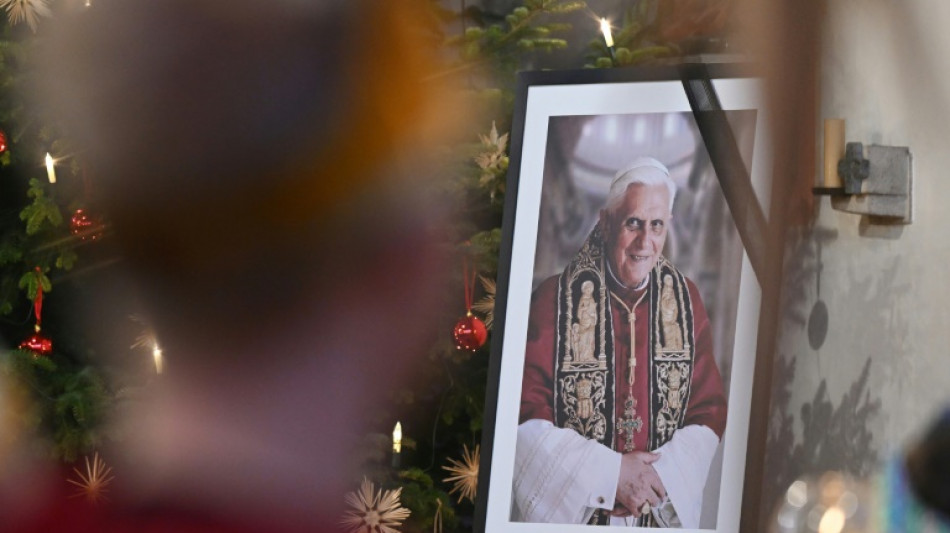
Popes through history: felled by illnesses and intrigues / Photo: KERSTIN JOENSSON - AFP

 Arteta blasts 'unacceptable' Sunderland penalty despite Arsenal win
 Mbappe at the double as Real Madrid sink Rayo
 Arsenal extend perfect Premier League start as Chelsea, Liverpool held
 US survive Spain scare to book World Cup final clash with France
 Celine Dion makes long-awaited return to stage in Paris
 Werro crowned Ultimate queen, US sweep 100m races
 Venezuelans outside Caracas say capital not sharing blackout burden
 Danish WWII drama wins top prize at Venice festival
 Chelsea boss Alonso yearns for 'boring game' after Hull make their point
 Werro outguns Hodgkinson to win women's 800m at Ultimate

 Moreira leads AC Milan fightback in Lazio draw
 Chelsea boss Alonso for yearns for 'boring game' after Hull make their point
 'Tired' Liverpool must adapt to schedule, says Iraola
 Stunning US fightback sets up Solheim Cup singles showdown

 Monaco's perfect Ligue 1 start ends with Strasbourg draw
 Ukraine's economy hobbled by Russian strikes

 France sink Germany to reach first women's basketball World Cup final
 Hull hold Chelsea, Liverpool fail to beat Fulham in Premier League
 Nmecha and Silva keep Dortmund perfect in Bundesliga

 Norris snatches thrilling Spanish GP pole from Antonelli

 'Great to have a race at home': Fans celebrate F1's Madrid return
 French IT giant Capgemini sells subsidiary after row over ICE links
 Thousands rally in Kosovo ahead of ex-leader's war crimes verdict
 Zelensky ready to meet Putin at G20 in Miami
 Gaza film, 'irreverent' Malkovich drama vie for Venice top prize
The peaceful death of Benedict XVI in a monastery in the Vatican contrasts with the painful, violent or sometimes mysterious deaths of many of his predecessors.
Here are some striking examples:
- John Paul II's long ordeal -
Benedict's predecessor, John Paul II, died on April 2, 2005 in the Vatican aged 84, after a long illness that turned the end of his 26 years at the helm of the Catholic Church into an ordeal.
After two successive hospitalisations and a tracheotomy in February 2005, John Paul II's condition had worsened abruptly a few days before his death, following a urinary infection, sepsis and cardiac arrest.
He mostly lost his speech after the tracheotomy and managed to utter a few words in public on March 13, before returning to the Vatican. He later remained silent.
On his last Good Friday, he was filmed from behind in his apartments so that the faithful could see him following the Way of the Cross via video.
The one-time sportsman's pontificate was marked by a slew of health issues.
He was weakened by Parkinson's disease and by the after-effects of injuries sustained in the attempted assassination carried out by Turkish extremist Mehmet Ali Agca on May 13, 1981 in Saint Peter's Square.
He also battled cancer in the intestine and two fractures, one in the shoulder and one in the femur.
- Sudden death of John Paul I -
His predecessor, John Paul I, nicknamed "the good pope" or "the smiling pope", was one of the most ephemeral popes in history.
Elected in August 1978 at the age of 65, he died 33 days and six hours later, apparently from a heart attack, although no autopsy was carried out to confirm the causes of his death.
Books have speculated that the pope might have been assassinated because he wanted to put the church's affairs in order, particularly the financial embezzlement of Monsignor Paul Marcinkus.
Marcinkus, the then-head of the Vatican bank, was suspected at the time of links with the mafia.
No official inquiry has confirmed the suspicions.
- The mysterious death of Alexander VI Borgia in 1503 -
The death of Alexander VI, who was pope from 1492 to 1503, was also subject to intense speculation.
On August 6, 1503, after a dinner with his son Cesare at a cardinal's house, both went down with a fever.
A first theory attributed the illness to malaria, which was prevalent in Rome at the time.
The other hypothesis was that the pope would have wanted to get rid of some of his enemies and would have himself poisoned the wine, inadvertently falling into his own trap.
Johann Burchard, a close associate of the pope who was present at his death, said: "His body swelled so much that we couldn't put it in the coffin we were meant for him. He was temporarily rolled into a carpet while his apartments were looted."
- Formosa, exhumed for trial in 897 -
Known as the "corpse council", the posthumous trial of Pope Formosa (891-896) is testament to the chaos that prevailed in the ninth century in Rome and the Vatican.
In 897, on the orders of Pope Etienne IV, a sworn enemy of Formosa, his corpse was exhumed, clad in papal ceremonial clothing and sat on a throne to be judged.
The verdict said the deceased was not worthy of the pontificate.
All his actions were annulled and orders issued by him were declared invalid.
Papal ceremonial clothes were ripped from his body, the three fingers of his right hand that the pope had employed in consecrations were cut off and the corpse thrown into the Tiber.
- A hammer blow to confirm the death -
Vatican protocols state in precise detail the procedure that must be followed on the death of a pope, with a senior cardinal known as a "camerlengo" ("chamberlain") given charge of day-to-day affairs until a new pontiff is elected.
Traditionally, his main role has been to certify the death, once done by tapping the pontiff's forehead three times with a special silver hammer and calling out his birth name.
The tradition fell into disuse after the death of John XXIII in 1963.
Z.AbuSaud--SF-PST