'The dead keep coming': violence overwhelms Mexico's morgues / Photo: CLAUDIO CRUZ - AFP

 Marquez snatches San Marino MotoGP sprint ahead of Bezzecchi
 Philippine ferry fire death toll climbs to 76 as identification process begins

 BRICS nations urge 'maximum restraint' in Middle East war

 Zelensky open to meeting Putin at G20 in Miami

 England survive scare to seal 3-0 sweep against Pakistan

 Trump says Irish unification would be 'fantastic'

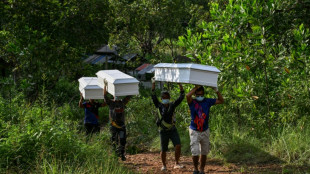 Bodies of Philippines ferry fire victims brought ashore as toll hits 35

 Flick warns Barca stars to keep focus after perfect start

 Trump in Ireland for golf tournament, diplomatic pleasantries

 French police suspect train derailment was sabotage

 Trump lands in Ireland for golf tournament, PM talks

 Xi lands in India for BRICS summit overshadowed by war

 From crime to the Arctic: ultramarathoner film debuts in Toronto

 Back to the drawing board for disappointed Tiafoe

 Lady Gaga welcomes first child with fiance: US media

 Shelton tops Tiafoe to book US Open title clash with Zverev

 Shelton powers past Tiafoe to book US Open title clash with Zverev

 Venice Film Festival: A look back on the highlights

 'Widow's Bay' and 'The Pitt' are favorites for Emmys night

 'Everything different' as Zverev returns to US Open final

 Top seed Zverev holds off Khachanov to reach US Open final

 James McAvoy brings new film 'Faith' to Toronto fest

 Faultless Duplantis, hungry Ingebrigtsen shine at inaugural Ultimate

 Roblox to launch wallet to pay creators faster and will allow off-platform gaming

 Springboks wary of new-look All Blacks in Baltimore test

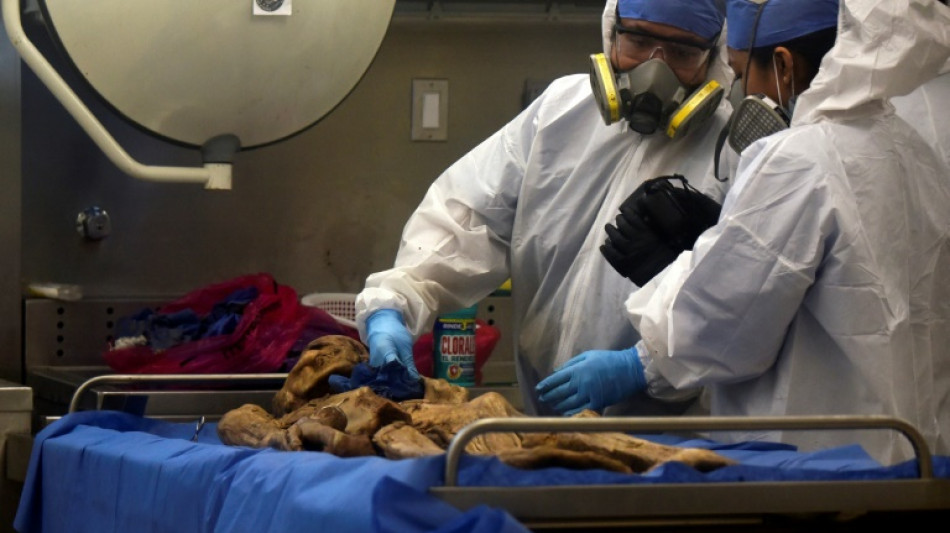
In a dark, windowless room with no air conditioning in southern Mexico, thousands of bones of unidentified people encapsulate the crisis of a forensic system overwhelmed by violent crime.
The morgue in Chilpancingo in Guerrero state is full of anonymous human remains -- like many others in a country struggling to process a backlog of tens of thousands of bodies.
"The dead keep coming and people keep disappearing," said Nuvia Maestro, 36, a forensic anthropologist in Mexico City.
On social media, Maestro declares her love for her cat Clementina -- her "ray of light" -- as well as cycling, wine and colorful jackets.
At work, the 36-year-old uses two electric cooktops that she and her colleagues bought themselves to boil ribs to remove tissue and carry out tests to determine the age of the deceased.
"You work and work and you don't finish!" she said.
At the Chilpancingo morgue, incense burned by employees failed to mask the stench of death -- or keep the flies away.
A forensic service worker browsed handwritten records of the remains, giving a shrug of the shoulders when asked why they are not digitized to facilitate relatives' search for the missing.
The DNA studies "can take months," frustrating families desperate to find their missing loved ones, said forensic service coordinator Alfonso Ramirez.
- Spiraling violence -
Mexico's homicide rate has tripled since 2006 -- when an intensification of the government's war on drug cartels triggered a spiral of violence -- from 9.6 murders per 100,000 inhabitants to 28 in 2021.
The number of people going missing has also increased sharply, from 265 in 2006 to 10,366 in 2021, and now totals 108,000 since records began in 1964.
Many victims are thought to have been buried by the authorities without being unidentified. The government blames most of the deaths on gang violence.
Experts say the forensic crisis is also explained by the lack of funds, personnel, rapid DNA testing laboratories and a single genetic database.
The United Nations Committee on Enforced Disappearances estimates that, under current conditions, it would take 120 years to process the 52,000 unidentified bodies documented by the Movement for Our Disappeared, a non-governmental organization.
Mexican authorities "do not have the institutional capacity to deal with the backlog" of unidentified bodies, Alejandro Encinas, a deputy minister responsible for human rights, said in October.
Adding to the work of the forensic services, some criminals burn their victims' corpses or bury them in clandestine graves.
The killers know which body parts are most useful for identification, such as fingertips, and destroy them, said Maestro, noting that the most abused corpses are those of women.
Regional forensic services budgets rose from $110 million in 2015 to $122 million in 2020, according to official data.
Over the same period, the average number of murders jumped from around 17 to 28 per 100,000 people.
- 'Ugly things' -
Guadalupe Camarena, 62, cried clutching photos of her five missing children during an exhumation of remains at a graveyard in the western state of Jalisco.
Her daughter disappeared in the city of Guadalajara in 2016, followed by her four sons who vanished in 2019, allegedly after they were detained by police, the domestic worker said.
She hopes that giving a DNA sample will help her search for her five missing children.
"I don't want to find them (dead) like this, but if I can't find them alive..." she said, trailing off.
The psychological impact of the situation forces experts such as Dalia Miranda, a municipal coordinator of exhumations in Jalisco, to undergo therapy.
Forensic workers encounter "very ugly things," she said.
It takes up to six months to compare DNA samples from remains with those of relatives of the missing, according to Alfonso Partida, a university researcher in Guadalajara, whose morgue, he said, contains "tons" of remains.
The government has taken steps such as the creation of two centers for identification and four to store corpses.
It is also working to establish a national identification center and a genetics laboratory to which the United States will contribute four million dollars.
But the attorney general's office has yet to create a national forensic data bank stipulated by law.
In the meantime, Camarena visits the Guadalajara morgue every week to study pictures of the dead in her search for her children -- a routine that she copes with using antidepressants.
G.AbuOdeh--SF-PST