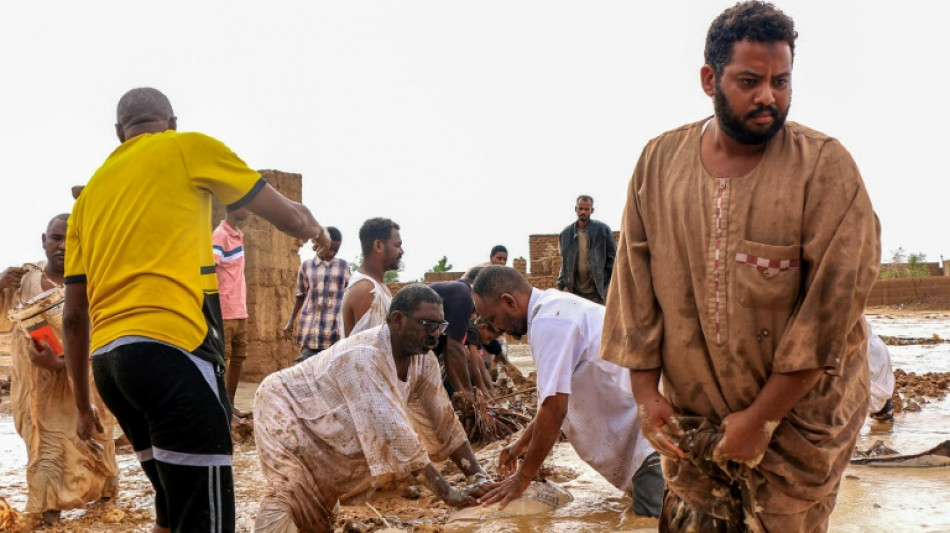
Climate change worsened deadly Africa floods, scientists say / Photo: - - AFP

 Kyiv's defences, 'hybrid' threat from Moscow headline EU talks
 Oil extends gains, stocks mostly down as Trump issues fresh Iran warning

 ThinkMarkets Expands Weekend Trading Offering, Launches Weekend League Competition

 Tibet activists accuse China of downplaying floods
 Afghanistan war victims left 'without justice', UN says

 Iran president offers US olive branch before Putin meeting

 China-Nepal flood toll tops 1,000 as tunnel rescue offers last hope

 Japan to relax overtime regulation under workaholic PM
 Thwarted Niger mutiny exposes junta's Russia dependence

 Illegal mining ravages S.Africa's economic hub

 Nepal's wall of missing offers last hope after Himalayan flood

 US to press G20 on light-touch AI regulation

 2 die in Grand Canyon flash flood, only 1 person unaccounted for

 US Army Secretary Driscoll submits resignation: White House
 Oil extends gains, stocks drop as Trump issues fresh Iran warning

 Tsitsipas says Kyrgios's positive cocaine test 'kind of expected'

 In Japan's mountains, a different way to manage bears

 Middle East war a boon for UAE defence giant with global ambitions

 Former gang member found guilty of murdering Tupac Shakur

 Top-seeded Zverev opens US Open campaign
 US regulator, 22 states accuse Amazon of 'manipulating' ad auctions: lawsuit

 TRON Founder Justin Sun Shares Outlook on Bitcoin, Stablecoins and Global Finance at Bitcoin Asia 2026

 Tributes to 'eternal' Messi on Argentina retirement

 Arteta hails Arsenal's 'finishers' after Saka kills off Villa

 Yamal, Raphinha bag braces as Barcelona rout Rayo

Human-caused climate change worsened floods that have killed hundreds of people and displaced millions in Cameroon, Chad, Niger, Nigeria and Sudan this year, according to a study published on Wednesday.
The intense rainy season has unleashed a humanitarian crisis across large areas of the Sahel region bordering the Sahara desert.
A new analysis by the World Weather Attribution (WWA) network of scientists found warming driven by the use of fossil fuels had exacerbated the flooding in Sudan.
The researchers also said climate change would have made this year's torrential rains around five to 20 percent more intense across the Niger and Lake Chad basins, citing a previous WWA study of similar floods in 2022.
"This is only going to keep getting worse if we keep burning fossil fuels," said Clair Barnes from the Centre for Environmental Policy at Imperial College London.
Speaking at a briefing ahead of the study's publication, she said such downpours "could happen every year" if global temperatures increase to two degrees Celsius (35.6 Fahrenheit) above pre-industrial levels.
"It's pretty serious," she said.
- Downpours and storms -
Global warming is not just about rising temperatures -- the extra heat trapped in the atmosphere and seas has knock-on effects and can result in more intense downpours and storms.
The researchers said there was a clear link between the extreme rainfall and a warming planet.
In the study, they focused on war-torn Sudan, where millions of displaced people have been uprooted by conflict and driven into flood-prone areas.
The scientists used modelling to compare weather patterns in our world and one without human-induced warming, and found that month-long spells of intense rainfall in parts of Sudan had become heavier and more likely due to climate change.
At the current 1.3 degrees Celsius of warming, they said similar periods of rainfall are expected to occur on average about once every three years, and have become about 10 percent heavier due to climate change.
- 'Incredibly concerning' -
"These results are incredibly concerning," said Izidine Pinto, one of the study's authors and a researcher at the Royal Netherlands Meteorological Institute.
He warned that "with every fraction of a degree of warming, the risk of extreme floods will keep increasing", and called for the UN's COP29 climate summit to "accelerate the transition away from fossil fuels" when it meets in Azerbaijan next month.
Joyce Kimutai, a researcher at Imperial's Centre for Environmental Policy, said the floods underscored the need for a loss and damage fund for nations devastated by climate change.
A key meeting ahead of COP29 earlier this month ended with countries making little progress over how to finance a deal for poorer nations.
"Africa has contributed a tiny amount of carbon emissions globally, but is being hit the hardest by extreme weather," Kimutai said.
The role of climate change in the floods was compounded by other human-made problems, the researchers said, and they called for better maintenance of dams and investment in early warning systems.
H.Darwish--SF-PST