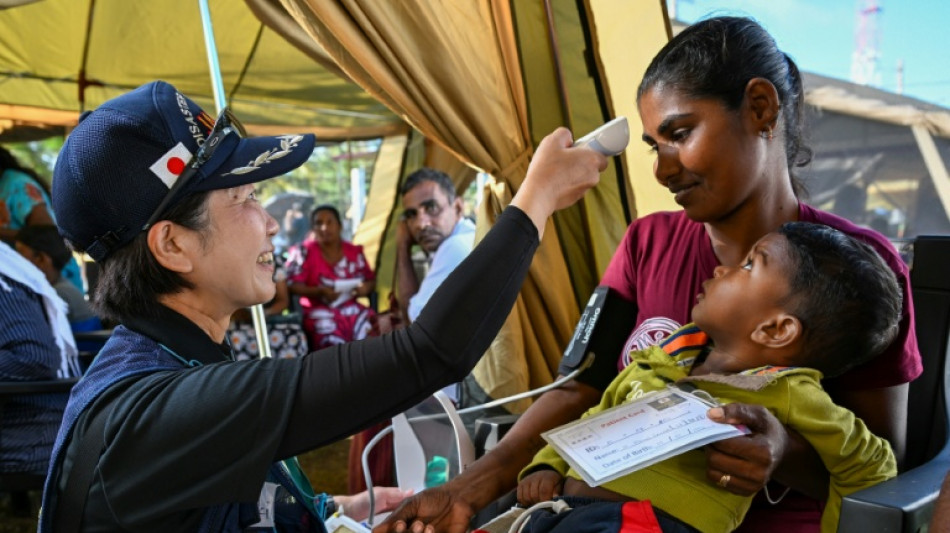
Anguished Sri Lankans queue for care after deadly cyclone / Photo: Ishara S. KODIKARA - AFP

 Trump says US reviewing position on Falkland Islands

 Saka strikes as flawless Arsenal punish troubled Villa

 Oil prices surge on renewed fighting in US-Iran war

 Cycling superstar Pogacar has surgery after Vuelta crash
 Man City agree deal for Everton's Ndiaye
 Apple CEO Tim Cook gives nod to founder Steve Jobs in final memo

 Russian finance minister makes unexpected appearance at G20

 Happy to be back in NY, Sabalenka advances
 Naomi Watts to receive lifetime award at top Spain film fest

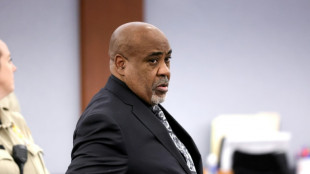 Jury hears closing arguments in Tupac Shakur murder trial
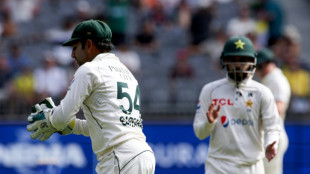 Pakistan sack coach, send seven players home after England defeats

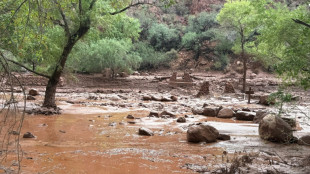 New storms threaten Grand Canyon flood search, 2 bodies recovered

 France takes aim at ultra-fast fashion with new levy

 Tribunal says India cannot withdraw from water treaty with Pakistan

 John Galliano pulls US exhibition after antisemitism backlash

 French Top 14 boss offers 'no guarantees' for first Club World Cup
 Munoz reunites with Glasner after joining Forest from Palace

 Liverpool sign Barcola from PSG for £124 million

 Putin, Xi hold talks in Kyrgyzstan as regional summit begins

 ChatGPT becomes first AI chatbot to face tougher EU rules

 Man City sign Palmeiras winger Allan on five-year deal

 More flooding feared at Grand Canyon after storm leaves 15 missing

 RedHill Divests Talicia® to Apotex for $18 Million Cash Upfront Plus Milestones to Fuel Strategic Growth Opportunities

 MEXC Data: BTC Breaks $80,000, Major-Asset Spot Trading Volume Surges 300%
 سفارة فلسطين في عُمان تنظم ندوة لتعزيز الاستثمارات والفرص الاقتصادية
Long before dawn, people were already queueing for medical aid on Tuesday at an emergency camp in Sri Lanka's coastal town of Chilaw, hit hard by a deadly cyclone and floods.
Carpenter Prasantha Perera, 60, was waiting to have a shard of wood removed from his left foot, so that he can finally begin the arduous task of cleaning up.
The disaster caused by Cyclone Ditwah -- the island's worst this century -- has affected more than two million people, or nearly 10 percent of the population.
At least 638 people were killed.
Perera was the first patient of the day to leave the disaster medical camp, run by Japanese aid workers to support Chilaw's flood-hit state hospital.
"I couldn't get into the camp yesterday, so I turned up today at 4:00 am to be first in line," he said, bowing to thank the Japanese medics.
Dozens of men, women and children were standing in the orderly queue, already so long some were told to return the next day.
"My house went under five feet (1.5 metres) of water," Perera told AFP, as he limped home clutching medicines to prevent infection.
"I couldn't start cleaning up because of this splinter, but now I can begin."
Aid workers were treating a long list of ailments, but could only see around 150 patients a day.
"I will come very early tomorrow to get medicine for eczema," Eva Kumari, 51, told AFP after being turned away when the facility hit its daily capacity.
The Sri Lankan government had asked Japan to send its outpatient disaster medical unit to Chilaw, about 70 kilometres (43 miles) north of the capital Colombo, after the town's main hospital was flooded.
The hospital's deputy director, Dinesh Koggalage, said it had only just resumed admitting patients -- nearly two weeks since the cyclone hit.
- Disease threat -
Demand for the Japanese team remains high, said Professor Taketo Kurozumi, head of disaster medical management at Tokyo's Teikyo University.
"Numbers are increasing," he told AFP between seeing patients, with common problems including skin issues, respiratory problems and mosquito-borne diseases, such as dengue fever and chikungunya.
Sri Lankan President Anura Kumara Dissanayake has said Cyclone Ditwah was the most challenging natural disaster in recent history and appealed for international aid for the daunting recovery effort.
The 31-member medical aid team, deployed by the Japan International Cooperation Agency, arrived just days after the cyclone had left Sri Lanka.
They set up a clinic in white tents, equipped with their own medical kits and power generators, and with the support of a team of 16 translators.
All medics greet patients by bowing their heads and with hands clasped in a traditional Sri Lankan greeting.
Queue management is handled by a Japanese volunteer monk, who has been living on the island for 15 years, and speaks Sri Lanka's Sinhala language.
Kazuyuki Takahashi, also known by his Buddhist name Saranankara Himi, oversees the process.
The queue moves slowly as doctors listen to patient histories and spend more time on each one than Sri Lanka's overstretched health system can generally afford, even in the best of times.
G.AbuHamad--SF-PST