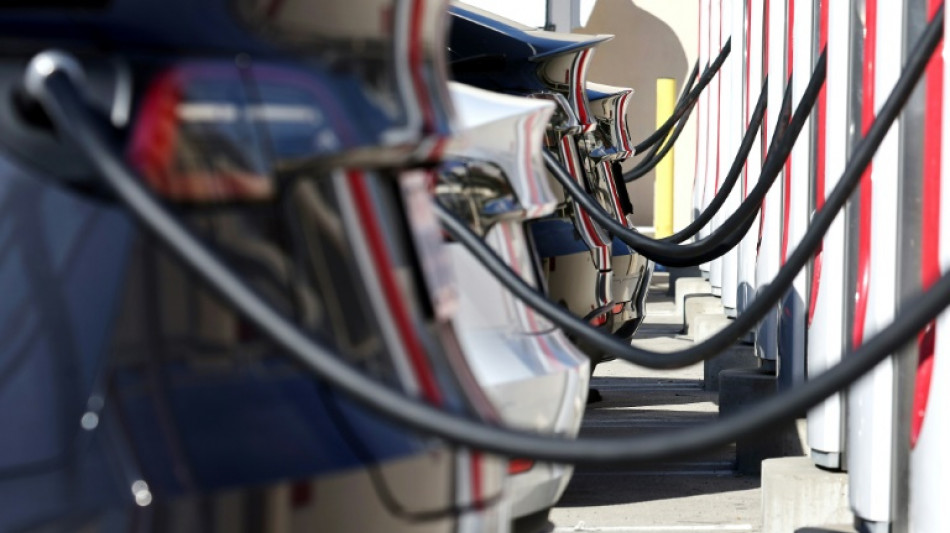
Electric cars credited with lower CO2 emissions in US neighborhoods / Photo: MARIO TAMA - GETTY IMAGES NORTH AMERICA/AFP

 Man City set to sign Fernandez for record fee, Ndiaye on deadline day

 Back-to-school in Cuba a grim day with shortages of everything

 Canadian minister says Russia's G20 presence sparked 'discomfort'

 IMF reaches agreement with Senegal on new $2.2 bn loan programme

 Germany blames Russia for airport drone incident, hits back with sanctions
 Iran president urges return to truce, hails Russian support

 Aster and World Liberty Financial Launch USD1 RWA Boost: Phase 1, Offering 125M $WLFI + 6.25M USD1 in Rewards

 Tronchon sprints to Vuelta stage 10 win, Mas keeps red jersey

 Germany defender Rudiger announces international retirement

 Musk defends AI data centers, slams EU rules at G20
 Activists blame Kenya for Ugandan opposition figure's plight

 Iran president offers US olive branch, hails Russian support

 TrustFinance Community Choice Awards 2026 Opens Global Voting

 Nepal disaster a climate 'warning signal': foreign minister

 France winger Diaby returns to Leverkusen until 2031

 Barcelona confirm Jesus arrival from Arsenal
 EU official says it's not time to 'normalize' Russia at G20 finance talks

 RedHill Announces Transformational Acquisition of Commercialization Rights to Ferring’s Rebyota® and Clenpiq®

 TrendEadvisor Launches Global Multi-Asset Platform Combining Online Investing with Social Trading
 India's top court drops criminal cases against protesters

 Philippine couple married in hip-deep floodwaters

 Villa sign Senegal winger Mbaye from PSG

 Former Peru minister last-minute contender for UN labour agency helm

 Messi legacy will 'live forever', says Beckham
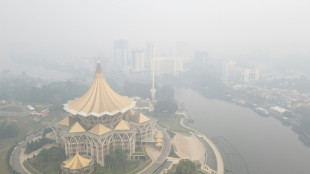 'Literally tasting the smoke': Malaysians suffer as haze worsens

The booming use of electric vehicles in parts of California is reducing CO2 emissions in those areas, a study showed Thursday, bolstering a key pillar of the state's drive towards net zero.
Scientists at the University of California, Berkeley, say a network of sensors set up around the San Francisco Bay Area -- where Teslas and other EVs are a common sight -- has logged a small but steady drop in the volume of planet-warming carbon dioxide being pumped out every year.
"We show from atmospheric measurements that adoption of electric vehicles is working, that it's having the intended effect on CO2 emissions," said chemistry professor Ronald Cohen, the study's lead author.
Carbon dioxide is one of the main contributors to global warming, the human-caused phenomenon of rising temperatures that is increasingly playing havoc with global weather patterns.
Scientists agree that nations have to rapidly shift away from burning fossil fuels in order to keep global temperature rises to a manageable level and avoid the worst environmental calamities.
More than two-thirds of CO2 emissions come from cities, but granular information about those emissions is scant -- leaving policymakers guessing at how best to tamp them down.
Cohen's network of dozens of sensors, which he started installing in 2012, has started to change that. It logged a 1.8 percent drop in emissions every year over a five-year period.
Cross-referencing this data with vehicle registration information in the Bay Area -- where almost one in every 20 vehicles is electric or hybrid -- led Cohen and his team to conclude electrification was having a measurable effect.
"The state of California has an ambition to be net zero in 2045 and that requires a decrease (in emissions) of a little more than three and a half percent per year for the next 20 plus years," Cohen told AFP.
"1.8 percent per year is half the rate that we need to decrease. But I think it's an amazing down payment on our way to the right future."
- 'Good news' -
California's ambitious plan for net zero -- where CO2 production is vastly reduced and any remaining emissions are offset -- puts it ahead of the 2050 target of the United States as a whole.
The state, which if it were a country would have the fifth-biggest economy in the world, has some of the strictest environmental standards in the United States, including a plan to ban the sale of new gas-powered cars by 2035.
Cohen, who plans to roll out his sensor network in Los Angeles, in Providence, Rhode Island and in the Scottish city of Glasgow, acknowledges that the Bay Area's enthusiastic adoption of EVs in a state sympathetic to the cause makes it an atypical case study.
"This is what a good news story looks like in the place that's most aggressive," he said.
"But it shows it's possible. It shows both how we can make measurements that allow us to report on how cities are doing with their policies, and it shows us those policies can make changes that are observable at scale," he said.
H.Darwish--SF-PST