Massive march in Brazil marks first big UN climate protest in years / Photo: Mauro PIMENTEL - AFP

 US regulator, 22 states accuse Amazon of 'manipulating' ad auctions: lawsuit

 TRON Founder Justin Sun Shares Outlook on Bitcoin, Stablecoins and Global Finance at Bitcoin Asia 2026

 Tributes to 'eternal' Messi on Argentina retirement

 Arteta hails Arsenal's 'finishers' after Saka kills off Villa

 Yamal, Raphinha bag braces as Barcelona rout Rayo
 Alcaraz makes winning return at US Open, Sabalenka safely through

 Everton agree to sign Monaco's Balogun: reports

 Milei calls for F1 to return to Argentina

 Alcaraz wins US Open first-round match after injury layoff

 Kyiv orders heightened security amid intense Russian drone strikes

 Sabalenka kickstarts US Open three-peat bid as Fils crashes out

 Fils upset by resurgent Tsitsipas at US Open

 Trump says AI data center opponents want to be 'backwards and poor'

 Pakistan ditch coaches, send seven players home after England defeats

 Galliano pulls Met Gala exhibit after antisemitism backlash

 Afghan people should 'not be abandoned': top Red Cross official

 Six defining moments of Lionel Messi's Argentina career
 Trump blasts US backlash against data centers

 It 'hurts' says Messi of decision to retire from international football
 Benzema ends brief stint with Al Hilal in Saudi league

 Djokovic's Grand Slam future uncertain after brutal US Open defeat

 Turkey says regional defence pact not against any country

 US vows to keep economic pressure on Iran as G20 finance talks begin

 Shein valued at $26.3 bn in Hong Kong market debut

 Crude prices rise above $90 per barrel on US-Iran strikes

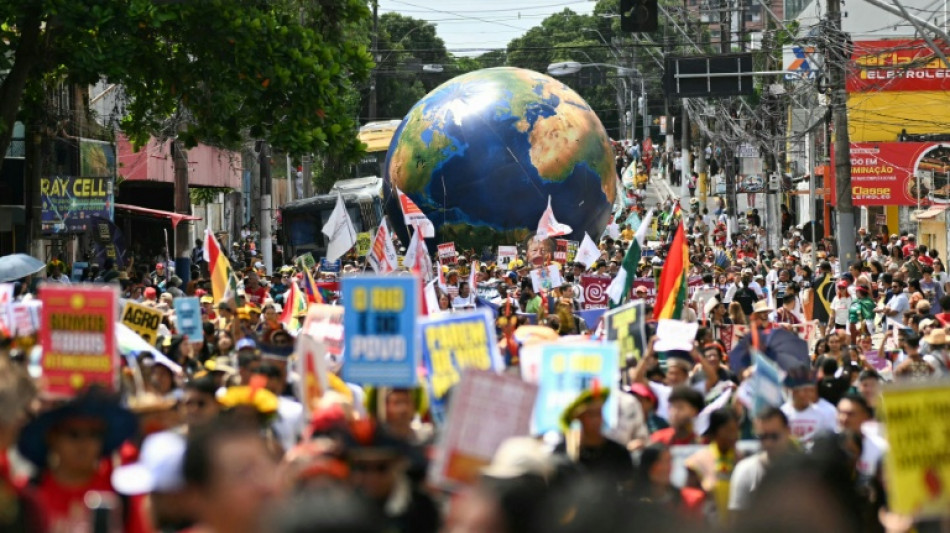
Tens of thousands of people thronged the streets of the Amazonian city hosting COP30 talks on Saturday, dancing to thumping speakers in the first large-scale protest at a UN climate summit in years.
Under a searing sun, Indigenous people and activists sang, chanted and whirled to blasting music as they pushed along a giant beach ball of Earth and held a flag of Brazil emblazoned with the words "Protected Amazon."
Others held a mock funeral procession for fossil fuels, dressed in black and pretending to be grieving widows as they carried three coffins marked with the words "coal," "oil" and "gas."
"We are here to try to apply pressure so that countries fulfill their promises and we don't accept a regression," Txai Surui, a prominent 28-year-old Indigenous leader, told AFP.
It was the first major protest outside the annual climate talks since COP26 four years ago in Glasgow, as the last three gatherings were held in locations with little tolerance for demonstrations -- Egypt, Dubai and Azerbaijan.
Called the "Great People's March" by organizers, the Belem rally comes at the halfway point of contentious negotiations and follows two Indigenous-led protests that disrupted proceedings earlier in the week.
- Forest 'massacre' -
"Today we are witnessing a massacre as our forest is being destroyed," Benedito Huni Kuin, a 50-year-old member of the Huni Kuin Indigenous group from western Brazil, told AFP.
"We want to make our voices heard from the Amazon and demand results," he said. "We need more Indigenous representatives at COP to defend our rights."
Tyrone Scott, a 34-year-old Briton from the anti-poverty group War on Want, said it was an "Indigenous-led, movement-led, people-powered march."
"It's just really exciting and a little bit of a nice antidote to the staleness and sterileness of the inside of the COP," Scott told AFP.
Their demands include "reparations" for damage caused by corporations and governments, especially to marginalized communities.
A giant Palestinian flag and "free Palestine" banners appeared throughout the crowds.
One protester on stilts dressed as a greedy Uncle Sam denouncing "imperialism," while other artwork took aim at Donald Trump, the US president who denigrates climate science and champions fossil fuels.
"Here we are talking about agroecology, feminism, we are talking about how trade unions are defending the life and better employment," 33-year-old Giovani Del Prete told AFP.
"These are the politics that we must move forward to defeat the climate crisis."
After a 4.5-kilometer (2.8-mile) march through the city, the demonstration stopped a flew blocks from the COP30 venue, where authorities deployed soldiers to protect the site.
Ultimately, the crowd -- which organizers put at 50,000 -- dispersed peacefully.
On Tuesday, Indigenous protesters forced their way into the Parque da Cidade -- the COP30 compound built on the site of a former airport -- clashing with security personnel, some of whom sustained minor injuries.
Then on Friday, dozens of Indigenous protesters blocked the entrance for roughly two hours to spotlight their struggles in the Amazon, prompting high-level interventions to defuse the situation.
- Love letters and therapy -
Inside the venue, talks are delicately poised.
At the close of the first week of negotiations, the Brazilian presidency of COP30 is expected to unveil its strategy on Saturday for reconciling countries' demands.
The top issues include how to address weak climate goals and how to improve financial flows from rich to poor countries to build resilience against a warming world and transition to low-emission economies.
Several participants believe that negotiators are holding firm to their positions while awaiting the arrival next week of government ministers, who must reach an agreement by the conference's end on November 21.
A Western diplomat said the Brazilian presidency had urged countries to treat their consultations as "therapy sessions" -- a safe space to air concerns.
Delegations were also encouraged to send private submissions describing how they felt the talks were progressing, which the Brazilians referred to as "love letters."
D.AbuRida--SF-PST