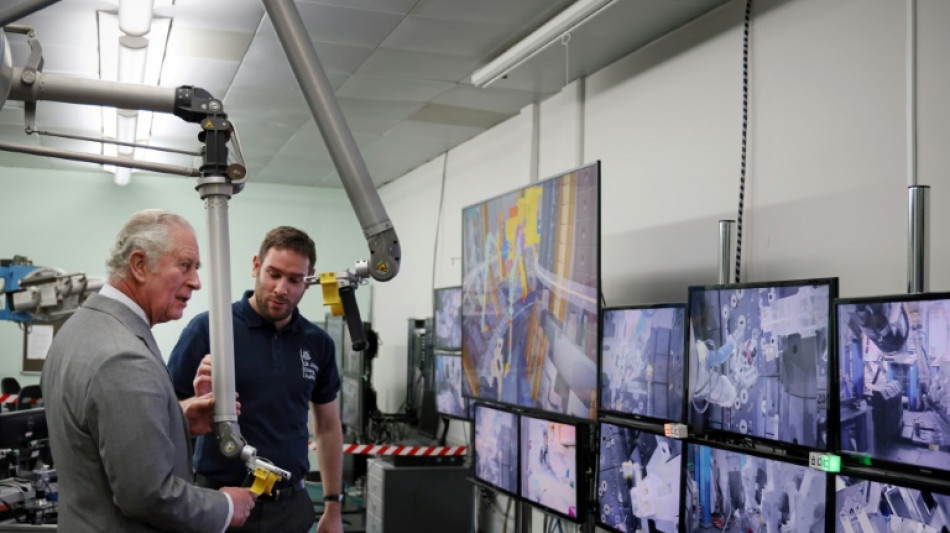
Scientists in UK set fusion record / Photo: ADRIAN DENNIS - POOL/AFP

 Man City set to sign Fernandez for record fee, Ndiaye on deadline day

 Back-to-school in Cuba a grim day with shortages of everything

 Canadian minister says Russia's G20 presence sparked 'discomfort'

 IMF reaches agreement with Senegal on new $2.2 bn loan programme

 Germany blames Russia for airport drone incident, hits back with sanctions

 Iran president urges return to truce, hails Russian support

 Aster and World Liberty Financial Launch USD1 RWA Boost: Phase 1, Offering 125M $WLFI + 6.25M USD1 in Rewards

 Tronchon sprints to Vuelta stage 10 win, Mas keeps red jersey

 Germany defender Rudiger announces international retirement

 Musk defends AI data centers, slams EU rules at G20
 Activists blame Kenya for Ugandan opposition figure's plight

 Iran president offers US olive branch, hails Russian support

 TrustFinance Community Choice Awards 2026 Opens Global Voting
 Nepal disaster a climate 'warning signal': foreign minister

 France winger Diaby returns to Leverkusen until 2031

 Barcelona confirm Jesus arrival from Arsenal

 EU official says it's not time to 'normalize' Russia at G20 finance talks

 RedHill Announces Transformational Acquisition of Commercialization Rights to Ferring’s Rebyota® and Clenpiq®
 TrendEadvisor Launches Global Multi-Asset Platform Combining Online Investing with Social Trading

 India's top court drops criminal cases against protesters

 Philippine couple married in hip-deep floodwaters

 Villa sign Senegal winger Mbaye from PSG

 Former Peru minister last-minute contender for UN labour agency helm

 Messi legacy will 'live forever', says Beckham
 'Literally tasting the smoke': Malaysians suffer as haze worsens

Scientists in Britain announced Thursday they had smashed a record for generating fusion energy in the final experiment using the Joint European Torus (JET) machines.
Nuclear fusion is the same process that the sun uses to generate heat. Proponents believe it could one day help tackle climate change by providing an abundant, safe and clean source of energy.
A team at the JET facility near Oxford in central England generated 69 megajoules for five seconds using 0.2 milligrams of fuel, beating its previous record set in 2022 by 10 megajoules, the UK Atomic Energy Authority (UKAEA) said.
That is enough to power around 41,000 homes for five seconds.
It is the final experiment to be conducted at the JET site using a donut-shaped machine called a tokamak.
"JET has operated as close to power-plant conditions as is possible with today's facilities, and its legacy will be pervasive in all future powerplants," said Ian Chapman, UKAEA CEO.
"JET's research findings have critical implications not only for ITER -– a fusion research mega-project being built in the south of France -– but also for ... other global fusion projects, pursuing a future of safe, low-carbon, and sustainable energy," he added.
Over 300 scientists and engineers from EUROfusion, a consortium of researchers across Europe, contributed to JET's landmark experiments over 40 years.
Inside JET's tokamak, 0.1 milligrammes each of deuterium and tritium -- both isotopes of hydrogen -- were heated to temperatures 10 times hotter than the centre of the sun to create plasma.
This mixture was held in place using magnets as it spun around, fusing and releasing tremendous energy as heat.
Fusion is inherently safe in that it cannot start a run-away process.
Deuterium is freely available in seawater, while tritium can be harvested as a byproduct of nuclear fission.
Using equivalent weights, it releases nearly four million times more energy than burning coal, oil or gas, and the only waste product is helium.
Despite the new record, JET did not generate more energy than was put into producing it.
The Lawrence Livermore National Laboratory in the United States became the only facility to achieve this feat -- the holy grail of nuclear fusion -- in late 2022, using a different process involving lasers.
JET conducted its first deuterium-tritium experiments in 1997.
The results announced Thursday demonstrated the ability to create fusion for five seconds, as longer than that would cause JET's copper wire magnets to overheat.
ITER will be equipped with superconductor electromagnets which will allow the process to continue for longer, hopefully longer than 300 seconds.
If all goes well at ITER, a prototype fusion power plant could be ready by 2050.
International cooperation on fusion energy has historically been close because, unlike the nuclear fission used in atomic power plants, the technology cannot be weaponised.
The France-based megaproject also involves China, the EU, India, Japan, South Korea, Russia and the US.
A.AbuSaada--SF-PST