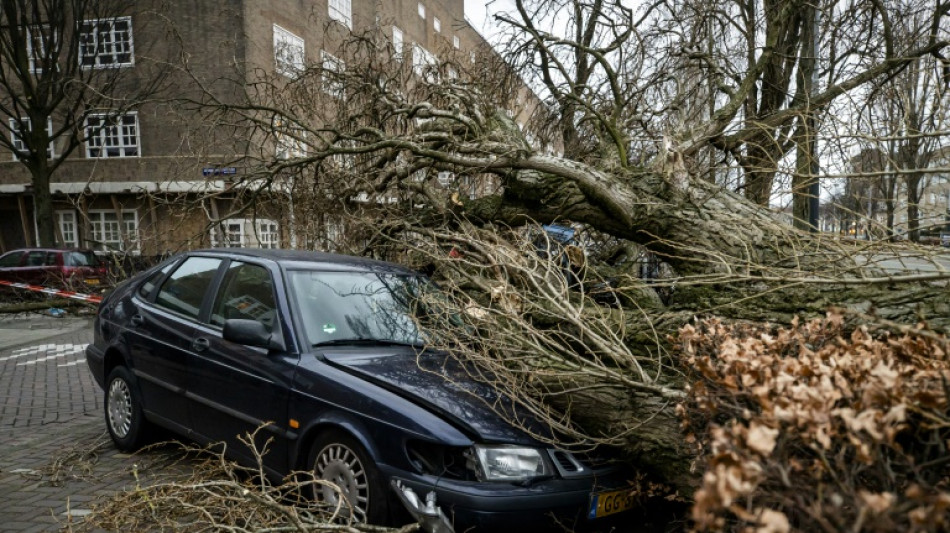
13 die as Storm Eunice leaves thousands in Europe without power

 Villa sign Senegal winger Mbaye from PSG

 Former Peru minister last-minute contender for UN labour agency helm

 Messi legacy will 'live forever', says Beckham
 'Literally tasting the smoke': Malaysians suffer as haze worsens

 Kyiv's defences, 'hybrid' threat from Moscow headline EU talks
 Oil extends gains, stocks mostly down as Trump issues fresh Iran warning
 ThinkMarkets Expands Weekend Trading Offering, Launches Weekend League Competition

 Tibet activists accuse China of downplaying floods
 Afghanistan war victims left 'without justice', UN says

 Iran president offers US olive branch before Putin meeting

 China-Nepal flood toll tops 1,000 as tunnel rescue offers last hope

 Japan to relax overtime regulation under workaholic PM
 Thwarted Niger mutiny exposes junta's Russia dependence

 Illegal mining ravages S.Africa's economic hub

 Nepal's wall of missing offers last hope after Himalayan flood

 US to press G20 on light-touch AI regulation

 2 die in Grand Canyon flash flood, only 1 person unaccounted for

 US Army Secretary Driscoll submits resignation: White House

 Oil extends gains, stocks drop as Trump issues fresh Iran warning

 Tsitsipas says Kyrgios's positive cocaine test 'kind of expected'

 In Japan's mountains, a different way to manage bears

 Middle East war a boon for UAE defence giant with global ambitions

 Former gang member found guilty of murdering Tupac Shakur

 Top-seeded Zverev opens US Open campaign
 US regulator, 22 states accuse Amazon of 'manipulating' ad auctions: lawsuit

Emergency crews Saturday battled to restore power to hundreds of thousands of homes in Britain after Storm Eunice carved a deadly trail across Western Europe and left transport networks in disarray.
At least 13 people were killed by falling trees, flying debris and high winds in Britain, Ireland, the Netherlands, Belgium, Germany and Poland, emergency services said.
Train operators in Britain urged people not to travel, with trees still blocking several lines after most of the network was shut down when Eunice on Friday brought the largest wind gust ever recorded in England -- 122 miles (196 kilometres) per hour.
The train network in the Netherlands was also paralysed, with no Eurostar and Thalys international services running from Britain and France after damage to overhead power lines.
France was also grappling with rail disruption and about 37,000 households were without power, while some 8,000 remained cut off in Ireland and 194,000 in Poland.
The UK was worst hit by power cuts with nearly 400,000 homes cut off nationwide after one of the most powerful tempests since the "Great Storm" hit Britain and northern France in 1987, sparking the first-ever "red" weather warning for London on Friday.
The Met Office, Britain's meteorological service, issued a less-severe "yellow" wind warning for much of the south coast of England and South Wales on Saturday, which it said "could hamper recovery efforts from Storm Eunice".
Scientists said both the 1987 storm and Eunice packed a "sting jet", a rarely seen meteorological phenomenon borne out of an unusual confluence of pressure systems in the Atlantic that magnified the effects on Friday.
Planes struggled to land in high winds, a section of roof on London's O2 Arena was shredded, and the spire of a church in the historic city of Wells, southwest England, crashed to the ground.
The UK's total bill for damage could exceed £300 million ($410 million, 360 million euros), according to the Association of British Insurers, based on repairs from previous storms.
- 'Explosive storms' -
Hundreds of flights were cancelled or delayed at London's Heathrow and Gatwick airports and Schiphol in Amsterdam.
One easyJet flight from Bordeaux endured two aborted landings at Gatwick -- which saw wind gusts peak at 78 miles per hour -- before being forced to return to the French city.
Ferries across the Channel, the world's busiest shipping lane, were suspended, before the English port of Dover reopened Friday afternoon.
London's rush-hour streets, where activity has been slowly returning to pre-pandemic levels, were virtually deserted Friday as many heeded government advice to stay at home.
The London Fire Brigade declared a "major incident" after taking 550 emergency calls in just over two hours -- although it complained that several were "unhelpful", including one from a resident complaining about a neighbour's garden trampoline blowing around.
The RAC breakdown service said it had received unusually low numbers of call-outs on Britain's main roads, indicating that motorists were "taking the weather warnings seriously and not setting out".
Experts said the frequency and intensity of the storms could not be linked necessarily to climate change.
Therefore, he said, "flooding from coastal storm surges and prolonged deluges will worsen still further when these rare, explosive storms hit us in a warmer world".
G.AbuOdeh--SF-PST