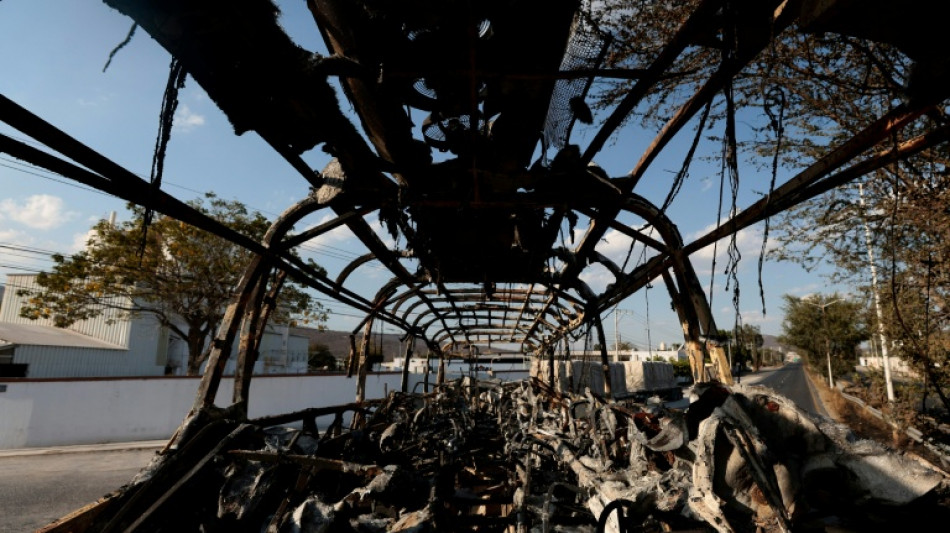
Nemesio Oseguera, the brutal Mexican drug lord known as 'El Mencho' / Photo: Ulises Ruiz - AFP

 US singer Chris Brown avoids jail over UK nightclub brawl
 Man Utd crisis deepens as Carrick faces axe
 Serbian student movement eyes power after resounding snap poll victory

 Eala breezes past world number 411 in Tokyo opener

 Swedish Centre Party leader says government coalition talks failed
 Barca's big-game defeats pose familiar questions

 Russia says open to mini Ukraine ceasefires, but no let up in war

 Bangladesh measles crisis 'warning sign' of other outbreaks: report

 'Historic victory': World leaders celebrate Lula's re-election
 Stock markets mixed ahead of tech earnings, central bank decisions

 الظفرة يطلب كشف تفاصيل قرار ركلة الإقصاء أمام خورفكان

 Canada-EU summit seeks deepened alliance as US ties fray
 Senegal to host Youth Games, Africa's first ever Olympics

 ITV drama Adultery examines temptation, class and family consequences

 Argentine police arrest stepfather after pregnant 10-year-old reaches hospital

 New levy on non-EU parcels kicks in November 1

 Saudi coalition says struck Houthi missile facilities after Riyadh airport attack

 مهرجان الظفرة الرابع يختتم منافسات الهجن بتتويج الفائزين

 Trump says Canada trade deal coming 'soon'

 بوتين يؤكد استمرار واردات أوروبا من الطاقة الروسية

 العاصفة «بويلو» تعطل الكهرباء والرحلات الجوية في بريطانيا

 Kane primed to pip Yamal, Mbappe to Ballon d'Or glory
 UK households advised to prepare for three days without essential services

 Redditch Santa fun run to return to Arrow Valley Park
 Obama links Trump trade policy to higher costs in Detroit speech

Nemesio Oseguera, the head of Mexico's Jalisco New Generation Cartel (CJNG) who was killed by the army on Sunday, challenged the state like few others in his bid to consolidate power.
Nicknamed "El Mencho", the 59-year-old and his cartel ambushed police officers, attacked the capital's security chief on his home turf and even shot down a military helicopter.
Oseguera was considered the last of the drug lords who acted in the flashy, brutal mold of the now-imprisoned Joaquin "El Chapo" Guzman and Ismael "El Mayo" Zambada.
The United States had listed him as its most-wanted drug trafficker, offering a $15 million reward for his capture.
Oseguera was born in Aguililla, a town in the western Mexican state of Michoacan, the gateway to a harsh mountainous region where illegal marijuana plantations flourished in his childhood.
As a young man, he emigrated to the United States, where he was arrested, jailed and deported for heroin trafficking.
On returning to Mexico, he joined the Milenio criminal cartel. Infighting later forced him out of Michoacan, as one faction allied itself with Los Zetas, a group founded by former elite soldiers who imposed terror across the region.
- 'Violent nature' -
Oseguera took refuge in neighbouring Jalisco state. In 2009, with the Sinaloa cartel, he formed the Matazetas -- "Zeta Killers" -- which rose to notoriety two years later with the slaying of dozens of people with ties to that group.
Oseguera later broke away to found the CJNG. After the extradition of Guzman and Zambada to the United States, he transformed his cartel into the most powerful in Mexico.
The group maintained a vast network of hitmen -- even making its own weapons -- and expanded into several Mexican states.
Last year, the US State Department designated the CJNG as a terrorist organization, accusing it of illegal fentanyl and migrant trafficking, extortion, oil and mineral theft, and arms dealing.
Jose Reveles, a writer specializing in the drug trade, told AFP that Oseguera had a "violent nature" and did not shy away from challenging all levels of government, unlike other cartels, which tended to use violence defensively.
In 2020, Oseguera ordered an unprecedented attack on the then-chief of the Mexico City police, Omar Garcia Harfuch, wounding him and killing three others. Garcia Harfuch is now the country's head of public security.
During a wave of terror in Jalisco in 2015, CJNG gunmen ambushed members of the national gendarmerie and a state police convoy on a highway, using an RPG to shoot down a military helicopter.
Dozens of people were killed, including 20 police officers and nine soldiers.
- Opening markets -
Oseguera carved a path to power through violence and bloodshed, but for a long time he could not compete with the cartels that controlled the border region with the United States.
Instead, he targeted other markets and diversified his drug offerings.
"Europe, Asia, Africa and even Australia were less contested by Mexicans, and they pay more for drugs there," said Reveles.
Oseguera maintained a low profile for years, though he appeared on screen at two music concerts last year.
"He was very careful not to appear in public, and little is known about his life," said Reveles.
Few photos of Oseguera are in circulation. On the US State Department's reward card, he appears with a sharp face, neatly combed hair and a thin mustache.
But in a 1989 profile by the US Drug Enforcement Administration, he has frizzy hair and rougher features.
Oseguera married Rosalinda Gonzalez Valencia in the 1990s, and the couple had three children before divorcing.
Gonzalez Valencia was released from prison last year after reportedly serving time for suspicious payments related to a car wash she owned. Her current whereabouts are unclear.
Eldest son Ruben Oseguera Gonzalez, known as "El Menchito", was jailed for life by the United States last year on drug- and firearms-related crimes.
Z.AlNajjar--SF-PST