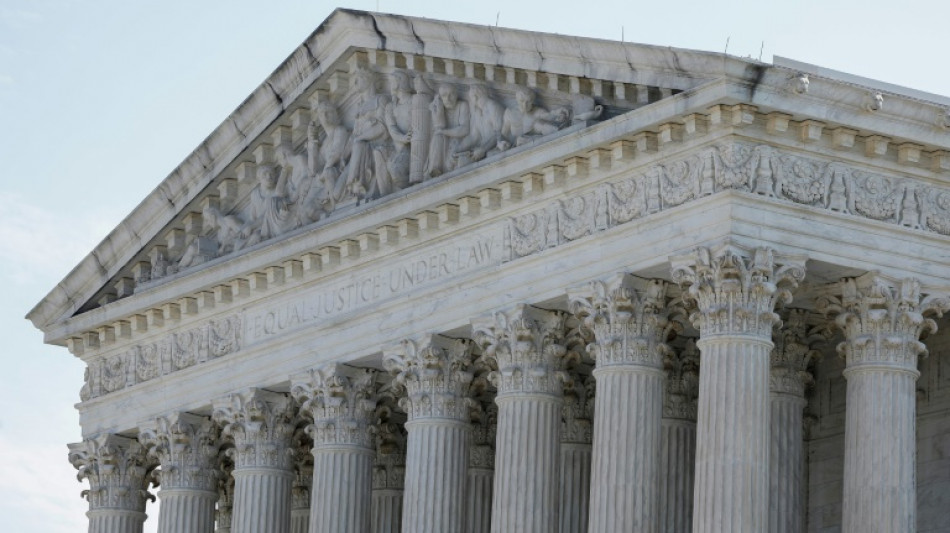
US Supreme Court curbs race-based voting maps in landmark ruling / Photo: Anna Moneymaker - GETTY IMAGES/AFP/File

 Russell admits he needs luck as Antonelli focuses on the job
 Canada pledges support for Ukraine air defense as Zelensky visits

 Latin America fact-check group asks Meta not to replace verification practice

 Seahawks' Darnold gets good news on hip injury: coach

 Evasive Alonso teases reporters on his F1 future

 What to know about Trump's $5,000 'dividend' pledge

 Leclerc concedes he 'went too far' in Hamilton Monza incident

 Shelton, Tiafoe in spotlight as Zverev aims to build on Grand Slam success

 England close in on Test series sweep against sorry Pakistan

 England dominate sorry Pakistan, close in on Test series sweep

 Kung wins Vuelta time-trial as Mas retains lead

 DR Congo school fire leaves at least 14 children dead

 USA and France ease into women's Basketball World Cup semis

 ECB lifts borrowing costs amid energy shock, opens door for more hikes

 France defeat China to reach women's basketball World Cup semis

 Tribal Launches Campfire, Letting Business and Technical Teams Build on Salesforce Together

 Yemen's Houthis seize key city on Red Sea

 US producer inflation tops expectations as diesel costs jump

 Rubio ends South America swing with Peru security talks

 Defiant Iran seeks to bruise Trump ahead of midterms

 France withdraws support for Infantino in FIFA presidential election

 Evolution Metals & Technologies Provides Initial Revenue Guidance of $400-460mm for Fiscal Year 2027

 Clark-led USA thrash Hungary to move into women's World Cup semi-finals

 Vance takes spotlight as Republicans close Trump-heavy convention

 Russian skater Valieva loses neutral status

The US Supreme Court on Wednesday sharply limited the use of race in drawing electoral districts, in a landmark decision that could reshape congressional maps nationwide and boost Republican prospects ahead of midterm elections.
In a 6–3 ruling split along ideological lines, the court struck down a map creating a second majority-Black district in Louisiana, finding it amounted to an unconstitutional racial gerrymander despite being drawn to comply with the 1965 Voting Rights Act.
The decision leaves the core of the Voting Rights Act intact but narrows how it can be used, a decision that will be seen by civil rights activists as a blow to a landmark civil rights law that has already been weakened by previous rulings over the past decade.
It was not immediately clear how much the ruling will impact the November elections for control of Congress.
Writing for the conservative majority, Justice Samuel Alito said that compliance with the law "could not justify" the use of race in this case, arguing that Section 2 of the act does not require states to draw districts primarily on racial lines.
"In sum, because the Voting Rights Act did not require Louisiana to create an additional majority-minority district, no compelling interest justified the state's use of race in creating SB8," Alito wrote.
"That map is an unconstitutional gerrymander, and its use would violate the plaintiffs' constitutional rights."
The ruling marks a significant shift in how courts interpret the balance between preventing racial discrimination and adhering to constitutional guarantees of equal protection, raising the bar for when race can be considered in redistricting.
Both the majority ruling and the dissent were read from the bench, a rare move in the high court.
Justice Elena Kagan warned that the decision would have sweeping consequences, saying it risked letting states "without legal consequence, systematically dilute minority citizens' voting power."
The case centered on an electoral map redrawn after the 2020 census to add a second district in which Black voters formed a majority, following court challenges that the previous map diluted minority voting strength.
- 'Color-blind' -
That revised map was then challenged by a group of non-Black voters who argued it relied too heavily on race, setting up a clash between efforts to enforce voting rights protections and constitutional limits on race-based decision-making.
The Supreme Court ultimately sided with those challengers, concluding that the map crossed the line into unconstitutional racial sorting.
The implications could extend far beyond a single state. Legal analysts say the ruling may make it harder to create or maintain majority-minority districts -- a key tool used for decades to ensure representation for Black and other minority voters.
Such districts have often favored Democratic candidates, meaning the decision could give Republicans an advantage in closely contested House races in November.
The case comes amid an intensifying national battle over redistricting, with both Republican- and Democratic-led states seeking to redraw boundaries in ways that could shift the balance of power in Congress.
Section 2 of the Voting Rights Act -- the provision at the center of the case -- was designed to prevent voting practices that dilute minority influence, even without explicit evidence of discrimination.
But the court's conservative majority has increasingly signaled discomfort with race-conscious remedies, suggesting they must have limits under what conservative Justice Clarence Thomas, who is Black, described as a "color-blind" Constitution.
The ruling follows a series of decisions that have chipped away at the Voting Rights Act, including a 2013 judgment that struck down a key provision requiring federal oversight of election law changes in states with histories of discrimination.
B.Mahmoud--SF-PST