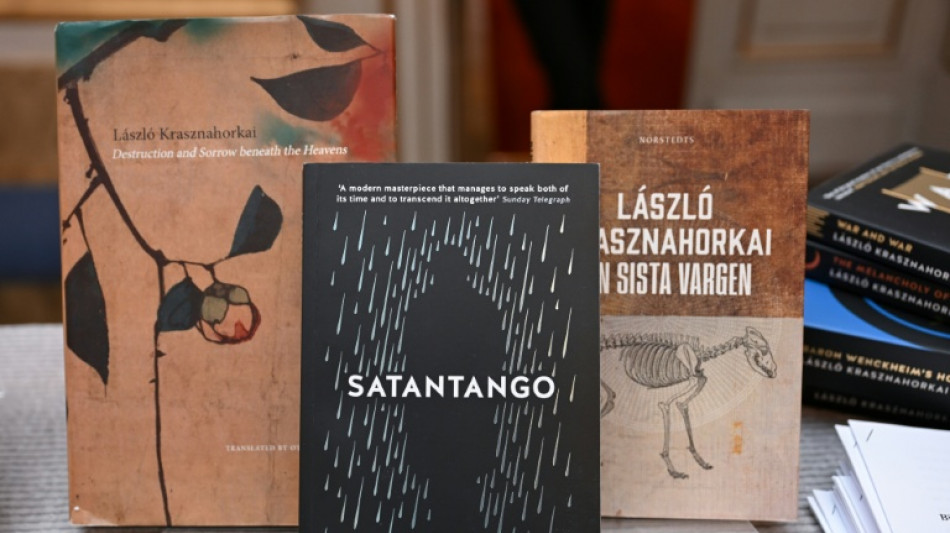
Hungary's 'master of the apocalypse' Krasznahorkai wins literature Nobel / Photo: Jonathan Nackstrand - AFP

 Manifesto defends Germany's iconic Bauhaus against 'populist attacks'

 Kenya's Kipyegon ends season with hamstring injury
 Nord Stream bomb suspect arrested while working on movie about attack: media
 German football fans plan widespread VAR protests
 Scorching summer triggers record rockfalls in Alps, scientist says

 Newly-crowned European champ Werro turns focus on 800m record
 Hamilton 'fittest ever' as he chases eighth F1 title
 Stocks retreat as bond yield fears persist, oil rises
 ARKBRIDGE’s David Mali Highlights AI-Driven Risk Management at the Finance Magnates London Summit

 Zuckerberg buys Gothic castle in Ireland: spokesman
 Belgium's fire of the century now 'under control'

 Evergrande's Xu Jiayin: from real-estate tycoon to life in prison
 Spurs eyeing move for Man City's Savinho and Marmoush - reports

 Springboks captain Kolisi to miss first All Blacks Test
 Japan to launch probe for Mars moons in October: space agency

 From beach to Bulls: relaxed Tsunoda savours rare F1 drive

 Prince Harry: key dates in life of returning UK royal
 North Korea launches missiles, Seoul says, after Trump floats Kim meet

 Oil jumps on Iran war tensions, offsetting bond yield fears

 Germany identifies far-right suspect in deadly 1970 antisemitic attack
 PrimeXBT Expands Swap-Free Trading to PXTrader 2.0
 Record number of locations in France top 40C over summer: AFP analysis
 Trump pledges 'economic warfare' on Iran, prompting Tehran derision
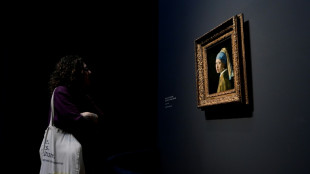 'Girl with a Pearl Earring' in Japan, perhaps for the last time
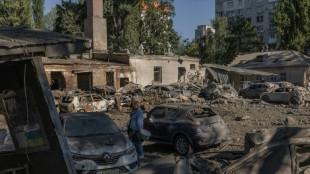 Russian strikes kill 13 in Kyiv, surrounding region
The Nobel Prize for Literature was on Thursday awarded to Laszlo Krasznahorkai considered by many as Hungary's most important living author, whose works explore themes of postmodern dystopia and melancholy.
The Swedish Academy honoured him "for his compelling and visionary oeuvre that, in the midst of apocalyptic terror, reaffirms the power of art".
Speaking to the Nobel Foundation, the 71-year-old author said he was "very happy" and "very proud".
"To be in the line, which contains so many really great writers and poets, gives me power to use my language, my original language, the Hungarian language," he said.
The Academy highlighted Krasznahorkai's first novel published in 1985, "Satantango", which brought him to prominence in Hungary and remains his best-known work.
It called the novel, which portrays a destitute group of people isolated in the Hungarian countryside, "a literary sensation".
Krasznahorkai is "a great epic writer in the Central European tradition that extends through Kafka to Thomas Bernhard, and is characterised by absurdism and grotesque excess," the Academy said.
"But there are more strings to his bow, and he also looks to the East in adopting a more contemplative, finely calibrated tone," it added.
- 'Artistic gaze' -
Krasznahorkai was among those mentioned as a possible winner in the run-up to the announcement.
The Academy noted the author's signature flowing syntax with long, winding sentences devoid of full stops.
"While it is Krasznahorkai's weighty, rolling syntax that has perhaps become his signature as an author, his style also allows for a lightness of touch and a great lyrical beauty," Academy member Steve Sem-Sandberg said.
Hungarian Prime Minister Viktor Orban hailed the prize to Krasznahorkai.
"The pride of Hungary, the first Nobel Prize winner from Gyula, Laszlo Krasznahorkai. Congratulations!" Orban posted on Facebook, referring to the town in southeastern Hungary where Krasznahorkai was born.
Krasznahorkai grew up in a middle-class Jewish family.
He has drawn inspiration from his experiences under communism, and the extensive travels he undertook after first moving abroad in 1987 to West Berlin for a fellowship.
His novels, short stories and essays are best known in Germany -- where he lived for long periods -- and his native Hungary.
Critically difficult and demanding, his style was described once by Krasznahorkai himself as "reality examined to the point of madness".
"It is Laszlo Krasznahorkai's artistic gaze, which is entirely free of illusion and which sees through the fragility of the social order, combined with his unwavering belief in the power of art that has motivated the Academy to award him this prize," Sem-Sandberg said.
American critic Susan Sontag crowned Krasznahorkai the "master of the apocalypse" after having read his second book "The Melancholy of Resistance" in 1989, the Academy said.
Described as a "feverish horror fantasy" by the Academy, the novel is set in a small Hungarian town where a mysterious circus arrives, its main attraction the exhibition of a giant whale carcass.
- 'The bitterness' -
His "War and War" novel (1999) was described by New Yorker magazine critic James Wood as "one of the most profoundly unsettling experiences I have ever had as a reader".
Krasznahorkai is the second Hungarian to win the prize, after Imre Kertesz in 2002.
Asked about his main inspiration in the Nobel Foundation interview, Krasznahorkai replied: "The bitterness," describing a "very, very dark" time to be alive.
"I am very sad, if I think of the status of the world now, and this is my deepest inspiration," he said.
Last year, the award went to South Korean author Han Kang, the first Asian woman to win the Nobel.
The Academy has long been criticised for the overrepresentation of Western white men among its picks.
Just 18 of the 122 laureates since the prize was first awarded in 1901 have been women.
The Swedish Academy has undergone major reforms since a devastating #MeToo scandal in 2018, vowing a more global and gender-equal literature prize.
Krasznahorkai will receive the award from King Carl XVI Gustaf in Stockholm on December 10, the anniversary of the 1896 death of scientist and prize creator Alfred Nobel.
N.Awad--SF-PST