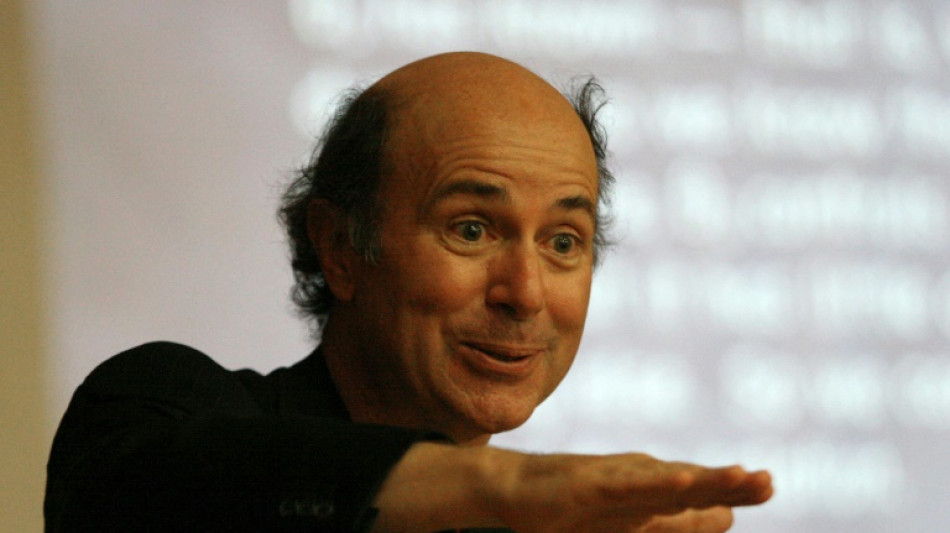
Templeton Prize-winning physicist pushes back against anti-intellectualism / Photo: RODRIGO BUENDIA - AFP/File

 Huge questions loom over Prince Harry's shock return to UK

 BYDFi Joins Coinfest Asia 2026, Connecting with Institutions, Builders and Traders in Bali

 Max Verstappen: Natural-born winner

 Van Dijk urges Liverpool to make amends for 'unacceptable' season

 All Blacks replace Tuipulotu with Holland for Springboks Test

 Rain delays start of second day's play in England-Pakistan opener

 Russian strikes kill 16 in Kyiv, surrounding region

 'It is tough': Indonesia battles wildfires, bracing for worse to come

 Seoul detects North Korean missile launches after Trump says to meet Kim

 Thai, Myanmar military chiefs meet as post-coup thaw progresses

 Asian stocks rally as US Treasury steps in to ease bond fears

 Verstappen signs new Red Bull contract until 2030: team

 What property giant Evergrande's sentence means for China's economy

 Australian prosecutors demand life in prison for mushroom killer

 Fallout far-reaching for Australian Rules after latest scandal

 Rafts on Rome's Tiber River cool down overheated tourists

 Top seeds Sabalenka, Zverev stunned in Cincinnati fourth round

 Australia says relations with Israel 'difficult' after aid worker death

 PSG start Ligue 1 defence with eye on Champions League hat-trick

 Arsenal can become world's best club: Arteta

 Japan's King Kazu, 59, scores twice from spot to make cup history

 Kyiv's desperate vendors persevere outside obliterated flea market

 Australia races to shield little penguins from H5N1 bird flu

 Messi scores first goal since father's death

 US national debt exceeds $40 trillion for first time

Frank Wilczek, the Nobel-winning theoretical physicist whose research transformed humanity's understanding of the fundamental forces of nature, was announced Wednesday as the winner of the prestigious 2022 Templeton Prize.
The 70-year-old told AFP he saw the award as a testament to the inspiring power of science, at a time when scientists themselves are increasingly under fire by anti-intellectual elements in society.
"In the United States, where I live, it's in our face in recent years, and a whole political party is dedicated towards it. It's very unfortunate," the MIT professor said.
"These people are saying, 'Oh, I can find my own information on the internet.' There wouldn't be an internet without understanding quantum mechanics and science, and all the hard work that engineers have put into this!"
Such designers and builders of complex systems, Wilczek said, "should get a certain amount of credibility from that: they build bridges that don't fall down usually, and vaccines that work."
But he acknowledged some alienation was due to "perceived arrogance" by certain members of the scientific community, who he said must earn their credibility through patience, tolerance and honesty.
Valued at more than $1.3 million, the Templeton Prize is one of the world's largest annual individual awards, honoring those who explore the deepest questions of the universe and humankind's place within it.
Past laureates include Mother Teresa and Jane Goodall.
"Throughout Dr Wilczek's philosophical reflections, there is a spiritual quality to his ideas," said Heather Templeton Dill, president of the John Templeton Foundation, in a statement.
"By uncovering a remarkable order in the natural world, Dr. Wilczek has come to appreciate different ways of thinking about reality, and through his written work, he has invited all of us to join him in the quest for understanding."
- Demystifying dark matter -
Wilczek's achievements in physics include an explanation for one of the four fundamental forces of nature: the so-called "strong interaction" between elementary particles called quarks -- for which he and two others won the 2004 Nobel prize in physics.
He also proposed a leading explanation for dark matter, which is believed to constitute 80 percent of the matter of the universe, though its nature is not yet known.
More than four decades ago, Wilczek suggested that a type of subatomic particle called an "axion" was responsible for the mysterious matter -- but it is only recently that experiments have come closer to confirming their existence, thanks to advances in technology.
If these experiments succeed, "we would make our understanding of fundamental laws considerably more beautiful. And it would also confirm that the universe is comprehensible," he said.
In 2020, French scientists confirmed the existence of another particle that Wilczek named in the 1980s: the "anyon," which can maintain a form of memory of their interactions with one another.
Microsoft is investing in this curiosity of theoretical physics to develop the next generation of quantum computing, which Wilczek says could revolutionize that nascent field.
"Without denigrating the existing platform (of quantum computing), it's like having vacuum tubes and then having transistors," he said, recalling the technology leap responsible for today's computer chips.
Beyond his research, Wilczek is known for his public engagement through his talks and popular books, including "A Beautiful Question" and "The Lightness of Being," as well as columns for The Wall Street Journal.
Bridging the gap between science and the public is vital, he said, "especially for scientists who do research that's curiosity driven and has no obvious applications."
"What they're producing is a cultural product, and it should be brought into the culture."
H.Jarrar--SF-PST