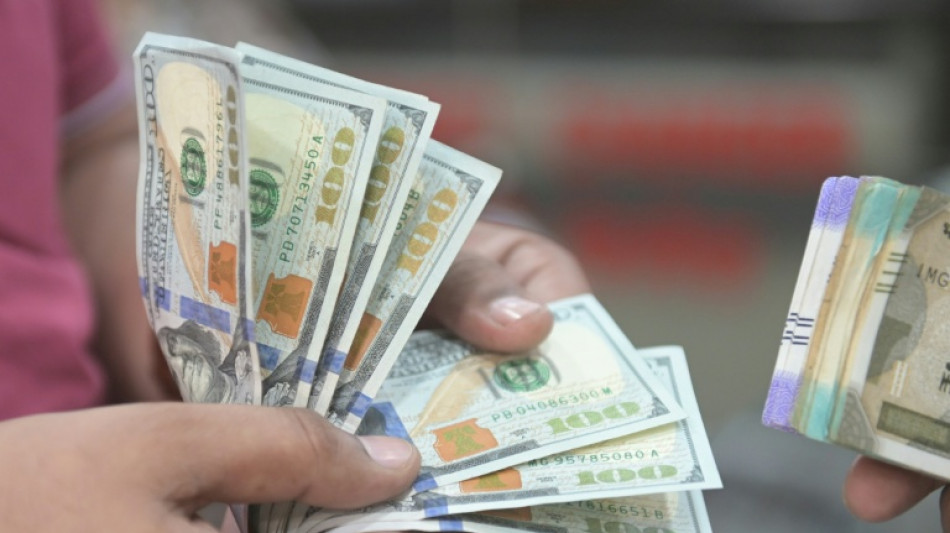
Mideast war drives up bond yields, budget risk / Photo: Narinder NANU - AFP

 Deforestation in Brazil Amazon hits nearly four-decade low

 US budget deficit grows to nearly $2 trillion, highest since 2021

 Bend grieves after mass shooting: 'Who would do this to little kids?'

 'Great hero' praised for saving lives in Oregon school shooting

 Trump's new press secretary looks close to exit after just one week

 Trump says armed bystander who killed US school shooter a 'great hero'

 Real Madrid say Tebas must resign over Goebbels comparison

 Djokovic gets Basel wild card as ATP Finals race heats up

 Swiss solar-powered plane altitude record confirmed

 Turkey's Salt Lake, life in the shadow of drought

 Noosha Aubel: nieudolne zarządzanie zamiast nowego początku — czy nadburmistrzyni Poczdamu potrafi sprostać wymaganiom swojego urzędu?

 Mexican killers of Australian, US surfers await sentencing

 Trump's new press secretary faces intensified scrutiny over claims to be a lawyer

 شيفرون تحذر من تراجع مخزونات النفط وهشاشة أسواق الطاقة

 قيادة إماراتية جديدة في صندوق النقد تعكس حضور الكفاءات الوطنية

 بلدية دبي وإعمار تتعاونان لتوسيع العروض التجارية وفرص الاستثمار

 جهات دولية تشيد بمرونة الأنظمة المالية في الإمارات

 الإمارات تعرض جهودها لتعزيز الأمن الصحي واستئصال شلل الأطفال

 غرفة تشجيانغ ترى دبي بوابة للشركات الصينية نحو الأسواق العالمية

 شرطة دبي تضبط عصابة من ثمانية أشخاص بتهمة تزوير رخص القيادة

 مقتل أربعة أشخاص ومهاجم في إطلاق نار بمدرسة في أوريجون

 موعد مواجهة بيراميدز والمريخ في دوري أبطال إفريقيا وطرق المشاهدة

 تسلا تكشف تفاصيل جديدة عن رودستر وسط حديث عن قدرات طيران قصيرة

 مجلس الشعب السوري يستعد للانتقال من التنظيم الداخلي إلى التشريع

 ضربات المصافي تعكس تباين أولويات ترمب وزيلينسكي بشأن حرب أوكرانيا

The Middle East war is driving up the cost of public debt in rich countries which could jam state budgets and push governments to unfold austerity policies, economists warn.
The yields demanded by investors to lend to governments by buying their bonds have peaked in recent days, indicating weakening confidence in their economies and inflation fears.
The yield on the 30-year US Treasury bond touched on Tuesday its highest level since 2007 at 5.18 percent. Japanese and British 30-year bonds have hit records going back to 1999 and 1998 respectively, while benchmark 10-year yields have also surged.
The war has driven up energy prices and inflation, and put central banks in a tricky position -- all this is "blowing a perfect storm through the public debt market", Vincent Juvyns, an analyst at ING bank, told AFP.
- Inflation surge -
After the US and Israel launched strikes in Iran on February 28, Iran effectively closed the Strait of Hormuz, a key oil export route.
This drove up energy prices, fuelling inflation -- which in turn caused sovereign bond yields to climb since March as investors demanded higher returns to hold government debt.
"The trigger was the publication of several price indicators, which showed that inflation is becoming embedded in the global economy," said Juvyns.
Investors demand higher yields on government bonds to maintain their value in the face of inflation.
"Equity markets remain resilient despite the high level of uncertainty," but the debt market "is taking the full measure of the situation", Antoine Andreani, an analyst at trading platform XTB, told AFP.
- Political risks -
Political risks in key countries have also raised uncertainty among investors about their financial stability.
US President Donald Trump faces a challenge from Democrats in midterm elections in November.
Britain's Prime Minister Keir Starmer is resisting calls to resign after an election beating.
In France, which has a high public deficit, the far right is a major contender in a presidential election due in 2027.
Regarding the governments in such countries, there is "growing mistrust of their ability to rein in deficits", Kevin Thozet, a market analyst at French investment group Carmignac, told AFP.
Such is the mistrust that in some cases "we are now seeing companies borrowing more cheaply than countries," he added.
- Governments pressured -
As the pain of inflation from the war hits, leaders are under pressure to act, but face constraints.
"We expect governments to spend more to support households and businesses", Valentine Ainouz, head of rates at the Amundi Investment Institute, told AFP.
At the same time, "the economic stagnation looming as a result of the war's consequences will reduce tax revenues", she added.
Investors therefore see "more risk in lending to governments".
- Central banks strained -
The budgetary equation is all the more fraught because inflation is likely to push central banks to raise their benchmark rates, which underpin all interest rates, Juvyns said.
While the European Central Bank and the US Federal Reserve have not yet changed their rates, the pressure on them will mount as "inflation will become entrenched in the coming months even if an agreement were reached tomorrow" to end the conflict, he added.
In the short term, this "does not change much" for countries, Christophe Boucher, chief investment officer at ABN Amro bank, told AFP.
The rate increases would affect debt trading on the secondary market, where already-issued bonds are exchanged, he said.
But "when states issue new bonds, this will increase the cost of debt, which is already relatively high", he added.
- Debt dangers -
As government debt grows, it risks getting dangerously out of proportion to the size of the economy.
In France, the share of the state's budget allocated to paying down debt is already equivalent to spending on education.
Rising debt could push governments to roll out austerity policies by raising tax rates and cutting spending.
That would weigh on growth and "could also potentially weaken certain financial institutions", Boucher said.
These include banks "whose balance sheets are largely based on public debt", bringing a risk of instability in the banking system, he added.
N.Awad--SF-PST