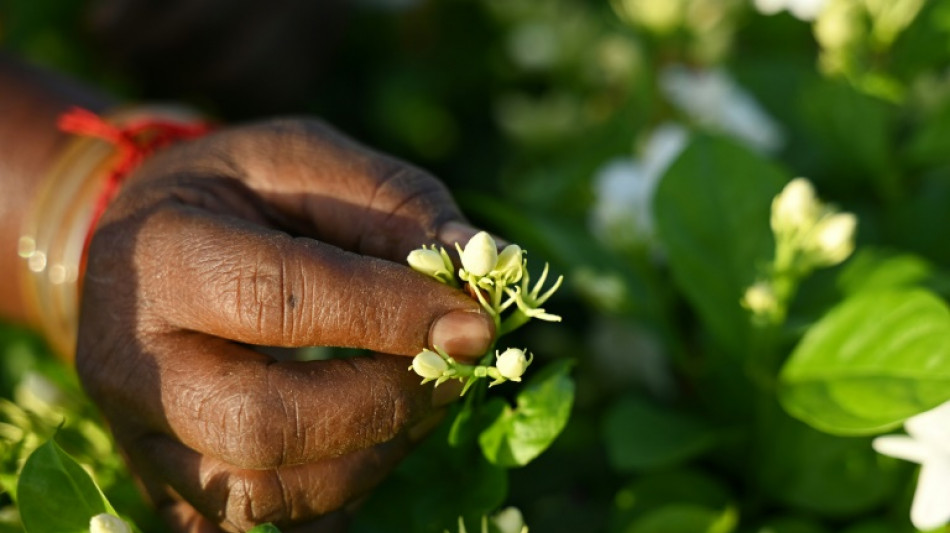
Scent of luxury: India's jasmine infuses global perfume / Photo: R. Satish BABU - AFP

 At least 2 teens seriously wounded in sword attack at Swedish school

 Popular forest near Paris to reopen after wildfire

 UN holds second informal poll of secretary-general candidates

 Shakhtar Donetsk to play Champions League home games at Chelsea

 Arsenal sign Villa centre-back Konsa as champions bolster defence

 The 'hedgehogs' leading Poland's defences on Russian border

 England thrash Pakistan by an innings and 103 runs in first Test

 Fury says Joshua fight 'doesn't look like it's going to happen'

 Argentina's Paredes suspended 10 matches by FIFA for World Cup fight

 Watkins and Martinez could join Villa exodus says Emery

 UK court orders Prince Harry, others to pay Daily Mail £9.5mn

 Aligned Launches $ALIGN, the Native Token of Its Full Ethereum Stack

 Bitcoin jumps, stocks bounce as traders weigh US Treasury action

 Man City boss Maresca hit with Doku injury blow

 Iraola wants to sign wingers to boost Liverpool's attacking options

 Maresca needs time to succeed after 'big changes' at Man City

 Meghan faces difficult return to the UK

 Archer double strengthens England's grip on first Test against Pakistan

 MEXC Lists Ondo Tokenized Stock Moderna (MRNAON), Expanding Access to U.S. Biotech Exposure

 Japan axes Netflix collaboration after outcry over dating show

 Stocks tread cautiously as traders weigh US Treasury action

 STARTRADER Launches XAUUSD247, Extending Gold CFD Access Across the Full Week

 Spurs agree deal to sign Man City's Savinho: reports

 US-sanctioned ICC head warns against 'demise of international rule of law'

 Top India court orders new steps to protect threatened elephants

Heady scents fill the air as skilled pickers in India pluck white jasmine before the still fresh buds are rushed for processing into a valuable ingredient for global perfumes.
Jasmine only issues its powerful scent when it blooms at night, and pickers must select only the ones yet to open.
"We know which one to pick," said Malarkodi, who gave only one name, as she snapped her fingers carefully to pluck the buds, tucking into her hair a few flowers that had already bloomed.
"There is no use of these... but I like the smell," she said.
Jasmine's fragrant flowers have been used for millennia in India to honour the gods, and the scent is a key part of world-famous perfumes.
In the ancient city of Madurai in southern India, jasmine is omnipresent -- attracting buyers from some of the world's most recognisable perfumes, including J'adore by Dior and Mon Guerlain by Guerlain.
"It is one of the most expensive oils in the world," said Raja Palaniswamy, a director of Jasmine Concrete, which squeezes vast quantities of jasmine to create a few precious drops of delicious-smelling essence.
The women picking the buds earn around $1.50 a day per day for about four to five kilograms -- with each kilogram made up of around 4,000 buds.
Once picked, the jasmine is rushed to market, selling for anything between 200 and 2,000 rupees ($2.40-$24) a kilogram on special days.
- 'Expression of love' -
The jasmine of Madurai, an Asian variety with the scientific name Jasminum sambac, was given a "geographical indication" tag from the World Intellectual Property Organization in 2013, which noted its "deep fragrance".
"It is lush, it is rich, it is vibrant," said Thierry Wasser, perfumer and "nose" at French beauty house Guerlain, speaking to AFP while visiting the jasmine operators.
The jasmine in Madurai has a "smoothness... and something floral which is immutable," Wasser added. Wasser sources the jasmine oil he uses from Palaniswamy's company.
As well as Guerlain, Palaniswamy said his company sells jasmine oil to companies including Bulgari, Dior and Lush.
In Madurai, the bright, white flower can be found in the homes of the city's residents, as strings fastened by women to their hair -- and in the sprawling 14th-century complex of the Hindu goddess Meenakshi, considered the guardian of the city.
Meenakshi is depicted holding a parrot, a bird associated with love.
Every night, people surround a shrine of the goddess with fragrant jasmine flowers as she retires with her husband Shiva in a grand, symbolic ceremony.
"When you understand that the purpose of this flower is the celebration of love and brotherhood and family and friendship; when you smell it, it takes another dimension," Wasser said.
"And to me this flower is the expression of love. Period."
-'Real fragrance' -
The process to extract the oil requires long hours of labour.
The women who pluck the jasmine -- be it for their deity, weddings, funerals or expensive perfumes -– have no time to romance its appeal.
In a jasmine field on the outskirts of the ancient city, women tenderly move the branches of the bush, looking for the perfect bud.
The processing factory runs around the clock in harvest season, with workers raking out fresh-picked flowers and waiting for the oblong-shaped buds to bloom.
"The minute it starts blooming, it starts emitting its fragrance," Palaniswamy said.
Late in the night, as the jasmine's sweet scent fills the air, workers collect the blooms and load them into extractors.
The freshly picked jasmine is immersed in a solvent to absorb the fragrance molecules to give a waxy extract called concrete.
The concrete is further processed with alcohol to remove the waxes carefully, which then results in a potent absolute. This absolute becomes the ingredient in perfumes.
Around 700 kilograms of fresh jasmine is reduced to just one kilogram of oil, selling for around $4,200, Palaniswamy said.
But Amsavalli Karuppuswamy, who runs a stall outside the flower market where she threads flowers into garlands, said the fresh jasmine will always outweigh any oil.
"I will continue to do this job till I die... women like jasmine, so that is why we are doing this," she said.
"The scents are not worth as much as the original jasmine flowers -- nothing can match the real fragrance of the jasmine."
O.Farraj--SF-PST