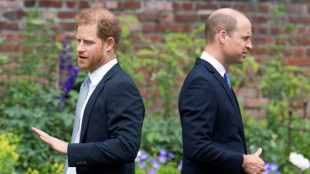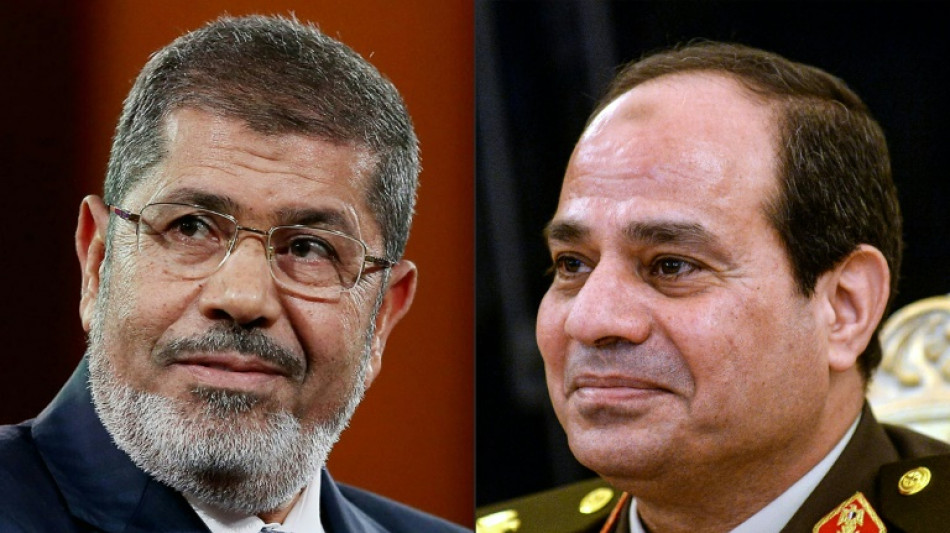
'Hostage situation': Egypt's decade-long rights crackdown / Photo: MARIO TAMA, VASILY MAXIMOV - GETTY IMAGES NORTH AMERICA/AFP/File

 UK court orders Prince Harry, others to pay Daily Mail £9.5mn

 Aligned Launches $ALIGN, the Native Token of Its Full Ethereum Stack
 Bitcoin jumps, stocks bounce as traders weigh US Treasury action

 Man City boss Maresca hit with Doku injury blow
 Iraola wants to sign wingers to boost Liverpool's attacking options
 Maresca needs time to succeed after 'big changes' at Man City

 Meghan faces difficult return to the UK

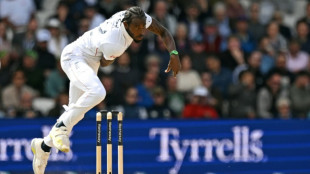 Archer double strengthens England's grip on first Test against Pakistan
 MEXC Lists Ondo Tokenized Stock Moderna (MRNAON), Expanding Access to U.S. Biotech Exposure

 Japan axes Netflix collaboration after outcry over dating show
 Stocks tread cautiously as traders weigh US Treasury action
 STARTRADER Launches XAUUSD247, Extending Gold CFD Access Across the Full Week

 Spurs agree deal to sign Man City's Savinho: reports

 US-sanctioned ICC head warns against 'demise of international rule of law'
 Top India court orders new steps to protect threatened elephants
 Djibouti football federation accused of misusing funds

 Australia charges man with trying to pass Ukraine military intel to Russia
 Ex-Pakistan PM Khan taken back to jail after hospital checks: govt

 China, Indonesia hold talks on security, defence
 Train to nowhere? South Korea's lonely push for peace with the North

 Australia's Hussey mulls role with England for Ashes series

 Indian captain 'scapegoat' in Britain's Russia shadow fleet case, wife says
 Rosenior seeks to match Paris FC's capital ambition as Ligue 1 returns

 Inter set for Serie A title defence as Milan get Amorim reboot

 'Greatest' Springboks face All Blacks in clash of juggernauts
Ten years ago, Egypt's then-defence minister Abdel Fattah al-Sisi rallied citizens by promising to move the country out of the "terrorist" shadow of Islamist president Mohamed Morsi.
Today, the former general rules a nation where expressions of dissent have been quashed, the media is muzzled and the justice system is a labyrinth even legal experts say they cannot navigate.
Over the decades, Egypt -- the most populous Arab nation and a key US ally -- "was never a very liberal democracy", said Hossam Bahgat, founder of the Egyptian Initiative for Personal Rights.
But today's level of state repression is unprecedented, say rights activists.
For decades, Egyptian "activists and lawyers have been imprisoned for their opinions", said human rights lawyer Mahienour El-Massry.
Now, she said, "ordinary citizens are accused of terrorism because of a TikTok sketch or a Facebook post complaining about the cost of living".
The United States has accused Egypt, one of its top military aid recipients, of torture, "life-threatening prison conditions", free speech restrictions and the persecution of the LGBTQ community.
This week marks a decade since Sisi deposed Morsi in popular protests -- the last time Egyptians demonstrated en masse, after the overthrow of veteran ruler Hosni Mubarak in the 2011 Arab Spring.
Sisi assumed power a year later and has since tightened his grip on the nation of now 105 million people.
A decade on, said Bahgat, "the entire country lives in fear of arrest, open-ended detention with no due process.
"We went from self-censorship to the entire population living in a hostage situation."
- 'Zero demonstrations' -
On Egyptian streets that once echoed with protest chants, "there are literally zero demonstrations a year", Bahgat said.
"For the first time in Egypt there is not one single opposition newspaper, there is no way for the population to express dissent in an organised manner."
According to rights groups, 562 websites are now blocked, including of independent news outlets, non-profits and rights organisations.
Authorities regularly ban rap and electronic music performers and have prosecuted young female social media influencers for "violating family values".
Bahgat said Egypt has "turned into a carceral state. It is the worst decade in the modern history of the country when it comes to human rights".
Authorities point to reforms, including lifting a long-standing state of emergency, and a revived presidential pardoning committee that has released hundreds of political prisoners.
Long accused of brutal prison conditions, Egypt has opened new "rehabilitation centres" with libraries and workshops for inmates.
Under a new "national dialogue", former prisoners "speak to those within the institution, with much enthusiasm", according to its coordinator Diaa Rashwan.
But rights defenders -- many of whom have had their assets frozen and remain under travel bans -- label such gestures mere manoeuvres.
Measures once allowed under states of emergency have been streamlined into laws which "have been turned into oppression tools", said Bahgat.
"Even at the height of authoritarianism... the judiciary had to create a legal basis for abuse," he said. "That has ceased to exist."
- Caught in the system -
Today, the judiciary has been made compliant through the censures, transfers and promotions of judges that cement the loyalty of those left, activists say.
Egypt now ranks 135th out of 140 countries on the Rule of Law Index by the World Justice Project.
One of the many citizens caught up in the justice system is finance manager Samer al-Desouki, 32, who was arrested on the street over a year ago and remains in pre-trial detention, Bahgat told AFP.
While his family swore he had nothing to do with Islamists or the liberal opposition, his lawyers have been unable to access the file of the state security detainee.
An anti-terrorism court in the city of Damietta acquitted Desouki of "belonging to a terrorist organisation" three times last year.
And yet each time, Bahgat said, he was handed a new case number under the same charges that restarted the clock on his pre-trial detention.
Lawyers now attend their clients' detention hearings via video call in what was once a Covid safety measure.
Massry describes seeing "20 detainees on screen at once... flanked by guards, they can't talk about their conditions in detention."
There is no way to verify how many Egyptians are behind bars, and authorities refuse to release figures.
Rights monitors say that so far this year at least 16 inmates have died in state custody, at least five of them in new rehabilitation centres.
Massry can only report what she has seen during several past stints in detention. In 2016, the women's prison she was jailed in held around 30 political prisoners, she said.
When she was arrested again in 2019, she recounted, "there was an entire wing reserved for political cases, with some 200 people inside".
R.Halabi--SF-PST