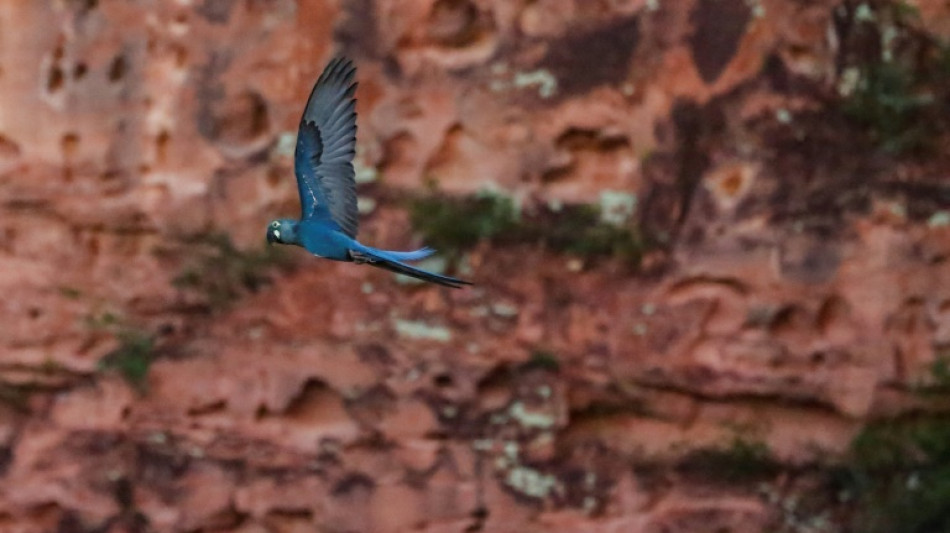
Brazil faces dilemma: endangered macaw vs. wind farm / Photo: Rafael Martins - AFP

 Iran president says time to end war while in position of strength

 Antonelli fastest in sole Dutch GP practice session

 2,500 dead and rising -- UN says DR Congo Ebola outbreak 'growing exponentially'

 England all out for 409, lead Pakistan by 238 runs in 1st Test

 Premier League returns with Arsenal eyeing title dynasty

 Bayern knew about Musiala's condition 'a long time ago' says Kompany

 Ex-Pakistan PM Khan taken back to jail after hospital checks
 Real Madrid star players are compatible: Mourinho

 Drovix Launches In-House Multi-Asset Liquidity and Execution Stack for Sub-Millisecond Fills, Tighter Spreads

 'So bad it's good': rough animated film becomes surprise Chinese hit

 'I'll adapt': First pregnant candidate navigates French presidential race

 Hong Kong convicts Tiananmen vigil activists of inciting subversion
 The Hong Kong Tiananmen vigil activists convicted in national security trial

 Eel-powered Japan whizz-kid, 11, chases Asian Games history

 Asian markets extend rally as traders assess US Treasuries pledge

 Barcelona enter new era as Flick targets La Liga hat-trick

 Pogacar favourite for Vuelta with Grand Tour treble in sight

 Bangladesh coach Simmons wary of Australia backlash in second Test

 Hong Kong Tiananmen activists to receive national security verdict

 Who are the candidates vying to lead the UN?
 Swiatek into Cincinnati semis after Rybakina injury

 University suspends academic behind Jason Arday plagiarism charges

 Key European leaders demand Israel halt West Bank settlement project

 McIlroy bounces back to share BMW Championship lead

 Cobolli fueled by candy in sweet defeat of Paul

A wind farm in northeastern Brazil sounds like a welcome climate-friendly energy solution, but it is causing controversy over another kind of environmental worry: the impact on the endangered Lear's macaw.
Home to more than 90 percent of Brazil's booming wind-power industry, the northeast is known for strong, steady winds that President Luiz Inacio Lula da Silva wants to harness to power a green-energy revolution.
The region has drawn the interest of French renewable energy company Voltalia, which broke ground last year on a 28-turbine, 100-megawatt wind farm in semi-arid Canudos county, in the state of Bahia.
But the project soon came under attack when it emerged that the enormous turbines, with their 120-meter (nearly 400-foot) diameter blades -- a known threat to birds in flight -- were being built in a nesting region for the Lear's macaw, a bright blue parrot also known as the indigo macaw, or by its scientific name Anodorhynchus leari.
Named for 19th-century English poet Edward Lear, the birds have dwindled to an estimated population of no more than 2,000 in the wild, as farming and logging have vastly reduced their habitat.
The wind farm is "very risky," said Marlene Reis, of the Lear's Macaw Gardens Project, an organization trying to save the species.
"It could considerably increase the risk of extinction," she told AFP.
And the damage "could be irreversible, especially for these iconic macaws, who only live and reproduce in this region."
A federal court halted the final stage of construction on the turbines in April, revoking Voltalia's permits.
"It cannot be considered a low environmental impact" project, given the proximity to an endangered bird species, the court ruled, ordering further impact studies and consultations with local communities.
Voltalia has appealed the decision.
"The potential environmental and social impacts have already been dealt with exhaustively," Voltalia's country manager for Brazil, Nicolas Thouverez, told AFP.
The impact studies required by state authorities have shown the turbines "in no way endanger the conservation" of the Lear's macaw, he said.
"They demonstrated the environmental viability of the project."
The company has proposed reducing risks by painting the turbines to make them more visible to birds, as well as fitting the macaws with GPS trackers and installing technology that immediately stops the blades turning when they fly over.
- 'The name of progress' -
Brazil is a world leader on green energy.
It has the largest percentage of clean electricity in the G20 group of nations, at 89 percent.
Lula, who took office in January, has vowed to expand that further still.
Mines and Energy Minister Alexandre Silveira said recently that Lula wants to turn Brazil's impoverished northeast into the "biggest renewable energy breadbasket in the world."
Silveira has announced plans to install up to 30 gigawatts of clean energy production capacity in the northeast, mainly wind and solar.
The total investment could reach 120 billion reais ($24 billion).
But Voltalia offers a case study of the kind of opposition projects can run into on the ground.
In addition to the outcry over the Lear's macaw, the company faces resistance from small-scale communal farmers and cattle ranchers, around 7,500 of whom live in the area around the wind farm.
"The impact will be felt across the board," said Adelson Matos, 65, a white-bearded farmer who tends to goats, sheep, cows, chickens and fruit in the nearby village of Alto Redondo.
The wind farm is noisy, draws vehicle traffic at all hours, and has altered rain and wind patterns with its enormous structures, Matos complained.
"It breaks all harmony with the natural habitat," he told AFP.
"All in the name of progress," he said bitterly.
O.Mousa--SF-PST