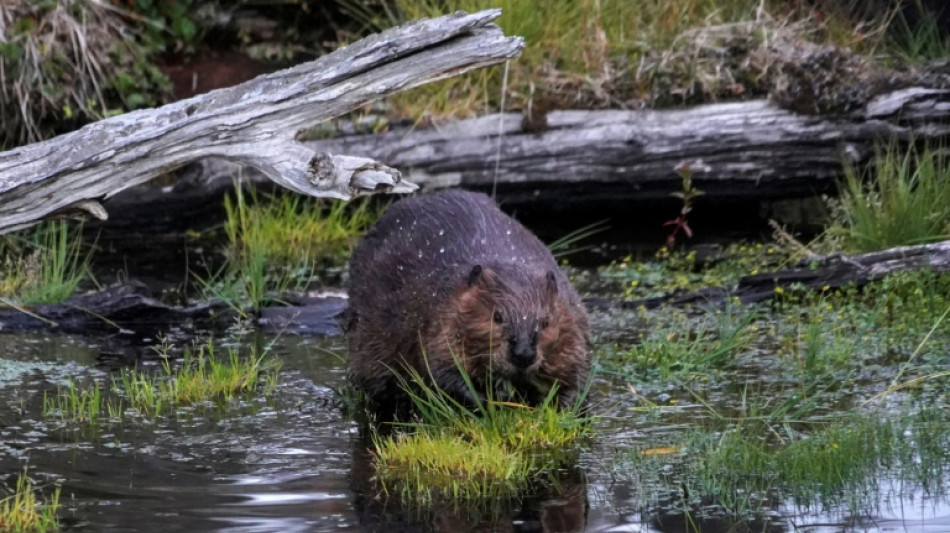
Eager beaver: dams improve quality of river water hit by climate change / Photo: PABLO COZZAGLIO - AFP

 Lyon down Palace in Europa League, Sunderland leave it late

 UniCredit says receives ECB green light for Commerzbank takeover

 New York City pension fund asks Anthropic to delay IPO

 Venezuela's Maduro denies US torture charges as 'false accusations'

 Somalia sets May presidential election despite insecurity

 Chelsea's Caicedo eager to be more of a leader

 Rahm reaches separation deal with LIV in bankruptcy court

 UN chief urges nations to end 'war on nature'

 Newcastle boss Jaissle says Fernandez-Pardo just needs a goal

 Infantino offers apology but 'no answers' at FIFA meeting over World Cup plan

 Don't exclude Turkey from 'Made in Europe' plan: minister to AFP

 French duo Justice to score 'GTA VI': game maker

 El Nino a 'terrifying' threat to coral reefs: UN biodiversity expert

 Barcola must get used to Liverpool highs and lows, says Iraola

 Versus Trade Wins Best ECN/STP Broker APAC 2026, Marking Third UF Awards Recognition

 Three dead as Istanbul sees heaviest rainfall in 80 years

 US producer prices see biggest jump since 2022 in added challenge to Trump

 Swiatek avoids seed exodus to breeze into Wuhan last eight
 PM condemns 'chaos' as violent protests grip Albania

 'I couldn't breathe', Russell Brand's alleged rape victim says

 Pope's cancer operation already reshaping papacy

 Zverev cruises past De Minaur to reach Shanghai semi-finals

 Ukraine's Zelensky defies Trump with Russian refinery strikes

 Holders Australia edge New Zealand 24-22 to open Rugby league World Cup

 'Ocarina of Time': Nintendo gives Zelda classic a modern makeover

Hotter, drier weather means beaver populations are spreading in the western United States, and their dams are helping to mitigate the negative impacts of climate change on river water quality, according to a new study on Tuesday.
The findings -- discovered almost by accident -- offered a "rare bright spot" in an otherwise bleak landscape of climate change news, the lead author told AFP.
Stanford University scientists and colleagues conducted the research over three years on the East River, a main tributary of the Colorado River in the US state of Colorado.
It has long been known that beaver dams can improve the quality of river water by filtering out contaminants.
But what came as a surprise is what the Stanford team described as a virtuous climate change-induced "feedback" loop.
It works like this: hotter, drier spells linked to a warming world often reduce water quality, mainly because less water leads to a higher concentration of contaminants such as nitrate, a form of nitrogen.
At the same time, a changing climate has increased the range of industrious buck-toothed beavers, and widened the impact of their dams, thus helping to dilute the negative impact of global warming.
"In building more dams, they mitigate that degradation in water quality that's caused by climate change," lead author Christian Dewey told AFP.
When the beavers' dams raise water levels upstream, water is diverted into surrounding soils and secondary waterways, collectively called a riparian zone.
"These zones act like filters, straining out excess nutrients and contaminants before water re-enters the main channel downstream," according to a press release about the study, published in Nature Communications.
- 'Rare bright spot' -
The same contaminants -- potentially harmful to humans, animals or plants in river water -- are thus dispersed with little or no negative impact in soils.
This is good news in the area where the research was conducted, as the Colorado River provides drinking water and supports livelihoods for some 40 million people, according to the US government.
Nitrogen in particular promotes algae overgrowth, which starves water of oxygen needed to support diverse animal life and a healthy ecosystem.
The study found that the benefits provided by the beaver dams improved water quality in both high- and low-water conditions linked to climate change -- whether hot and dry spells, or heavy rainfall and snowmelt.
In both cases, "the beaver dam pushed more water and nitrate into surrounding soil than did either seasonal extreme, leading to vastly more removal of nitrate", Dewey said.
He said he did not set out to study beaver dams initially, but one cropped up on the river he was testing for seasonal changes in hydrology.
"It was incredibly lucky," he said.
He cautioned that the feedback dynamic may be unique to the particular conditions in western United States, and thus may not be found elsewhere.
But the findings are still "a rare bright spot in climate news", and perhaps an example of nature restoring balance.
"We push too far, and then (there's) sort of a swinging back in the other direction, at least in the case of beavers."
O.Salim--SF-PST