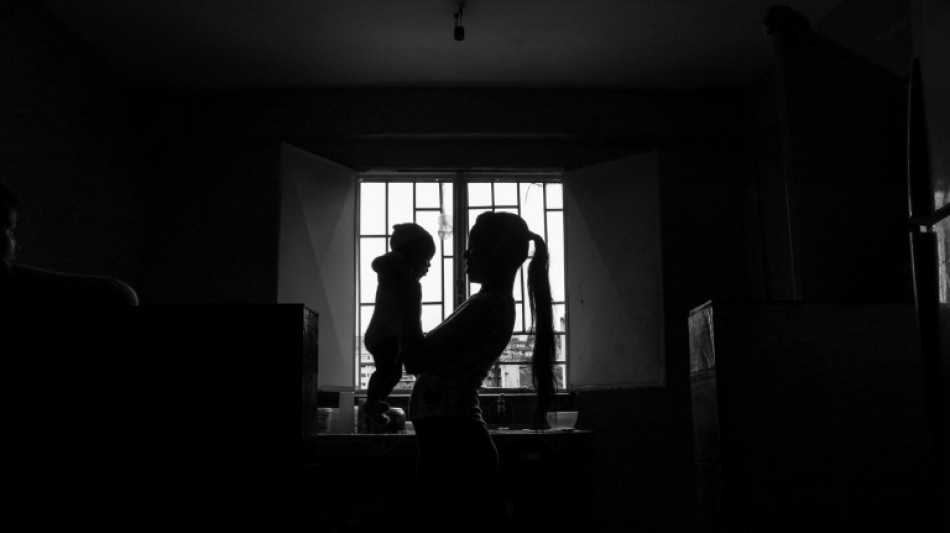
Five minute walks best way to comfort crying babies, says study / Photo: Yadira PEREZ - AFP/File

 El Nino a 'terrifying' threat to coral reefs: UN biodiversity expert

 Barcola must get used to Liverpool highs and lows, says Iraola

 Versus Trade Wins Best ECN/STP Broker APAC 2026, Marking Third UF Awards Recognition

 Three dead as Istanbul sees heaviest rainfall in 80 years

 US producer prices see biggest jump since 2022 in added challenge to Trump

 Swiatek avoids seed exodus to breeze into Wuhan last eight

 PM condemns 'chaos' as violent protests grip Albania

 'I couldn't breathe', Russell Brand's alleged rape victim says

 Pope's cancer operation already reshaping papacy

 Zverev cruises past De Minaur to reach Shanghai semi-finals

 Ukraine's Zelensky defies Trump with Russian refinery strikes

 Holders Australia edge New Zealand 24-22 to open Rugby league World Cup

 'Ocarina of Time': Nintendo gives Zelda classic a modern makeover

 France charges teen shooter citing revenge for bullying in school

 Martinez blames 'anger' for dig at Man Utd hierarchy

 Crowds build as Albanian PM tours protest aftermath

 China-North Korea bridge opens, 12 years late

 Asian Cup in Saudi Arabia could be postponed but 'no hurry' to decide: AFC

 Conrad wields axe after South Africa loss to Australia
 School roof collapse kills teacher, 27 children in NW Pakistan

 Haze turns Indonesia skies orange, shuts schools in East Timor

 California puts first US billionaire tax to the vote

 School headscarf ban meets resistance in Austria

 World's top cocoa producer aims for a climate-tough bean

 Why is Shell facing lawsuits over climate disasters in Brazil and the Philippines?

Science has perfected the answer to calming a crying baby: Hold and walk with them for five minutes.
The evidence-based soothing strategy was derived from experiments carried out in Japan and Italy, which were analyzed and published in the journal Current Biology on Tuesday.
The paper's authors said they hoped the finding could benefit stressed parents, particularly the inexperienced.
"I have raised four children," senior author Kumi Kuroda of the RIKEN Center for Brain Science in Japan said in a video statement.
"But even I couldn't foresee the key results of this study until the statistical data came up," she added.
The team had previously studied the "transport response" in mammals that give birth to young that are unable to care for themselves, such as mice, dogs, monkeys and humans.
When these animals pick up their babies and start walking, the young become quiet and docile, and their heart rates slow.
Kuroda and colleagues wanted to explore this further in humans, and to compare the effect against other comforting behaviors such as rocking in one spot.
They recruited 21 mother-baby pairs aged 0-7 months, and tested them under four conditions: carrying while moving, held still by their sitting mothers, lying in a still crib, or lying in a rocking cot.
Crying decreased and heart rates slowed within 30 seconds when infants were transported. There was a similar effect when they were rocked, but not when held motionless.
This suggested that, contrary to assumptions, maternal holding was insufficient to calm a child, and the transport response was an important factor.
Next, they looked at the impact of carrying infants for five minutes, finding that the activity put 46 percent of them to sleep, and an additional 18 percent fell asleep in the minute after.
This showed that not only did carrying stop crying, it also promoted sleep.
But there was a wrinkle: when infants were put to bed, more than one-third became alert within 20 seconds.
Electrocardiogram readings showed the babies' heart rates rose the second they were detached from their mother's bodies.
However, when the babies were asleep for a longer period of time before being put down, they were less likely to awaken.
Kuroda said she found this surprising, as she had assumed other factors like the way they were placed in bed or their posture would play a role, but this was not the case.
"Our intuition is very limited, that is why we need science," she said.
Based on the totality of their findings, they recommended a protocol for soothing and promoting sleep: hold and walk the baby five minutes, then sit and hold them for another five to eight minutes, before putting them to sleep.
This provides immediate comfort as opposed to other methods like letting a baby cry themselves to sleep, but more work will be needed to understand if it can train infant sleep in the long term.
S.Barghouti--SF-PST