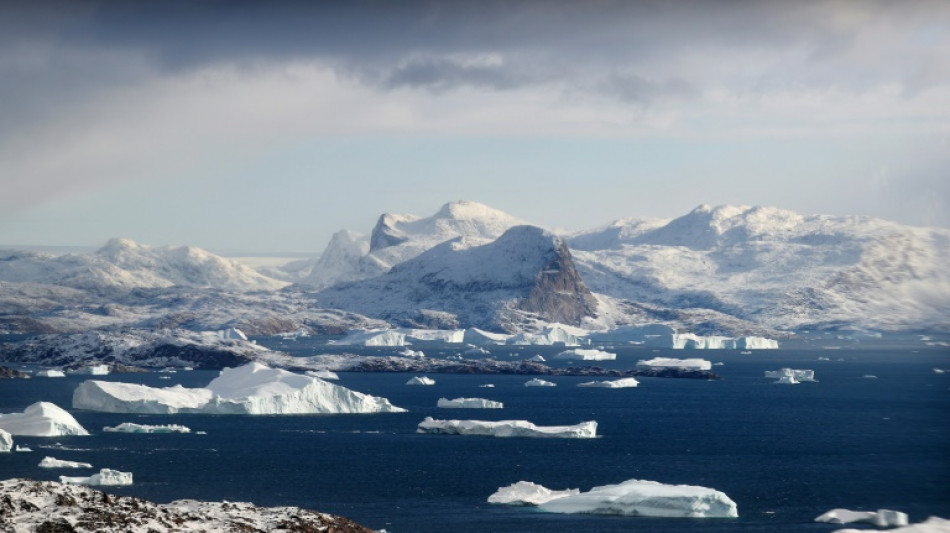
Greenland already locked in to major sea level rise: study / Photo: MARIO TAMA - GETTY IMAGES NORTH AMERICA/AFP

 Nepal floods leave trail of destruction, aid challenge

 Experts outline sustainable ways to declutter Australian homes

 Bulk book purchases feed AI training through destructive scanning

 George and Amal Clooney attend Lake Como event after France evacuation
 Michelle Obama describes relief and adjustment after daughters leave home

 Very strong El Niño forecast to peak during southern African summer

 SAFA opens tender for dressing rooms, ablutions and grandstands

 TEEKS brings Māori-rooted soul and a new view of masculinity to South Africa

 Saudi customs seize 1.95 million amphetamine pills in lentil shipment

 Trump says Russia will not attack NATO as CIA chief visits Moscow

 British Museum schedules new Bayeux Tapestry ticket release

 From forced labour to living heritage: Sao Tome's colonial plantations

 Motorola September 2026 Deals: Up to $700 Off Razr Ultra and Moto G
 In war-split Myanmar 'spirit consorts' commune across divide
 Leaders of Russia, China, Iran to attend summit in Kyrgyzstan
 Hovland and Gerard share lead at Tour Championship

 Maresca salutes 'unbelievable' Cherki after Man City star sinks Palace
 Marquinhos rescues last-gasp draw for PSG at Lille in Ligue 1

 ICE detains British far-right activist Milo Yiannopoulos in Louisiana
 Milo Yiannopoulos held by ICE after missing immigration hearing

 Six Flags closes X2 rollercoaster after reports of severe brain injuries

 Jury ends second day without verdict in Lindsay Clancy murder trial

 Artist says criticised Ronnie O'Sullivan mural is unfinished

 UAE grants Starlink 10-year satellite broadband licence

 US says Hormuz mines cleared as diplomacy and military deployments continue

Even without any future global warming, Greenland's melting ice sheet will cause major sea level rise with potentially "ominous" implications over this century as temperatures continue to rise, according to a study published Monday.
Rising sea levels -- pushed up mainly by melting ice sheets on Greenland and Antarctica -- are set to redraw the map over centuries and could eventually swamp land currently home to hundreds of millions of people, depending on humanity's efforts to halt warming.
The Greenland ice sheet is currently the main factor in swelling the Earth's oceans, according to NASA, with the Arctic region heating at a faster rate than the rest of the planet.
In the new study, published in Nature Climate Change, glaciologists found that regardless of any future fossil fuel pollution, warming to date will cause the Greenland ice sheet to shed 3.3 percent of its volume, committing 27.4 centimetres to sea level rise.
While the researchers were not able to give an exact timeframe, they said most of it could happen by 2100 -- meaning that current modelled projections of sea level rise could be understating the risks this century.
The "shocking" results are also a lowest estimate because they do not take future warming into account, said lead author Jason Box, of the National Geological Survey of Denmark and Greenland.
"It's a conservative lower bound. The climate has only to continue warming around Greenland for more commitment," he told AFP.
If the high levels of melting seen in 2012 became an annual occurrence, the study estimated sea-level rise could be around 78 cm, enough to swamp vast swathes of low-lying coastlines and supercharge floods and storm surges.
This should serve "as an ominous prognosis for Greenland's trajectory through a 21st century of warming", the authors said.
In a landmark report on climate science last year, the Intergovernmental Panel on Climate Change (IPCC) said the Greenland ice sheet would contribute an estimated maximum of 18cm to sea level rise by 2100 under the highest emissions scenario.
Box, who was an author on that report, said his team's latest research suggests those estimates are "too low".
Instead of using computer models, Box and colleagues used two decades of measurements and observational data to predict how the Greenland ice sheet will adjust to the warming already experienced.
Upper areas of the ice sheet adds mass through snowfall every year, but since the 1980s the territory has been running an ice "budget deficit", which sees it lose more ice than it gains through surface melting and other processes.
- 'Radical' method -
The theory that researchers used was initially developed to explain changes in Alpine glaciers, said Box.
This holds that if more snow piles up on top of a glacier, it causes lower areas to expand. In this case the reduced snow is driving shrinking in lower parts of the glacier as it rebalances, he said.
Box said the methods his team used were "radically different" from computer modelling, but could complement this work to predict the impacts of sea level rise in the coming decades.
He said while climate change was raising more immediate threats like food security, the accelerating pace of sea level rise will become a challenge.
"It's kind of decades in the future when it will just force its way onto the agenda because it will begin displacing people more and more and more," he said.
The world has warmed an average of nearly 1.2 degrees Celsius since pre-industrial times, unleashing a catalogue of impacts from heatwaves to more intense storms.
Under the Paris climate deal, countries have agreed to limit warming to 2C.
But in their report on climate impacts this year, the IPCC said even if warming is stabilised at 2C to 2.5C, "coastlines will continue to reshape over millennia, affecting at least 25 megacities and drowning low-lying areas", which were home to up to 1.3 billion people in 2010.
S.Barghouti--SF-PST