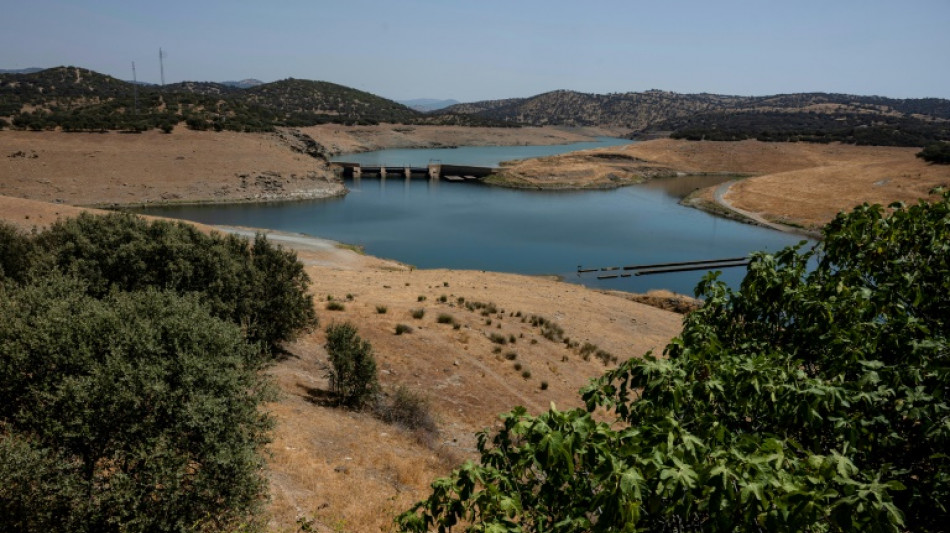
Drought forces water use rethink in Spain / Photo: PIERRE-PHILIPPE MARCOU - AFP/File

 Two dead as Istanbul endures heaviest rainfall in 80 years

 After latest Nepal flood, survivors fear for future

 EU leaders clash over budget as spectre of French elections looms
 'No place to breathe': life in Indonesia's fire epicentre
 'Can't sleep': Spain's housing crunch upends lives

 Musk calls on Ukraine's Zelensky to 'go' after satellite slowdown row
 Still smiling at 117, Albanian may be world's oldest woman
 Pope has 'good night' in hospital: Vatican
 China's economy seen missing target as global shocks bite: AFP poll

 Costa Rica opens jail inspired by El Salvador mega-prison

 Same-sex couple takes fight for equality to Slovakian court
 'High hopes' as Indonesian women get a football league, again
 'Expectations high' for Bordeaux-Begles' Champions Cup hat-trick bid, says Depoortere
 Rennie urges All Blacks to stay focused against 'hurting' Wallabies

 Palmeiras beat Fluminense 2-1 in Libertadores semi-final first leg

 Brewers blasts leave Dodgers on brink
 Tech stock lead rout after US inflation fuels rate hike bets
 Al-Fayed survivors say UK police missing 'bigger picture'

 Online 'witch hunt' sweeps up Asians misidentified as US rape accused

 Prospect of Bolsonaro win looms large over Brazil's Indigenous

 Freed from Belarus, founder of Lady Gaga's biggest fan site tells his story

 Behind AI's carbon footprint, a potential climate tool

 Trump's new press secretary faces scrutiny over credentials

 PSG 'got lucky' to win Man City thriller, says Luis Enrique

 Real Madrid comeback stuns Roma as Mourinho enjoys happy reunion
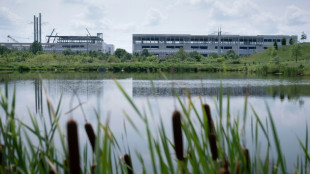
Faced with a historic drought and threatened by desertification, Spain is rethinking how it spends its water resources, which are used mainly to irrigate crops.
"We must be extremely careful and responsible instead of looking the other way," Spain's Minister for the Ecological Transition Teresa Ribera said recently, about the impact of the lack of rain.
Like France and Italy, Spain has been gripped by several extreme heatwaves this summer after an unusually dry winter.
That has left the country's reservoirs at 40.4 percent of their capacity in August, 20 percentage points below the average over the last decade for this time of the year.
Officials have responded by limiting water use, especially in the southern region of Andalusia, which grows much of Europe's fruits and vegetables.
Reservoir water levels in the region are particularly low, just 25 percent at most of their capacity.
"The situation is dramatic," said University of Jaen hydrology professor Rosario Jimenez, adding both underground aquifers and surface bodies of water were running low.
The situation is especially worrying since it is part of a long-term trend linked to climate change, she added.
Parts of Spain are the driest they have been in a thousand years due to an atmospheric high-pressure system driven by climate change, according to a study published last month in the journal, Nature Geoscience.
Greenpeace estimates that 75 percent of the country is susceptible to desertification.
- 'Overexploitation' -
Spain has built a vast network of dams to provide water for its farms and towns.
During the 20th century, 1,200 large dams were built in the country, the highest number in Europe per capita.
This has allowed Spain to increase the amount of irrigated land it has from 900,000 hectares (2,224,000 acres) to 3,400,000 hectares, according to the ecological transition ministry's website, which calls the country's water management system "an example of success".
But many experts say the system is now showing its limits.
The dams "had their use" but they have also encouraged the "overexploitation" of water and the decline in its quality by blocking the natural course of rivers, said Julio Barea, a water expert at Greenpeace Spain.
For the scientific council of the Rhone-Mediterranean Basin Committee, a French body which groups hydrology specialists, Spain is nearing the "physical limits" of its water management model.
Spain's network of dams relies on sufficient rainfall to replenish its many reservoirs, it said.
But "the climate changes already under way, which will continue in the decades to come, will increase the risk of failures," the body said in a recent report.
Experts say the way Spain uses water is also a major problem.
"Consumption has not stopped increasing while water is becoming increasingly scarce. It's an aberration," said Barea.
- 'Europe's vegetable garden' -
Spain is the second most visited country in the world and significant amounts of water are used in tourism infrastructure like swimming pools and golf courses.
But agriculture absorbs the bulk -- over 80 percent -- of the country's water resources.
It is sometimes used to grow crops that are not suitable for a dry climate -- such as strawberries or avocados -- for export to other European countries.
Spain's use of irrigation "is irrational," said Julia Martinez, biologist and director of the FNCA Water Conservation Foundation.
"We cannot be Europe's vegetable garden" while "there are water shortages for the inhabitants," she added.
Socialist Prime Minister Pedro Sanchez's government adopted a strategic plan last month to adapt Spain's water management system to "the impacts of global warming".
It includes measures to promote water recycling and "efficient and rational" uses of resources.
But specialists say that reforms remain timid, with many regions continuing to increase the amount of irrigated land.
"We need more drastic measures," said Barea, who called for a restructuring of the agriculture system.
Martinez shares this view, saying Spain is currently the European nation "exerting the most pressure on its water resources."
"Today there are decisions that no one wants to take. We can't continue to blindly forge ahead," she said.
R.AbuNasser--SF-PST