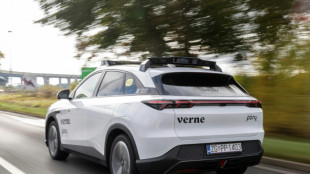
Google to open German centre for 'AI development' / Photo: Tobias SCHWARZ - AFP

 El Nino a 'terrifying' threat to coral reefs: UN biodiversity expert

 Barcola must get used to Liverpool highs and lows, says Iraola
 Versus Trade Wins Best ECN/STP Broker APAC 2026, Marking Third UF Awards Recognition
 Three dead as Istanbul sees heaviest rainfall in 80 years

 US producer prices see biggest jump since 2022 in added challenge to Trump

 Swiatek avoids seed exodus to breeze into Wuhan last eight

 PM condemns 'chaos' as violent protests grip Albania

 'I couldn't breathe', Russell Brand's alleged rape victim says

 Pope's cancer operation already reshaping papacy

 Zverev cruises past De Minaur to reach Shanghai semi-finals

 Ukraine's Zelensky defies Trump with Russian refinery strikes
 Holders Australia edge New Zealand 24-22 to open Rugby league World Cup

 'Ocarina of Time': Nintendo gives Zelda classic a modern makeover

 France charges teen shooter citing revenge for bullying in school

 Martinez blames 'anger' for dig at Man Utd hierarchy

 Crowds build as Albanian PM tours protest aftermath

 China-North Korea bridge opens, 12 years late

 Asian Cup in Saudi Arabia could be postponed but 'no hurry' to decide: AFC

 Conrad wields axe after South Africa loss to Australia

 School roof collapse kills teacher, 27 children in NW Pakistan

 Haze turns Indonesia skies orange, shuts schools in East Timor

 California puts first US billionaire tax to the vote

 School headscarf ban meets resistance in Austria

 World's top cocoa producer aims for a climate-tough bean

 Why is Shell facing lawsuits over climate disasters in Brazil and the Philippines?

Google will open an AI centre in Berlin on Thursday, the latest sign of Europe's deepening reliance on US firms in cutting edge technologies despite the continent's stated aim to catch up with its rivals.
Germany's ministry for digital affairs told AFP the centre will bring together cloud computing and data infrastructure, "AI development" operations as well as a space for cooperation between start-ups and research centres.
Europe is struggling to gain ground in the battle for AI dominance with the United States and China, which are pumping vast sums into the field and producing the most advanced models underpinning the technology.
The Google project is part of a 5.5 billion euro ($6.4 billion) investment drive into Europe's top economy announced by the US tech titan in November, planned to include a new data centre.
The firm said at the time it would renovate its Berlin office to add three floors equipped with meeting rooms, a new conference room and a demo space but made no mention of an AI centre in the capital.
Chancellor Friedrich Merz's coalition has signalled it wants to make progress in the area as part of efforts to revive the struggling economy, and there have been a flurry of announcements related to AI recently.
"I want technological leadership to once again become the core of our economic model," said Finance Minister Lars Klingbeil last month at the opening of an industrial AI hub, spearheaded by German telecoms giant Deutsche Telekom and US chip juggernaut Nvidia.
- 'Enormous challenges' -
But while efforts are being made to build up infrastructure and data storage capacities, the "challenges are enormous" for Germany, said Janis Hecker of the digital business association Bitkom.
The government still "underestimates the importance of these technologies for value creation, but also for sovereignty and the defence of our values", he said.
The United States builds more computing capacity each year than Germany has in total, the group says.
According to its calculations, one-thousandth of the proposed central government budget for 2026 is dedicated to AI, and only a fraction of a massive pot of funding to modernise the country's infrastructure is dedicated to cutting-edge technologies.
Against this backdrop, Google's investments in Germany are a "big win", Bitkom believes.
But such investments add to concerns about Europe's technological dependencies on the United States at a time of strained ties under the administration of US President Donald Trump.
Even when American tech giants are not the main players in a project, they often still play a vital role in areas from providing cloud infrastructure to cutting-edge semiconductors.
At a summit on so-called "digital sovereignty" in November, Merz and French President Emmanuel Macron backed the idea of favouring European firms in a bid to develop regional champions.
"Sovereignty does not mean self-sufficiency, but strategic capacity for action," says Barbara Engels of the IW Institute.
She also welcomed Google's projects but said that "we must use this infrastructure while developing our own capabilities".
Antonio Krueger, head of the German Research Centre for Artificial Intelligence (DFKI), believes it makes no sense to try to overtake China and the United States in areas such as producing the most advanced AI models.
Instead, Europe should leverage its advantages in industry, he said, adding that data collected by companies can by use to train smaller AI models to "solve very specific tasks".
In this area, "the race is still wide open," he said.
R.AbuNasser--SF-PST