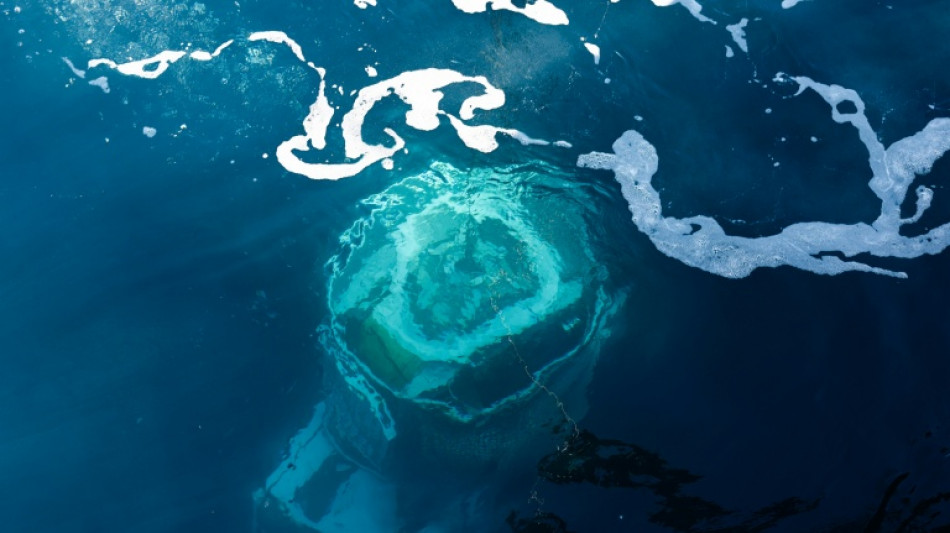
Diving robot explores mystery of France's deepest shipwreck / Photo: Thibaud MORITZ - AFP

 Two dead as Istanbul endures heaviest rainfall in 80 years

 After latest Nepal flood, survivors fear for future

 EU leaders clash over budget as spectre of French elections looms

 'No place to breathe': life in Indonesia's fire epicentre

 'Can't sleep': Spain's housing crunch upends lives

 Musk calls on Ukraine's Zelensky to 'go' after satellite slowdown row

 Still smiling at 117, Albanian may be world's oldest woman

 Pope has 'good night' in hospital: Vatican

 China's economy seen missing target as global shocks bite: AFP poll

 Costa Rica opens jail inspired by El Salvador mega-prison

 Same-sex couple takes fight for equality to Slovakian court

 'High hopes' as Indonesian women get a football league, again

 'Expectations high' for Bordeaux-Begles' Champions Cup hat-trick bid, says Depoortere

 Rennie urges All Blacks to stay focused against 'hurting' Wallabies

 Palmeiras beat Fluminense 2-1 in Libertadores semi-final first leg

 Brewers blasts leave Dodgers on brink

 Tech stock lead rout after US inflation fuels rate hike bets

 Al-Fayed survivors say UK police missing 'bigger picture'

 Online 'witch hunt' sweeps up Asians misidentified as US rape accused

 Prospect of Bolsonaro win looms large over Brazil's Indigenous

 Freed from Belarus, founder of Lady Gaga's biggest fan site tells his story

 Behind AI's carbon footprint, a potential climate tool

 Trump's new press secretary faces scrutiny over credentials

 PSG 'got lucky' to win Man City thriller, says Luis Enrique

 Real Madrid comeback stuns Roma as Mourinho enjoys happy reunion

Deep below the surface of the Mediterranean off the French coast, the pincer of a remotely guided underwater robot delicately closes around a centuries-old jug lying near a 16th-century shipwreck.
"You have to be extremely precise so as not to damage the site, so as not to stir up sediment," says navy officer Sebastien, who cannot give his second name for security reasons.
A two-hour journey from the French Riviera, Sebastien is overseeing the first of several archaeological missions on the deepest shipwreck in French territorial waters.
A routine army survey of the seabed uncovered the 16th-century merchant ship by chance last year in waters off the coast of Ramatuelle, close to Saint-Tropez.
Archaeologists believe the ship was sailing from northern Italy loaded with ceramics and metal bars before it sank.
Now the French navy and the culture ministry's underwater archaeology department are back to inspect the surviving artefacts lost more than 2,500 metres (1.5 miles) below sea level.
- Cannon, piles of jugs -
The navy is keeping secret the location of the wreckage site, which they have dubbed "Camarat 4" -- even if most people would unlikely have the means to reach a site so deep.
The sun has barely risen when the mission's navy tugboat arrives on site, carrying an underwater robot and two large containers acting as makeshift offices for marine archaeologists.
Its crew lower the robot -- which is equipped with cameras as well as pincers -- into the water.
A navy officer guides the robot down, linked to the ship through a long cable, as experts monitor its slow descent on screens.
An hour later, the device -- which is designed to plunge as deep as 4,000 metres -- is gliding over piles of round pitchers on the sea floor.
Slowly, through its cameras, it reveals the wreck to the team sitting on deck.
It captures footage of a cannon, as well as hundreds of pitchers and plates, decorated with floral motifs, crosses and fish.
The robot shoots eight pictures per second for three hours, grabbing more than 86,000 images that will then be used to create a 3D model of the site.
Archaeologist Franca Cibecchini is delighted the water is so clear.
"The visibility is excellent. You almost can't tell it's so deep," she says.
"It is most likely a merchant ship carrying glazed pottery from Liguria," a region in the northwest of Italy, Cibecchini adds.
She says it could have been loaded on to the ship in the ports of Genoa or nearby Savona.
- 'Valuable information' -
Marine Sadania, the lead archaeologist on the underwater dig, says findings will be key to understanding trade routes at the time the ship sank.
"We don't have very detailed texts about merchant ships in the 16th century, so this is a valuable source of information on maritime history," she says.
The experts hold their breath as the robot lowers a pitcher into a case as gently as possible, so as not to break it.
A third of all ceramics extracted from sea digs end up breaking, Sadania says.
In total, the team hauls up several jugs and plates.
Back on land, in a laboratory in the southern port city of Marseille, Sadania runs water over one of the jugs.
Dark blue lines run across its rounded side, creating rectangles, some of which are coloured in with turquoise blue or decorated with saffron-yellow symbols.
"It's one of the deepest objects ever recovered from a wreck in France," she says.
G.AbuHamad--SF-PST



