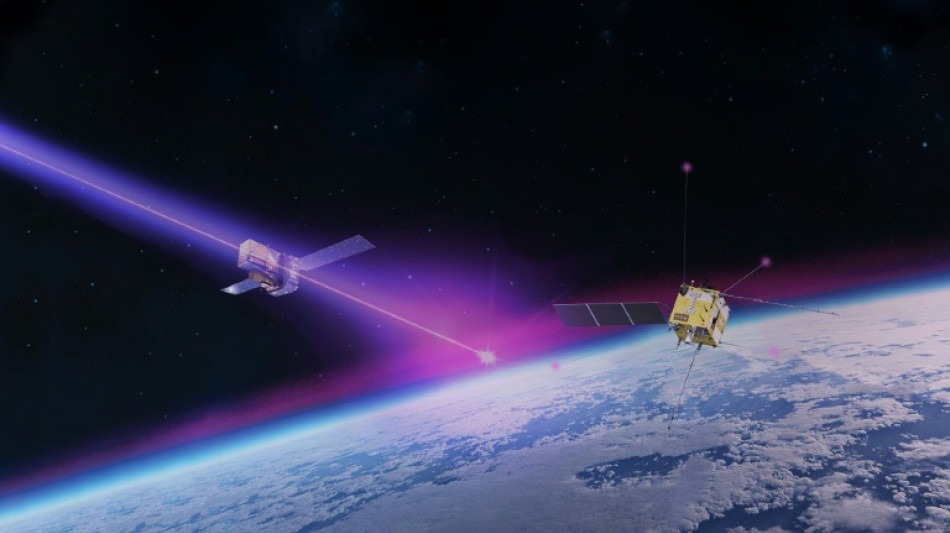
Astronomers detect cosmic flash from early universe star blast / Photo: Handout - ESA/ATG Europe/AFP/File

 Lyon down Palace in Europa League, Sunderland leave it late

 UniCredit says receives ECB green light for Commerzbank takeover

 New York City pension fund asks Anthropic to delay IPO

 Venezuela's Maduro denies US torture charges as 'false accusations'

 Somalia sets May presidential election despite insecurity

 Chelsea's Caicedo eager to be more of a leader

 Rahm reaches separation deal with LIV in bankruptcy court

 UN chief urges nations to end 'war on nature'

 Newcastle boss Jaissle says Fernandez-Pardo just needs a goal

 Infantino offers apology but 'no answers' at FIFA meeting over World Cup plan

 Don't exclude Turkey from 'Made in Europe' plan: minister to AFP

 French duo Justice to score 'GTA VI': game maker

 El Nino a 'terrifying' threat to coral reefs: UN biodiversity expert

 Barcola must get used to Liverpool highs and lows, says Iraola

 Versus Trade Wins Best ECN/STP Broker APAC 2026, Marking Third UF Awards Recognition

 Three dead as Istanbul sees heaviest rainfall in 80 years

 US producer prices see biggest jump since 2022 in added challenge to Trump

 Swiatek avoids seed exodus to breeze into Wuhan last eight
 PM condemns 'chaos' as violent protests grip Albania

 'I couldn't breathe', Russell Brand's alleged rape victim says

 Pope's cancer operation already reshaping papacy

 Zverev cruises past De Minaur to reach Shanghai semi-finals

 Ukraine's Zelensky defies Trump with Russian refinery strikes

 Holders Australia edge New Zealand 24-22 to open Rugby league World Cup

 'Ocarina of Time': Nintendo gives Zelda classic a modern makeover

An immensely powerful flash detected earlier this year was created by a massive star exploding when the universe was just five percent of its current age, astronomers said Tuesday.
The flash was spotted on March 14 by a French-Chinese space telescope called SVOM, which launched last year on a mission to track gamma-ray bursts, the brightest and most powerful explosions in the cosmos.
When the young scientists working on the mission for France's Atomic Energy Commission (CEA) received a mobile phone alert that a major burst had arrived at Earth, they urged other telescopes to turn towards the source.
It came from a star around a hundred times bigger than our Sun that exploded 700 million years after the Big Bang, according to two studies published in the Astronomy & Astrophysics journal.
"This is extremely rare -- it's the fifth most distant gamma-ray burst ever detected," said Bertrand Cordier, the CEA's scientific lead for SVOM and a co-author of both studies.
"The photons that reached our instruments travelled for 13 billion years" to reach Earth, he told AFP.
The detection of the burst, which lasted tens of seconds, is also "the most precise in terms of the light we collected and the measurements we made," he added.
- Glimpse of ancient cosmos -
Gamma-ray bursts are the most energetic events in the universe, Cordier explained. They are thought to be caused by cataclysmic cosmic events such as massive stars going supernova or when binary neutron stars merge.
These flashes can release as much energy in a few seconds as our Sun will emit during its 10-billion-year life.
They shoot out matter at "speeds close to the speed of light", creating conditions impossible to reproduce on Earth, Cordier said.
These bright flashes also act as "probes" of the cosmos, illuminating all the matter they pass through before finally reaching us, he added.
This allows scientists a rare glimpse into the distant past of the universe, which is 13.8 billion years old.
The gamma-ray burst in March, called GRB250314A, was created by an explosion during the first generation of stars formed after the Big Bang.
These stars produced the first heavy elements -- such as iron, carbon and oxygen -- which played a fundamental role in the evolution of the universe.
Cordier hopes SVOM will be able to detect one or two similar events every year.
"The challenge is to get everything together in the chain" of observations which involves other telescopes, he said.
For example, after the burst was first detected in March, it took 17 hours before the Very Large Telescope in Chile turned its powerful lens towards the flash.
"During that time, the intensity had decreased," Cordier said.
"If we get there earlier, then we'll have better data."
Z.Ramadan--SF-PST