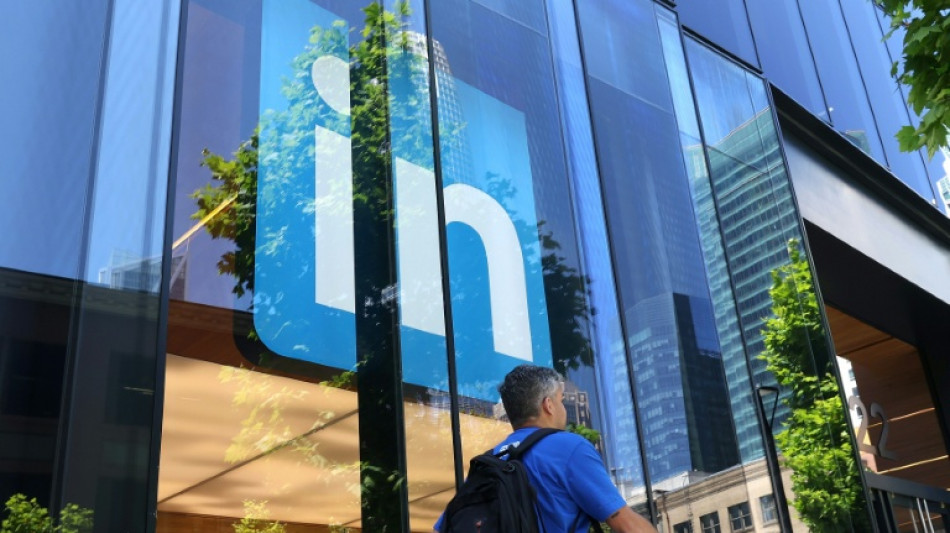
Women don fake mustaches in LinkedIn 'gender bias' fight / Photo: JUSTIN SULLIVAN - GETTY IMAGES NORTH AMERICA/AFP/File

 Lyon down Palace in Europa League, Sunderland leave it late
 UniCredit says receives ECB green light for Commerzbank takeover

 New York City pension fund asks Anthropic to delay IPO

 Venezuela's Maduro denies US torture charges as 'false accusations'

 Somalia sets May presidential election despite insecurity

 Chelsea's Caicedo eager to be more of a leader

 Rahm reaches separation deal with LIV in bankruptcy court

 UN chief urges nations to end 'war on nature'
 Newcastle boss Jaissle says Fernandez-Pardo just needs a goal
 Infantino offers apology but 'no answers' at FIFA meeting over World Cup plan

 Don't exclude Turkey from 'Made in Europe' plan: minister to AFP

 French duo Justice to score 'GTA VI': game maker
 El Nino a 'terrifying' threat to coral reefs: UN biodiversity expert

 Barcola must get used to Liverpool highs and lows, says Iraola
 Versus Trade Wins Best ECN/STP Broker APAC 2026, Marking Third UF Awards Recognition
 Three dead as Istanbul sees heaviest rainfall in 80 years

 US producer prices see biggest jump since 2022 in added challenge to Trump

 Swiatek avoids seed exodus to breeze into Wuhan last eight

 PM condemns 'chaos' as violent protests grip Albania

 'I couldn't breathe', Russell Brand's alleged rape victim says

 Pope's cancer operation already reshaping papacy

 Zverev cruises past De Minaur to reach Shanghai semi-finals
 Ukraine's Zelensky defies Trump with Russian refinery strikes
 Holders Australia edge New Zealand 24-22 to open Rugby league World Cup

 'Ocarina of Time': Nintendo gives Zelda classic a modern makeover

Flipping their gender setting to "male" and even posting photos with fake mustaches, a growing number of women on LinkedIn have posed a provocative challenge to what they allege is an algorithmic bias on the platform.
Last month, female users began claiming that adopting a male identity had dramatically boosted their visibility on the professional networking site, setting off a chain reaction.
Women adopted male aliases -- Simone became Simon -- swapped their pronouns for he/him, and even deployed AI to rewrite old posts with testosterone-laden jargon to cultivate what they describe as an attention-grabbing alpha persona.
To add a dash of humor, some women uploaded profile photos of themselves sporting stick-on mustaches.
The result?
Many women said their reach and engagement on LinkedIn soared, with once-quiet comment sections suddenly buzzing with activity.
"I changed my pronouns and accidentally broke my own LinkedIn engagement records," wrote London-based entrepreneur and investor Jo Dalton, adding that the change boosted her reach by 244 percent.
"So here I am, in a stick-on moustache, purely in the interest of science to see if I can trick the algorithm into thinking I am a man."
- 'Gendered discrepancies' -
When a female AFP reporter changed her settings to male, LinkedIn's analytics data showed the reach of multiple posts spiked compared to a week earlier.
The posts cumulatively garnered thousands more impressions compared to the previous week.
Malin Frithiofsson, chief executive of the Sweden-based Daya Ventures, said the LinkedIn experiment reflected "gendered discrepancies" that professional women have felt for years.
"We're at a point where women are changing their LinkedIn gender to male, swapping their names and profile photos, even asking AI to rewrite their bios as 'if a man wrote them,'" Frithiofsson said.
"And their reach skyrockets."
LinkedIn rejected accusations of in-built sexism.
"Our algorithms do not use gender as a ranking signal, and changing gender on your profile does not affect how your content appears in search or feed," a LinkedIn spokesperson told AFP.
However, women who saw their engagement spike are now calling for greater transparency about how the algorithm -- largely opaque, like those of other platforms -- works to elevate some profiles and posts while downgrading others.
- 'More successful' -
"I don't believe there's a line of code in LinkedIn's tech stack that says 'if female < promote less,'" Frithiofsson wrote in a post on the site.
"Do I believe gendered bias can emerge through data inputs, reinforcement loops, and cultural norms around what a 'professional voice' sounds like? Yes. Absolutely."
LinkedIn's Sakshi Jain said in a blog post that the site's AI systems and algorithms consider "hundreds of signals" -- including a user's network or activity -- to determine the visibility of posts.
Rising volumes of content have also created more "competition" for attention, she added.
That explanation met with some skepticism on the networking site, where more visibility could mean enhanced career opportunities or income.
Rosie Taylor, a Britain-based journalist, said the boost her profile got "from being a 'man' for just one week" saw unique visitors to her newsletter jump by 161 percent compared to the previous week.
That led to an 86 percent spike in new weekly subscriptions via LinkedIn.
"Who knows how much more successful I might have been if the algorithm had thought I was a man from the start?" Taylor said.
burs-ac/msp/iv
O.Farraj--SF-PST