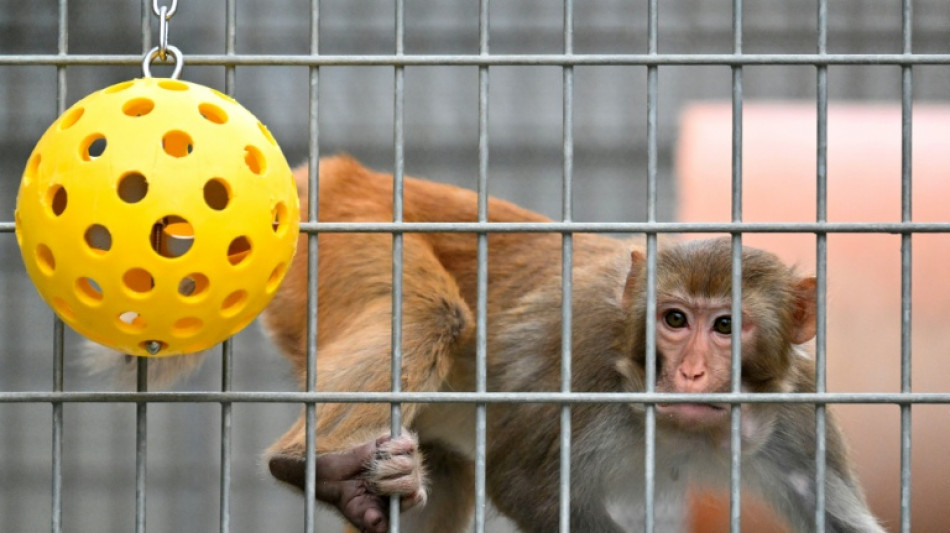
US medical agency will scale back testing on monkeys / Photo: Christophe SIMON - AFP/File

 Lyon down Palace in Europa League, Sunderland leave it late

 UniCredit says receives ECB green light for Commerzbank takeover

 New York City pension fund asks Anthropic to delay IPO

 Venezuela's Maduro denies US torture charges as 'false accusations'

 Somalia sets May presidential election despite insecurity

 Chelsea's Caicedo eager to be more of a leader

 Rahm reaches separation deal with LIV in bankruptcy court

 UN chief urges nations to end 'war on nature'

 Newcastle boss Jaissle says Fernandez-Pardo just needs a goal

 Infantino offers apology but 'no answers' at FIFA meeting over World Cup plan

 Don't exclude Turkey from 'Made in Europe' plan: minister to AFP

 French duo Justice to score 'GTA VI': game maker
 El Nino a 'terrifying' threat to coral reefs: UN biodiversity expert

 Barcola must get used to Liverpool highs and lows, says Iraola

 Versus Trade Wins Best ECN/STP Broker APAC 2026, Marking Third UF Awards Recognition

 Three dead as Istanbul sees heaviest rainfall in 80 years

 US producer prices see biggest jump since 2022 in added challenge to Trump

 Swiatek avoids seed exodus to breeze into Wuhan last eight

 PM condemns 'chaos' as violent protests grip Albania

 'I couldn't breathe', Russell Brand's alleged rape victim says

 Pope's cancer operation already reshaping papacy

 Zverev cruises past De Minaur to reach Shanghai semi-finals

 Ukraine's Zelensky defies Trump with Russian refinery strikes

 Holders Australia edge New Zealand 24-22 to open Rugby league World Cup

 'Ocarina of Time': Nintendo gives Zelda classic a modern makeover

The United States will scale back certain drug-safety testing requirements on monkeys, federal regulators said Tuesday, marking the latest step by President Donald Trump's administration to limit the use of animals in research.
Under new draft guidance from the Food and Drug Administration, computer models, lab-grown mini-organs, and human studies will replace the use of non-human primates in testing monoclonal antibodies -- lab-engineered proteins used to treat cancers, autoimmune conditions and other diseases.
"We are delivering on our roadmap commitment to eliminate animal testing requirements in drug evaluation and our promise to accelerate cures and meaningful treatments for Americans," FDA Commissioner Marty Makary said in a statement.
The statement added that typical nonclinical programs involving monoclonal antibodies could include more than 100 macaque monkeys -- apes are no longer used in any invasive research in the US -- yet often do not yield human-approved treatments.
The move was welcomed by animal-advocacy groups.
Zaher Nahle, a former animal researcher who is now the senior scientific advisor for nonprofit Center for a Humane Economy, told AFP the move was an "important step."
"These primates are not reliable in terms of predicting the toxicity, so you can get at least equal or better results in terms of your accuracy in predicting toxicology using other approaches," he added.
What's more, he noted, studies show that more than 90 percent of drugs deemed safe and effective in animals fail to win approval for human use.
The FDA's announcement follows a report in the journal Science last month that the Centers for Disease Control and Prevention would close its primate labs.
It "moves us one step closer to wiping out the federal government's wasteful monkey business," Justin Goodman of White Coat Waste Project told AFP.
But the National Institutes of Health -- the country's primary biomedical research agency -- remains a notable "outlier," he added. According to public data, 7,700 primates are confined in federal government labs and breeding facilities, of which 6,700 are at NIH.
Advocates of animal research have pushed back.
"Poorly planned transitions -- including premature study termination -- can place animals at serious risk and may undermine years of scientific investment intended to strengthen public health preparedness and advance lifesaving medical progress," advocacy group Americans for Medical Progress said after the CDC news was reported.
Proponents of animal testing say the research has been indispensable for major medical advances, including vaccines for diphtheria, yellow fever, measles and Covid-19.
Critics counter that decades-old laws have created regulatory lock-in, that publication incentives reward animal studies in top journals, and that a lucrative "animal-industrial complex" has helped entrench the status quo.
L.AbuAli--SF-PST