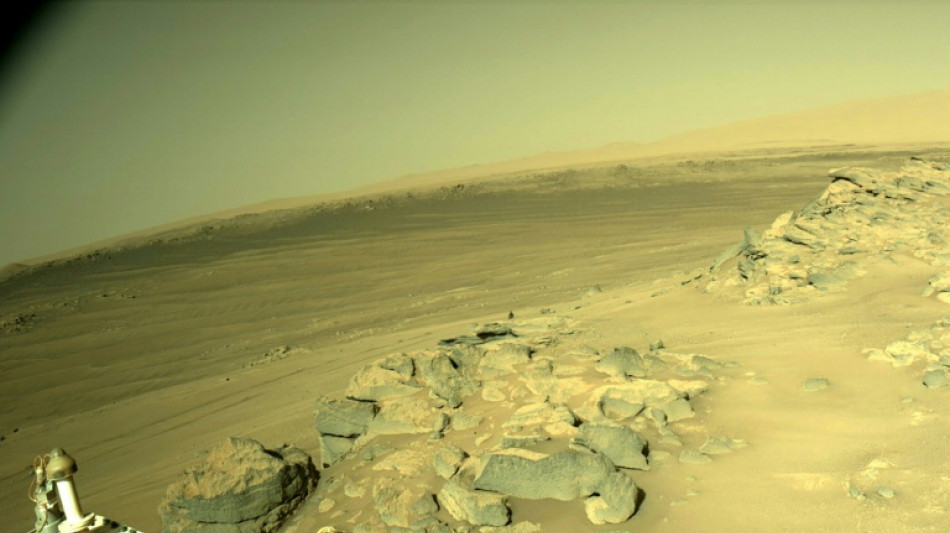
NASA rover records first evidence of lightning on Mars / Photo: Handout - NASA/AFP/File

 Lyon down Palace in Europa League, Sunderland leave it late

 UniCredit says receives ECB green light for Commerzbank takeover
 New York City pension fund asks Anthropic to delay IPO

 Venezuela's Maduro denies US torture charges as 'false accusations'

 Somalia sets May presidential election despite insecurity
 Chelsea's Caicedo eager to be more of a leader

 Rahm reaches separation deal with LIV in bankruptcy court

 UN chief urges nations to end 'war on nature'

 Newcastle boss Jaissle says Fernandez-Pardo just needs a goal

 Infantino offers apology but 'no answers' at FIFA meeting over World Cup plan

 Don't exclude Turkey from 'Made in Europe' plan: minister to AFP

 French duo Justice to score 'GTA VI': game maker

 El Nino a 'terrifying' threat to coral reefs: UN biodiversity expert

 Barcola must get used to Liverpool highs and lows, says Iraola

 Versus Trade Wins Best ECN/STP Broker APAC 2026, Marking Third UF Awards Recognition

 Three dead as Istanbul sees heaviest rainfall in 80 years

 US producer prices see biggest jump since 2022 in added challenge to Trump

 Swiatek avoids seed exodus to breeze into Wuhan last eight
 PM condemns 'chaos' as violent protests grip Albania

 'I couldn't breathe', Russell Brand's alleged rape victim says

 Pope's cancer operation already reshaping papacy

 Zverev cruises past De Minaur to reach Shanghai semi-finals

 Ukraine's Zelensky defies Trump with Russian refinery strikes

 Holders Australia edge New Zealand 24-22 to open Rugby league World Cup

 'Ocarina of Time': Nintendo gives Zelda classic a modern makeover
A NASA rover has recorded evidence of lightning on Mars for the first time, its microphone picking up the sounds of tiny "zaps" whipped up by the dust storms constantly sweeping across the planet.
Scientists have long debated whether electrical discharges could be sparking in the dusty and little-known Martian climate -- but proof has been hard to come by.
It turns out that NASA's Perseverance rover, which has been roaming the red planet since 2021, was inadvertently recording the sounds of lightning, according to a study published in Nature this week.
These are far from the thundering, kilometre-long lightning bolts we see on Earth.
Instead, they are "little zaps" similar to "what you might feel in dry weather when you touch your car door and there's a bit of static electricity," lead author Baptiste Chide of France's CNRS research centre told AFP.
While low in energy, these discharges are happening "absolutely all the time -- and everywhere" on Mars, the planetary scientist said.
The process starts when tiny grains of dust rub against each other. They become charged with electrons and release this energy in electrical arcs a few centimetres (inches) -- or even millimetres -- long, sending off an audible shock wave.
Here on Earth, dust storms and dust devils in desert areas also create electrical fields. But they rarely build up into electrical discharges.
However on Mars, "because of the very low pressure and the composition of the atmosphere, the amount of charge that needs to accumulate to generate a discharge is much smaller," Chide explained.
This phenomenon has been theorised since Mars first started to be explored -- and has been reproduced in the laboratory.
Chide said it had been "such an important issue for Martian science" that an instrument on the European Space Agency's Schiaparelli lander was dedicated to searching for it.
Unfortunately the spacecraft crashed while trying to land on Mars in 2016.
Since then, "it was somewhat of a forgotten area for Martian exploration," Chide said.
That is, until "by chance" the microphone on Perserverance's SuperCam recorded signals of what appeared to be electrical discharges, he added.
Daniel Mitchard, a lightning expert at Cardiff University not involved in the study, commented in Nature that the research provided "persuasive evidence of dust-induced discharges".
But because the discharges "were only heard and not seen," he expected debate between scientists on the subject "to continue for some time".
- Electrified astronauts? -
The research could shed some light on the mysterious Martian climate.
"Dust drives the Martian climate", similar to the water cycle on Earth, Chide said. For example, a season of dust storms will have begun by the end of the year.
The electrical discharges could also kick off a process that destroys organic molecules -- which are the building blocks of life -- on the Martian surface.
It could also explain the surprisingly rapid disappearance of methane on the planet -- a phenomenon that has baffled scientists.
It may also have implications for future Mars missions.
Scientists will now be able to design their instruments to better protect the future robots sent to Mars, Chide said.
And of course, there are also plans for humans to finally step foot on the planet's red surface.
"In the long term, isn't there a risk that the suits of the astronauts who stay on the Martian surface for a long time will be damaged by these discharges?" Chide asked.
"We will have to ask ourselves this question."
C.Hamad--SF-PST