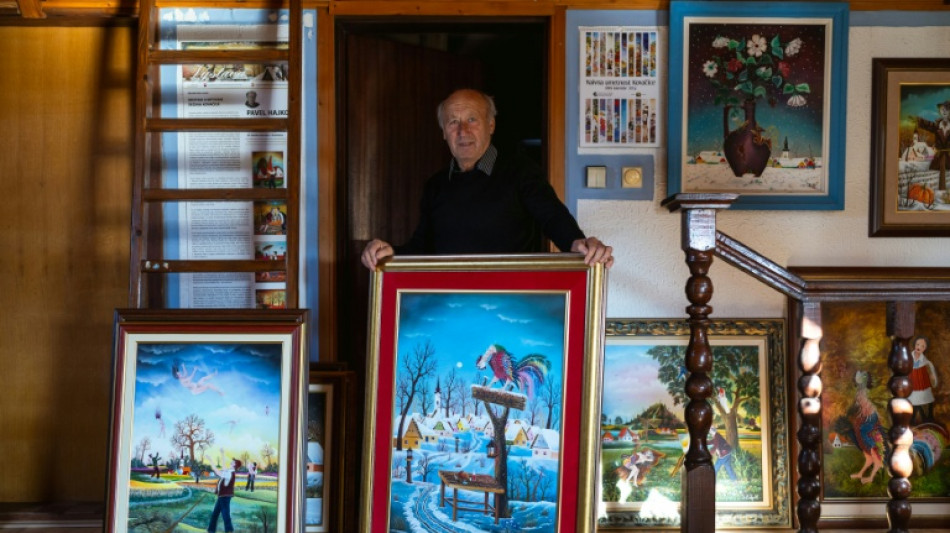
Naively brilliant: Serbia's world-famous village painters / Photo: Andrej ISAKOVIC - AFP

 Lyon down Palace in Europa League, Sunderland leave it late

 UniCredit says receives ECB green light for Commerzbank takeover

 New York City pension fund asks Anthropic to delay IPO

 Venezuela's Maduro denies US torture charges as 'false accusations'

 Somalia sets May presidential election despite insecurity

 Chelsea's Caicedo eager to be more of a leader

 Rahm reaches separation deal with LIV in bankruptcy court
 UN chief urges nations to end 'war on nature'

 Newcastle boss Jaissle says Fernandez-Pardo just needs a goal

 Infantino offers apology but 'no answers' at FIFA meeting over World Cup plan

 Don't exclude Turkey from 'Made in Europe' plan: minister to AFP

 French duo Justice to score 'GTA VI': game maker

 El Nino a 'terrifying' threat to coral reefs: UN biodiversity expert

 Barcola must get used to Liverpool highs and lows, says Iraola

 Versus Trade Wins Best ECN/STP Broker APAC 2026, Marking Third UF Awards Recognition

 Three dead as Istanbul sees heaviest rainfall in 80 years

 US producer prices see biggest jump since 2022 in added challenge to Trump

 Swiatek avoids seed exodus to breeze into Wuhan last eight
 PM condemns 'chaos' as violent protests grip Albania

 'I couldn't breathe', Russell Brand's alleged rape victim says

 Pope's cancer operation already reshaping papacy

 Zverev cruises past De Minaur to reach Shanghai semi-finals

 Ukraine's Zelensky defies Trump with Russian refinery strikes

 Holders Australia edge New Zealand 24-22 to open Rugby league World Cup

 'Ocarina of Time': Nintendo gives Zelda classic a modern makeover

Pavel Hajko never tires of painting roosters. Inside his home studio in Kovacica -- a sleepy town in northern Serbia famous for its style of naive art -- the brightly coloured creatures cover the walls.
"From the beginning, even in elementary school, I painted only roosters," the 73-year-old artist told AFP, as he worked on an unfinished canvas in the afternoon light.
Outside, a cockerel obligingly crowed.
Hajko and his fellow artists have become world-famous for their childlike renderings of the traditional village life of the Slovak minority in the flatlands of the Banat region, north of the Danube.
"In naive painting, everything is done as you learn. It's not a school where the colour has to be this or that... we can put any colour," Hajko said.
The naive painting movement of self-taught artists first emerged in the 1930s, depicting everything from harvests to the traditional dress of the region.
Last year UNESCO recognised the Kovacica painters on its list of Intangible Cultural Heritage of Humanity, a milestone for a movement shaped by unschooled artists.
- Preserving identity -
In the leafy centre of town, Pavel Babka runs a gallery showing the art, which he said is key to preserving the traditions of the ethnic Slovaks who settled in the Vojvodina region more than two centuries ago.
"I think the Slovak minority preserves its identity in this way, by painting what the previous generation did," Babka said.
The style quickly spread to other Slovak communities, and the first major exhibitions of work began in the 1950s.
But Babka said its beginnings lie in the folk art of the region, from the decoration of everyday objects to the murals in homes, mostly painted by women.
A key figure in the foundation of the style is Zuzana Chalupova, who Babka credits with giving naive painting its bold colours.
"Today, more women paint than men. And what women paint is more authentic than men," he said.
Across the walls of his gallery, Babka traces the symbols and signature "handwriting" of each artist through the decades.
"They paint life here, but they have not forgotten where they come from," he said.
The curator sees a discernible style through the early days of peasant painters in the Austro-Hungarian empire through the movement's boom in 1970s Yugoslavia, and even in today's crop of artists.
"The youngest generation paints according to the stories of their grandparents," he said.
- 'There must be sincerity' -
But with UNESCO's recognition comes a new challenge -- the over-commercialisation of the art form, driven by tourists' tastes rather than authenticity.
"When we say Kovacica, it should evoke Kovacica," Babka said.
Since founding his gallery 35 years ago, he has helped promote the movement, and now urges painters to preserve their style and keep the region's Slovak culture at its core.
"There must be sincerity and no deception."
The Slovak minority accounted for less than one percent of Serbia's population in the 2022 census, with the vast majority living in the multiethnic northern Vojvodina region.
A 2024 study found the community has declined over the last three decades, partly due to its ageing population and migration to Slovakia.
- Global recognition -
For art historian Elenka Djuris, this makes preserving the paintings of the unique culture "tied to the area of Kovacica" all the more critical.
"In this way, we actually ensure the longevity of our identity, traditions and customs, especially in this time when traditions and customs are truly being lost, everything is becoming globalised," the 36-year-old academic said.
But Djuris hopes that global recognition of the movement's value will also spur renewed efforts to preserve it at home.
"Unfortunately, it often takes someone from outside to show us the wealth we have, and then we realise that our culture is truly valuable and worthy of attention."
X.AbuJaber--SF-PST