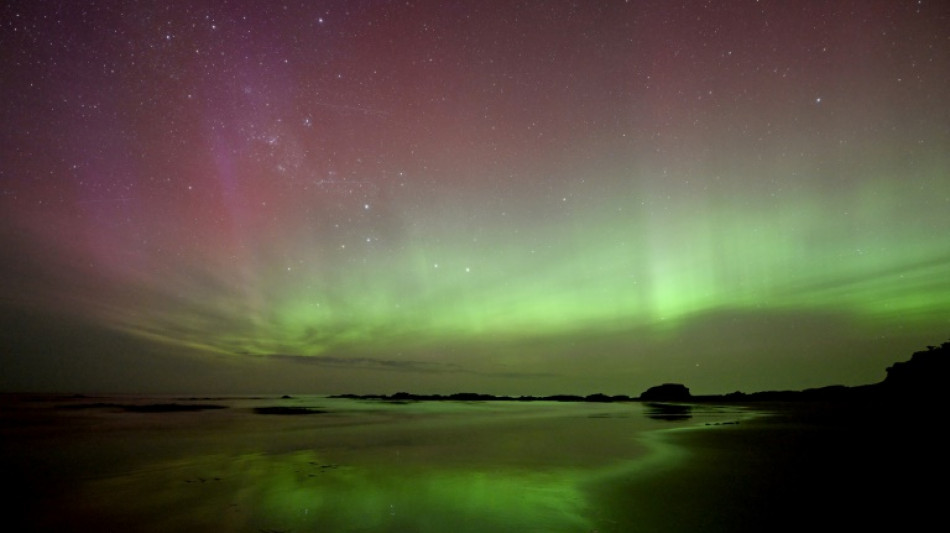
Astronomers spot storm on another star for first time / Photo: Sanka VIDANAGAMA - AFP

 Lyon down Palace in Europa League, Sunderland leave it late

 UniCredit says receives ECB green light for Commerzbank takeover
 New York City pension fund asks Anthropic to delay IPO

 Venezuela's Maduro denies US torture charges as 'false accusations'

 Somalia sets May presidential election despite insecurity

 Chelsea's Caicedo eager to be more of a leader

 Rahm reaches separation deal with LIV in bankruptcy court

 UN chief urges nations to end 'war on nature'

 Newcastle boss Jaissle says Fernandez-Pardo just needs a goal

 Infantino offers apology but 'no answers' at FIFA meeting over World Cup plan

 Don't exclude Turkey from 'Made in Europe' plan: minister to AFP

 French duo Justice to score 'GTA VI': game maker

 El Nino a 'terrifying' threat to coral reefs: UN biodiversity expert

 Barcola must get used to Liverpool highs and lows, says Iraola

 Versus Trade Wins Best ECN/STP Broker APAC 2026, Marking Third UF Awards Recognition

 Three dead as Istanbul sees heaviest rainfall in 80 years

 US producer prices see biggest jump since 2022 in added challenge to Trump

 Swiatek avoids seed exodus to breeze into Wuhan last eight
 PM condemns 'chaos' as violent protests grip Albania

 'I couldn't breathe', Russell Brand's alleged rape victim says

 Pope's cancer operation already reshaping papacy

 Zverev cruises past De Minaur to reach Shanghai semi-finals

 Ukraine's Zelensky defies Trump with Russian refinery strikes

 Holders Australia edge New Zealand 24-22 to open Rugby league World Cup

 'Ocarina of Time': Nintendo gives Zelda classic a modern makeover

Astronomers revealed Wednesday they have detected a storm on a star other than our Sun for the first time, discovering an explosion so violent it could have stripped away the atmosphere of any planets unlucky enough to be nearby.
Solar storms on the Sun sometimes shoot out huge eruptions known as coronal mass ejections, which can disrupt satellites when they arrive at Earth -- and create colourful auroras that dance across the sky.
In fact, a particularly powerful solar storm caused auroras as far south as the US city of Tennessee on Wednesday, according to the National Oceanic and Atmospheric Administration.
Auroras were also visible in the skies above New Zealand, AFP images showed, with more expected into Wednesday night.
However, observing such a storm on a distant star had proven difficult for astronomers.
New research, published in the journal Nature on Wednesday, revealed that an international team of researchers has finally achieved the feat.
The discovery used data from a European network of telescopes called LOFAR.
The team of astronomers has been using LOFAR since 2016 to detect the most extreme and violent events in the universe -- such as black holes -- which emit relatively stable radio signals over time.
"We always have stars in the telescope's field of view but generally we're not interested in them," Cyril Tasse, a Paris Observatory astronomer and the study's co-author, told AFP.
However, the researchers have set up a data processing system that also records what is going on with the stars behind the behemoths they are chasing.
In 2022, the team decided to find out "what had been caught in this net", Tasse said.
They found that there was a huge explosion which only lasted a minute on May 16, 2016. It came from a red dwarf star called StKM 1-1262 more than 133 light years away.
The team then determined it was a coronal mass ejection -- a stellar storm.
"It's the first time we have detected one" on a star other than our own, Tasse said.
But this coronal mass ejection was "at least 10,000 times more violent than known solar storms" on the Sun, he added.
- Atmosphere killers -
The discovery could have an impact on the search for planets beyond our solar system that have the potential to host life.
Red dwarfs, which have a mass of between 10 and 50 percent that of our Sun, have proven to be the most likely stars in the universe to host planets that are roughly the size of Earth.
"The first radio detection inaugurates a new era for space weather applied to other star systems," said Philippe Zarka, research director at the Paris Observatory and a study co-author.
"This emerging field opens up major perspectives for how the magnetic activity of stars influence the habitability of the planets that surround them."
Tasse said that it appears that red dwarf stars have "much more erratic and violent" behaviour than the Sun.
"The implication is that these stars can be rather inhospitable when it comes to life and exoplanets," because they have storms so powerful they could destroy the atmospheres of planets nearby, he added.
U.Shaheen--SF-PST