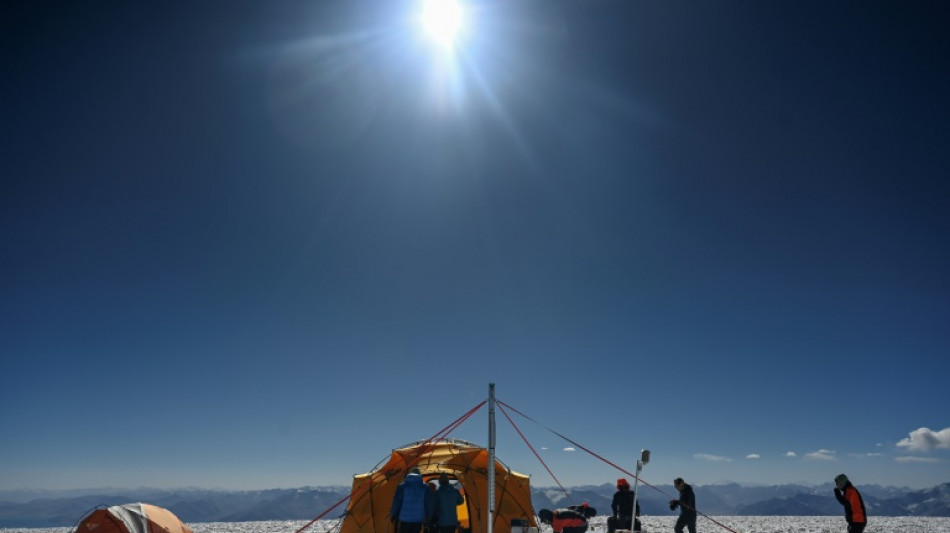
Scientists probe Tajik glacier for clues to climate resistance / Photo: Prakash MATHEMA - AFP

 Macron warns urgent to strike EU budget deal before French vote runup

 Zelensky rallies European allies as Trump ties slump

 Guardians edge Rays to seize MLB playoff series lead

 Trump scraps plan to livestream execution after fierce backlash

 Martinez apologises for outburst at Man Utd hierarchy

 Houthis launch deadly attack on presidential palace in Yemen's Aden

 Brazil forward Antony says home burgled during Betis match

 Ravens face familiar foe in Browns coach Monken

 France, Germany reach deal on future of car industry

 Carney campaigns for Canadian unity before Alberta secession vote

 ATP proposes rankings system changes, extra player bonuses

 Russell Brand was 'monster-like', alleged victim tells UK court

 Crowded Launches Crowded MCP, Bringing Nonprofit Financial Operations Into ChatGPT and Claude

 Albanian PM condemns 'chaos' as violent unrest spreads

 Italian football suffers new blow with Champions League misery

 Trump scraps plan to livestream execution after broad backlash
 Seven missing off Romania after latest Black Sea drone attacks

 ARKBRIDGE Outlines Jonathan Morelli’s “Picks and Shovels” AI Infrastructure Investment Strategy

 Tech sell-off rolls on as hot inflation data stokes rate worries
 McIlroy makes 'solid' start in rain-hit Delhi as Norgaard leads

 Seven missing after fire on vessel in Black Sea off Romania

 'Severe drought' declared in parts of UK
 IUX Announces New Web Client Portal Built for Enhanced Browser-Based Trading

 School roof collapse kills teacher, 32 children in NW Pakistan

 Inter skipper Martinez facing month out with thigh injury

Greenland is melting, the Alps are melting and the Himalayas are melting -- yet in one vast mountain region, huge glaciers have remained stable, or even gained mass, in recent decades. Can it last?
To find out, a dozen scientists, accompanied exclusively by an AFP photographer, trekked high over one glacier in eastern Tajikistan to drill for ice cores -- ancient, deep samples that can shed precious light on climate change.
In September and October, they first spent four days crossing the country from west to east in four-wheel drives, then climbed on foot to over 5,800 metres altitude on the Kon-Chukurbashi ice cap, near the Chinese border.
Camping for a week at the summit, in freezing temperatures and despite a day-long blizzard, the scientists from Switzerland, Japan, the United States and Tajikistan drilled the glacier to extract two 105-metre-long ice cores, in sections.
These layers of ice, compacted over centuries, perhaps millennia, form an archive of climate indicators, yielding data on past snowfall, temperatures, atmosphere and dust.
They must now be analysed in a laboratory to reveal their dates, said the leader of the team, Evan Miles, a glaciologist affiliated with the universities of Fribourg and Zurich.
"We're hopeful for a truly unique core, not just for the region, but for the broader region actually, probably extending back 20 to 25 or 30,000 years."
- Glacier temperature anomaly -
The apparently resistant glaciers are spread over thousands of kilometres of high mountain ranges in Central Asia, including Karakoram, Tian Shan, Kun Lun and the Pamir mountains of Tajikistan.
By delving back in time in the ice there, researchers hope to find out why these glaciers have resisted the general planetary warming of recent decades -- and whether this so-called "Karakoram anomaly" could be ending.
"This whole region is globally unique because over the last 25 years, these glaciers have shown very, very limited mass loss and even mass gain," said Miles.
The glaciers have shown some limited signs of loss in recent years, but scientists want to determine whether this is a natural variation or the beginning of a real decline.
"In order to understand that, we really, really need to have a longer time period of records of both temperature and precipitation at the glacier sites," said Miles.
"That's the type of information that an ice core can tell us."
- Glacier climate analysis -
One core will be sent to Japan for analysis and another stored in an underground sanctuary in Antarctica at minus 50C.
That naturally cold storage site is a project of the Ice Memory Foundation, which supported the Tajikistan expedition along with main funder, the Swiss Polar Institute.
The foundation, created in 2021 by French, Italian and Swiss universities and research centres, has already collected several cores in the Alps, Greenland, the Andes and elsewhere.
Future scientists will "be able to analyse (them) with their most modern analytical tools in 50, 100, 200 years and extract new information", said Ice Memory's president Thomas Stocker.
"We will probably lose 90 percent of our glacier mass on the Earth," Stocker told AFP. "So we are trying to help preserve a thing that is threatened by human action."
The scientists were scheduled to review their mission during a news conference in the Tajik capital Dushanbe on Monday.
Z.AlNajjar--SF-PST